
Nine ingredients and five hours, of which four are the fridge and about a minute is a blowtorch.
The vanilla is bean paste rather than extract. That is where the vanilla-bean identity lives, even though the specks are subtle in a pale set filling.
Why This Recipe Works
- Pressing the crumb into liners gives each cupcake a base that lifts cleanly.
- Stopping the mixer as the eggs go in avoids the air that cracks a cheesecake.
- Four hours cold sets the filling firm enough to take a sugar cap.
- A thin even sugar layer melts to glass instead of scorching in clumps.
- Serving soon after torching keeps the cap crisp before it dissolves.
Ingredient Notes
- Vanilla bean paste
- One teaspoon. Paste rather than extract — it carries the actual seeds, which is what makes this a vanilla bean cheesecake even where the specks are subtle.
- Superfine sugar, for brûlée
- A quarter cup. Superfine specifically: it melts evenly under a flame where granulated sits in crystals and scorches unevenly.
- Heavy cream, whipped
- Half a cup, piped as a small swirl under the sugar cap. A component the title does not name.
- Caramel sauce
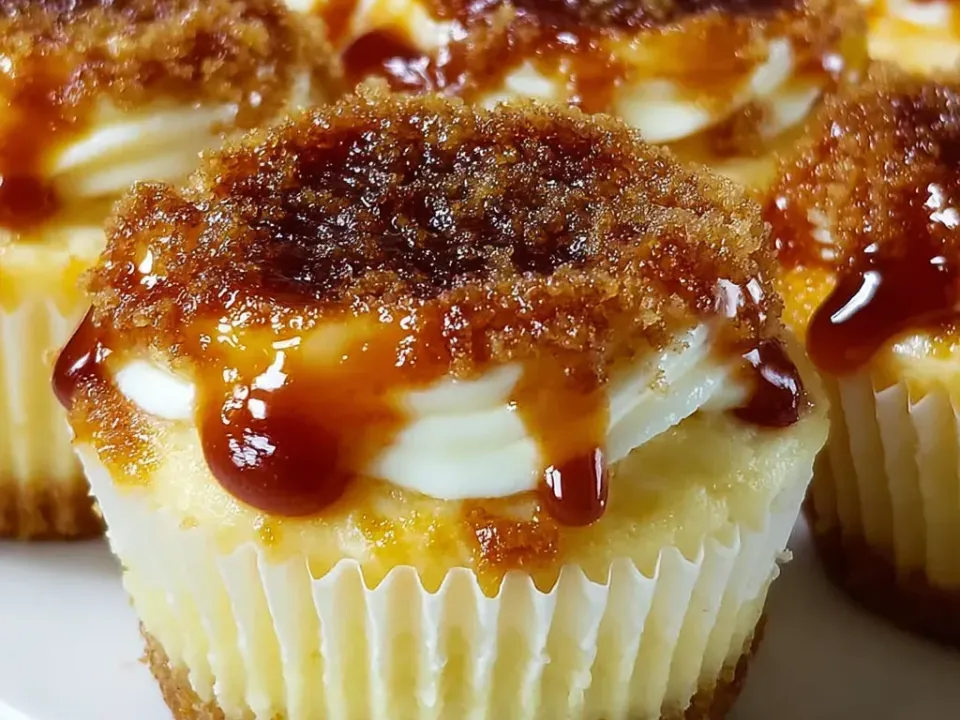
- A quarter cup, drizzled after torching. The dark syrup running down the sides in the finished photograph.
How to Make It
Oven to 325°F, a 12-cup muffin pan lined
Heat oven to 325°F and line a 12-cup muffin pan.
Crumbs and butter pressed into the liners
Mix crumbs and butter and press into liners.
Cream cheese and sugar smooth, eggs and vanilla bean paste just combined
Beat cream cheese and sugar smooth; add eggs and vanilla bean paste just until combined.
Baked to a slight wobble, cooled, refrigerated at least four hours
Bake 18 to 20 minutes until edges are set and centers retain a slight wobble; cool and refrigerate at least 4 hours.
A cream swirl piped on, then a thin even layer of superfine sugar
Pipe a small cream swirl on each chilled cheesecake, then add a thin, even layer of superfine sugar over the top surface.
Torched to amber and glassy, caramel drizzled, served soon after
Torch the sugar carefully until amber and glassy, keeping flame away from paper liners; drizzle lightly with caramel sauce and serve soon after brûlée-ing.
Four Hours Cold, Then an Open Flame
This recipe is patient for five hours and then, for about a minute, it involves a blowtorch held over paper cases. That minute's handling is written into the method itself rather than left to assumption, so it is set out below as its own gate - with what has to be true before it, and what happens immediately after.
- The bases and the batter - and the eggs go in LAST, briefly1 1/4 cups GRAHAM CRUMBS with 4 tbsp MELTED BUTTER pressed into the liners. Then 16 oz CREAM CHEESE beaten with 1/2 cup SUGAR SMOOTH, and 2 EGGS with 1 tsp VANILLA BEAN PASTE added JUST UNTIL COMBINED. That last instruction is a crack-prevention measure: air beaten in after the eggs expands in the oven and collapses into a fissure as it cools - and a cracked surface cannot hold an even sugar layer later. The PASTE is where the vanilla bean sits.
- 18 to 20 minutes, then AT LEAST 4 HOURS coldBaked UNTIL EDGES ARE SET AND CENTERS RETAIN A SLIGHT WOBBLE, cooled, then REFRIGERATED AT LEAST 4 HOURS. The chill is a precondition for the torch, not just for the texture: a firm, properly cold cheesecake can take a flame on its surface without the body beneath softening. A barely-set one melts under the torch and the sugar sinks into it.
- A cream swirl, then a THIN, EVEN sugar layerA small swirl piped from the 1/2 cup of whipped cream, then 1/4 cup of SUPERFINE SUGAR in A THIN, EVEN LAYER over the top surface. Superfine rather than granulated because it melts at an even rate; thin and even because thick patches carbonise black on top while the sugar beneath is still crystalline.
Check before you continue
Amber and glassy - and STOP; flame never on the paper liners — A kitchen torch, a heatproof surface, and distance
The safety advice is three separate instructions. TORCH ONLY ON A HEATPROOF SURFACE - a countertop, a metal tray, never a wooden board or the paper the cupcakes were chilled on. KEEP THE FLAME AWAY FROM PAPER LINERS AND HANDS - the fluted cases sit proud of the sugar and will catch, so work the flame across the sugar surface in small circles and angle it inward rather than out. AND ALLOW THE CARAMELIZED SUGAR TO COOL BEFORE TOUCHING - molten sugar is far hotter than boiling water and it sticks to skin rather than running off. AMBER AND GLASSY is the endpoint; past it the sugar turns bitter and black.
- Caramel drizzled LIGHTLY1/4 cup of CARAMEL SAUCE drizzled over, which becomes the dark syrup running down the sides. Lightly is the word the recipe uses - a flood would dissolve the sugar cap that was just made.
- SERVE SOON AFTER BRÛLÉE-INGThis is the last instruction and it is a real constraint rather than a preference. A hard sugar cap sitting on a cold, moist cheesecake absorbs water from it and goes from glass to syrup within the hour. Torch at the last possible moment.
- And back to 40°F or belowThe cheesecakes themselves remain a cold-hold item at 40°F OR BELOW. The torch changes the top; it does not change what is underneath it.
Success Tips
- Keep the sugar layer thin and even; thick patches scorch black before they melt.
- Work the flame in small circles rather than holding it in one place.
- Serve soon after torching — a sugar cap softens against cold cheesecake.
Serving Ideas
Twelve cheesecake cupcakes in fluted paper cases with pale set bodies on golden crumb bases, each under a piped cream swirl and a thick amber brûléed sugar cap with caramel running down the sides.
Frequently Asked Questions
Where is the vanilla bean?
In the filling, as vanilla bean paste. The paste carries real seeds, which is what gives the vanilla-bean identity — the specks are simply subtle against a pale cheesecake.
Is a blowtorch essential?
It is what the recipe is built around. Whatever you use, torch on a heatproof surface, keep the flame off the paper liners, and let the sugar cool before touching it.
Can I brûlée them in advance?
No. Serve soon after torching. A caramel cap sitting on a cold cheesecake draws moisture and softens from glassy to sticky within the hour.