
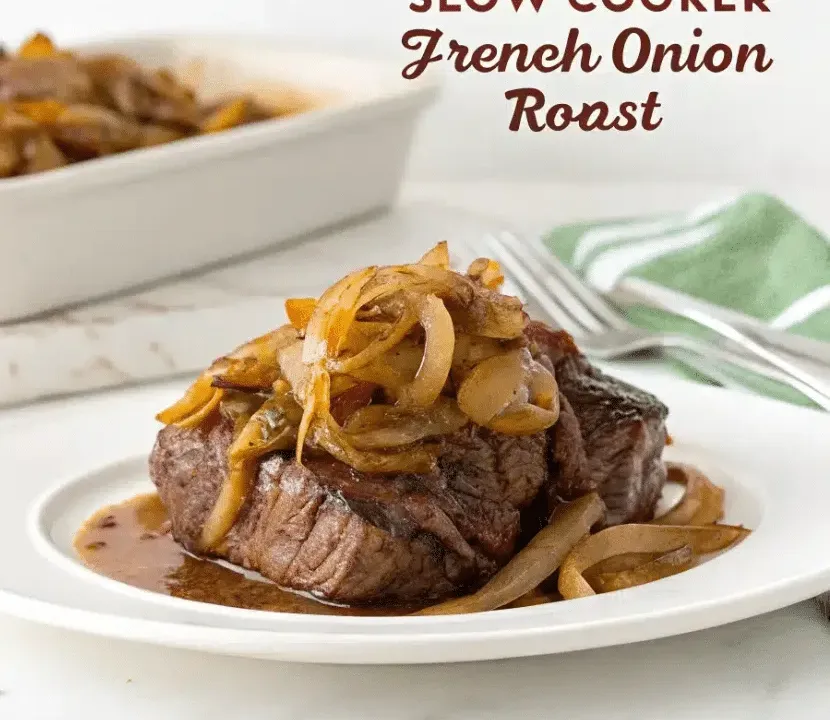
French onion soup gets its depth from one thing: onions cooked far past the point most people stop. This roast borrows that idea and puts a chuck roast on top of it. Three onions go golden in butter and oil, white wine lifts the browned bits off the pan, and the whole lot spends eight hours under a seasoned piece of beef.
What comes out is a roast that gives way to a fork, sitting in a jus that tastes like onion soup concentrated down. It takes about twenty minutes of real work at the front, and nothing at all afterwards.
The Four Stages
Almost all of the work happens in the first twenty minutes, in one skillet. After that the cooker does the rest and you come back once, at the end, to thicken the jus.
Caramelise12–15 min, medium
Butter and olive oil, three thinly sliced onions and a pinch of salt, stirred often until deep golden. This is the stage that decides whether the finished jus tastes like onion soup or like beef broth with onions in it.
Deglaze1–2 min
Garlic for thirty seconds, then white wine into the hot pan, scraping up the browned bits the onions left behind. Everything stuck to that skillet goes into the cooker rather than the sink.
Sear3–4 min per side
The roast is patted dry, seasoned, and browned in the same pan before it goes on top of the onions. Dry surface, hot pan — a wet roast steams and stays grey.
Braise, then thicken8–9 hrs LOW, then 10–15 min HIGH
Covered and left alone until fork-tender. The roast rests under foil while a cornstarch slurry goes into the skimmed cooking liquid on HIGH — thickened at the end, not the start, so the jus coats instead of splitting.
Why This Recipe Works
- The onions are cooked twice. They caramelise in the skillet first, then spend eight hours under the roast absorbing its juices. Sliced raw onions dropped straight into a slow cooker would still be sweet, but they would not have the browned, jammy depth that gives this its French onion character.
- Wine deglazes what the onions leave behind. The fond stuck to the pan after fifteen minutes of caramelising is pure flavour, and a half cup of white wine lifts all of it into the cooker rather than leaving it in the sink.
- Chuck is the right cut for a long braise. Its connective tissue breaks down over hours into gelatin, which is why the same cut that would be tough at forty minutes is fork-tender at eight hours.
- The jus is thickened at the end, not the start. A cornstarch slurry stirred in during the last ten to fifteen minutes on HIGH gives a jus that coats without going gluey — thickener added early would sit under the roast for eight hours and split.
Choosing the Right Beef Cut
The recipe calls for chuck, and that is not incidental. Chuck comes from the shoulder and is threaded with connective tissue that dissolves into gelatin over a long, low cook — which is exactly what gives the finished roast its texture and the jus its body.
Leaner roasts behave differently. A round roast or a sirloin tip will cook through in the same eight hours but will not shred, because there is far less collagen to break down. If chuck is what you can get, use it.
How to Make It
Caramelise the onions
Melt the butter with the olive oil in a large skillet over medium heat. Add the sliced onions and a pinch of salt, and cook 12–15 minutes, stirring, until they are soft and golden. This is the step that makes the dish, and it is the one worth not rushing.
Add garlic and deglaze
Stir the garlic in for 30 seconds, then pour in the wine and scrape up the browned bits from the base of the pan. Let it simmer 1–2 minutes.
Transfer to the slow cooker
Move the onions and every drop of the pan juices into a 6- to 8-quart slow cooker.
Season and sear the beef
Pat the roast dry and season with salt and pepper. Sear it 3–4 minutes per side in the same skillet until browned, then set it on top of the onions.
Mix the liquids
Whisk the broth, Worcestershire, balsamic, onion soup mix if using, and thyme together. Pour it around the roast — not over it — and drop in the bay leaf.
Slow cook
Cover and cook on LOW for 8–9 hours, or HIGH for 4–5, until the roast is fork-tender.
Rest, then thicken
Move the roast to a board and tent it with foil. Skim the fat from the cooker, stir in the cornstarch slurry, and cook on HIGH for 10–15 minutes until the jus thickens slightly.
Finish and serve
Slice or shred the beef and return it to the cooker to warm through. For the optional French onion melt, layer beef and onions in an oven-safe dish, top with cheese and broil. Spoon the onion jus over, garnish with parsley, and serve.
Getting the Jus Right
Skim the fat before you thicken. Eight hours under a chuck roast renders a lot of it, and a cornstarch slurry whisked into fatty liquid gives a greasy jus rather than a glossy one.
The slurry is one tablespoon of cornstarch in one tablespoon of water, stirred in and cooked on HIGH for 10–15 minutes. If the jus is still thinner than you want after that, give it another five minutes uncovered rather than adding more starch.
Ingredient Notes
- Beef chuck roast
- 3.5–4 lb, patted dry. Drying matters because a wet surface steams instead of searing. Chuck is specified for its connective tissue; a leaner cut like round will cook through but stays firm rather than shredding.
- Yellow onions
- Three large, thinly sliced. Thin slices caramelise evenly in the 12–15 minutes the recipe allows. Thick slices need longer and will still be firm when the pan is ready.
- Dry white wine
- Half a cup, used to deglaze. The recipe offers extra broth as a direct substitute, so this is optional without changing the method.
- Onion soup mix
- Optional, as a flavour boost. It is also the saltiest thing in the pot, so if you use it, hold back on the kosher salt until you taste the jus at the end.
- Gruyère or provolone
- Optional, and used only in step 9's broiled finish — layering beef and onions in an oven-safe dish and melting cheese over the top. Skip it and the roast is still complete.
Success Tips
- Taste the jus before you add any extra salt. Between the onion soup mix, the Worcestershire and the broth, it is usually seasoned enough.
- Pour the liquid around the roast rather than over it, as step 5 specifies — washing the seasoning off the top defeats the searing you just did.
- If the roast is not shredding at eight hours, it needs longer, not hotter. Chuck goes tender on its own schedule.
- The bay leaf comes out before serving.
Serving Ideas
Serve with mashed potatoes, noodles, or crusty bread — all three exist to catch the onion jus, which is the point. For the broiled variation, layering the beef and onions under Gruyère turns it into something much closer to French onion soup in roast form.
Storage and Reheating
Refrigerate
Keep leftovers in the jus rather than drained. The liquid is what stops sliced beef drying out in the fridge.
Reheat
Warm gently with some of the jus. Reheating shredded beef dry, or fast, is what makes it stringy.
Frequently Asked Questions
Can I skip searing the roast?
You can, and the roast will still cook through, but you lose the browned surface and the fond that the wine deglazes into the cooker. Since the skillet is already hot from the onions, it costs about eight extra minutes.
What if I do not cook with wine?
The ingredient list names extra broth as a direct substitute for the half cup of white wine. Use it to deglaze the same way — the job is lifting the browned bits, and broth does that.
LOW or HIGH?
The recipe gives LOW for 8–9 hours or HIGH for 4–5. LOW is the better choice for chuck: the slower the collagen breaks down, the more tender the result.