
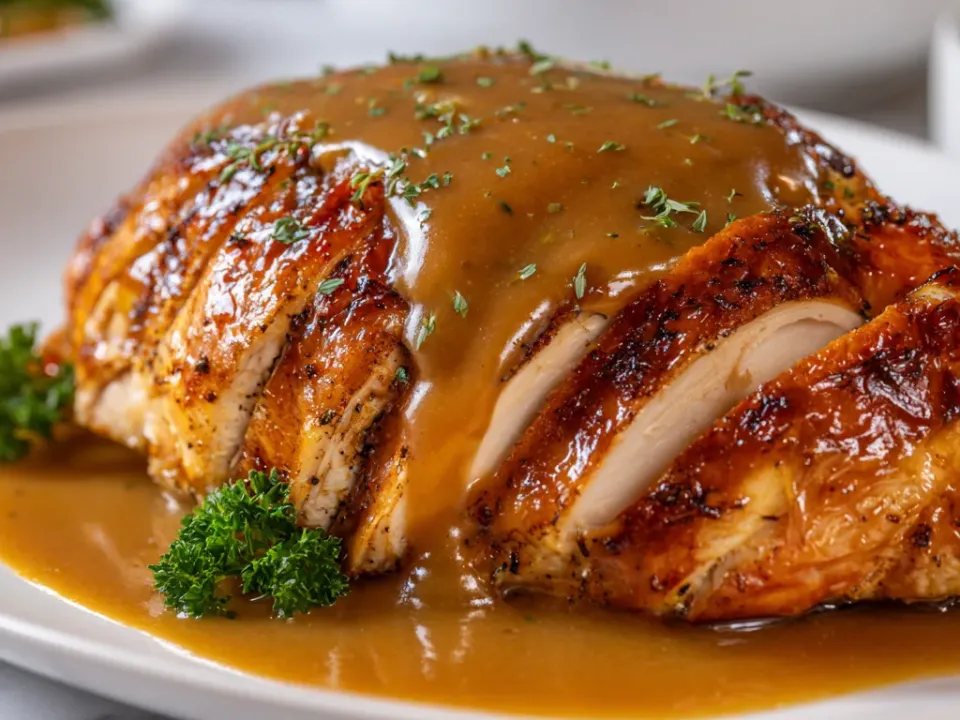
A turkey breast rather than a whole bird — under two hours, feeds six, and gives you a proper drippings gravy at the end of it.
It is the version of Thanksgiving turkey that fits a normal oven and a normal Thursday, and the gravy is made in the fifteen minutes the meat is resting.
Why This Recipe Works
- Roasting on a bed of onion, celery and carrot lifts the breast off the pan and gives the stock underneath something to take flavour from. Those drippings become the gravy.
- A dry surface and a 375°F oven brown the skin without overcooking a breast that has no dark meat to protect it.
- Cooking the roux for two to three minutes removes the raw flour taste and toasts it slightly, which is what makes a drippings gravy taste roasted rather than pasty.
- Adding warm stock half a cup at a time is what prevents lumps. Cold stock into a hot roux seizes it, and all of it at once gives you no chance to smooth it.
The Thermometer Divides the Recipe
This is two recipes joined at one measurement. Before it, a bird is roasting and there is nothing to do. After it, a sauce is being made from what the roasting left behind — and it could not have been started sooner, because the drippings did not exist.
- Season and set upDried, oiled and rubbed with salt, pepper, garlic and onion powder, thyme, rosemary and optional smoked paprika. Then set skin-side up on a bed of quartered onion, celery and carrot with a cup of stock in the pan.
- Roast, 60 to 90 minutes at 375°FThe vegetables are not a side dish — they hold the bird off the pan base and flavour the liquid that becomes the gravy. A splash more stock goes in if the pan runs dry, because a dry pan burns the drippings you are about to use.
Check before you continue
160–165°F (71–74°C) — Instant-read thermometer, in the thickest part
This is the range. A bone-in breast varies enormously with weight and oven, so the 60 to 90 minute window is a guide and this is the answer. Reading it early costs nothing; reading it late costs the bird.
- Rest 15 minutes, tentedNon-negotiable and easy to skip. Carving straight away loses the juice onto the board, and the fifteen minutes is also exactly when the gravy gets made.
- Strain and skimPan drippings strained, fat skimmed, three tablespoons of that fat reserved. This is the whole reason the gravy tastes of the bird rather than of stock.
- Roux, then stock, graduallyFat and butter with flour, cooked 2 to 3 minutes to golden and nutty, then warm stock whisked in half a cup at a time and simmered 5 to 8 minutes.
- Season, slice, serveWorcestershire, Dijon, lemon or vinegar, salt and pepper, then parsley. The turkey is sliced against the grain, and the trick is to dip the slices briefly in gravy to keep them moist.
Ingredient Notes
- Bone-in, skin-on turkey breast
- 3.5 to 4 lb, or 4 lb of thighs and drumsticks. Bone-in and skin-on both matter: the bone moderates the heat and the skin protects lean meat that has nothing else to protect it.
- Flour, or cornstarch
- A quarter cup of flour, or 2 tablespoons of cornstarch for a gluten-free gravy. Cornstarch does not want a long roux — whisk it into cool stock and add it to the simmering pan instead.
- Lemon juice or cider vinegar
- One to two teaspoons at the end. A small acid in a fat-and-flour sauce is what stops gravy tasting heavy, and it is the ingredient people leave out.
- Stock, in two places
- One cup into the roasting pan and 3 to 4 cups warmed for the gravy. The pan cup becomes part of the drippings; the gravy cups do not go in until step 7.
How to Make It
Heat the oven and dry the turkey
375°F (190°C). Pat the turkey dry with paper towels for better browning.
Season
Mix the salt, pepper, garlic powder, onion powder, thyme, rosemary and paprika. Rub the turkey with olive oil and then the seasoning.
Set up the pan
Layer the onion, celery and carrot in a roasting pan and pour in 1 cup of stock. Place the turkey skin-side up on top of the vegetables.
Roast
60 to 90 minutes, until the thickest part reaches 160–165°F (71–74°C). Add a splash of stock if the pan gets dry.
Rest and strain
Transfer the turkey to a board, tent with foil and rest 15 minutes. Strain the pan drippings, skim the fat and reserve 3 tablespoons.
Make the roux
In a saucepan, heat the 3 tablespoons of drippings with 3 tablespoons of butter over medium heat. Whisk in the flour to form a roux and cook 2 to 3 minutes, until golden and nutty.
Build the gravy
Gradually whisk in the warm stock, half a cup at a time, until smooth and velvety. Simmer 5 to 8 minutes to thicken.
Season the gravy
Worcestershire, Dijon, lemon juice or vinegar, salt and pepper, then stir in the parsley.
Slice
Slice the turkey against the grain. Dip the slices briefly in gravy if you want them extra moist.
Serve
Serve the turkey with the gravy spooned generously over the top.
Success Tips
- Take the temperature rather than trusting the time. Bone-in breasts vary by far more than you would expect.
- Rest for the full fifteen minutes, and use that time for the gravy.
- Warm the stock before it meets the roux.
- Add the stock gradually. This is where lumps come from and it is entirely avoidable.
Serving Ideas
Everything a Thanksgiving plate normally carries. The dip-the-slices trick is worth knowing when you are serving turkey that has been sitting a few minutes.
Storage and Reheating
Refrigerate
Refrigerate the meat and gravy separately up to 4 days. Sliced turkey dries faster than a whole piece, so keep any large section intact if you can.
Freeze
Freeze the meat up to 3 months. Flour-thickened gravy can go grainy after freezing, so it is better made fresh — and with no drippings, butter stands in for the fat.
Reheat
Warm the slices gently in gravy in a covered pan. That is far kinder to lean turkey than dry heat, and it is the same principle as the dipping trick.
Frequently Asked Questions
Can I use a whole turkey?
The method transfers but none of the timings do — a whole bird takes considerably longer and needs the thigh checked as well as the breast. The temperature is what stays constant. This recipe is written around a breast that feeds six.
What if I do not get 3 tablespoons of fat?
Make up the difference with butter, which is why the ingredient list carries 3 tablespoons of unsalted butter marked 'if needed'. The roux needs a set amount of fat for the flour; where it comes from matters less than the quantity.
Can I make the gravy gluten-free?
Use 2 tablespoons of cornstarch in place of the flour. Cornstarch behaves differently — whisk it into a little cool stock to make a slurry and stir that into the simmering liquid, rather than cooking it as a roux.