
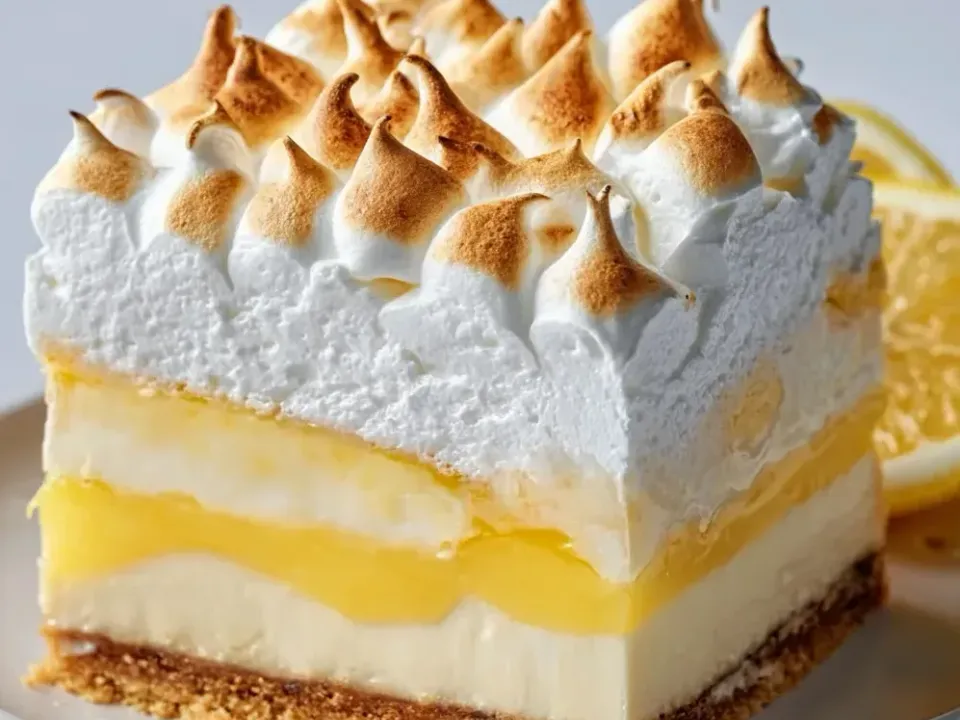
The three lemons are the lemon cheesecake itself, a cooked lemon curd spread across it, and lemon zest folded through the meringue on top.
Both egg toppings are cooked on the stove to 160°F. The torch at the end is only for colour on the meringue peaks.
Both Egg Toppings Reach 160°F
The cheesecake bakes; the curd and meringue are cooked on the stove, and each has to hit the same temperature.
- The baked baseGraham crust and lemon cheesecake baked at 325°F until set at the edges with a slight wobble, then cooled.
- The curdYolks, sugar, lemon juice and zest whisked over medium-low heat until thick.
- The meringuePasteurized whites and sugar whisked over simmering water until the sugar dissolves.
Check before you continue
At least 160°F — Instant-read thermometer
Check the curd before the butter goes in, and the meringue mixture before it is whipped.
- Curd layerButter whisked in, cooled, spread over the cheesecake and chilled.
- Meringue topWhipped to stiff glossy peaks, zest folded in, piled on and torched for colour. Kept refrigerated.
Ingredient Notes
- Egg yolks for the curd
- Three large yolks, cooked with the curd to at least 160°F.
- Pasteurized egg whites
- Three, for the meringue, which is also heated to 160°F before whipping.
- Lemon zest and juice
- Divided across all three layers: zest and juice in the cheesecake and curd, zest alone in the meringue.
How to Make It
Graham crust baked 8 minutes at 325°F
Heat the oven to 325°F. Mix the graham crumbs with the butter, press into a springform pan, and bake 8 minutes.
Lemon cheesecake baked and cooled
Beat the cream cheese with the sugar, then the eggs, lemon zest, lemon juice and sour cream. Bake 50 to 55 minutes, until set at the edges with a slight wobble in the centre, and cool.
Lemon curd cooked to 160°F, spread and chilled
For the curd, whisk the yolks, sugar, lemon juice and zest over medium-low heat until thick and at least 160°F. Whisk in the butter and cool, then spread it over the cheesecake and chill.
Swiss meringue heated to 160°F and whipped
For the meringue, whisk the pasteurized whites and sugar over simmering water until they reach 160°F and the sugar dissolves. Whip to stiff, glossy peaks and fold in the lemon zest.
Meringue piled on and torched
Pile the meringue over the chilled cake and use a torch only to brown the surface. Keep refrigerated.
Why This Recipe Works
- Zest and juice in the cheesecake give the base layer its own lemon flavour before any topping.
- Cooking the curd from yolks to at least 160°F thickens it enough to spread in a clean, bright yellow layer.
- Chilling the curd-topped cake before the meringue goes on keeps the layers distinct.
- A Swiss meringue whisked over simmering water to 160°F is stable enough to pile high in peaks.
Frequently Asked Questions
Is the meringue cooked?
Yes. The pasteurized whites and sugar are heated over simmering water to 160°F before whipping. Torching only browns the outside.
What are the three lemon layers?
Lemon cheesecake, a cooked lemon curd, and lemon-zest meringue.
How do I know the curd is done?
It should be thick and read at least 160°F on an instant-read thermometer.
Success Tips
- Whisk the curd constantly over medium-low heat so the yolks thicken without scrambling.
- Make sure the bowl for the meringue is completely grease-free or the whites will not whip.
- Keep the torch moving across the peaks for even colour.
Storage and Reheating
Refrigerate
Keep the finished cheesecake refrigerated at 40°F or below.
Serving Ideas
Cut tall slices with a knife dipped in hot water and wiped between cuts, so the crust, cheesecake, curd and meringue stay in clean layers.