
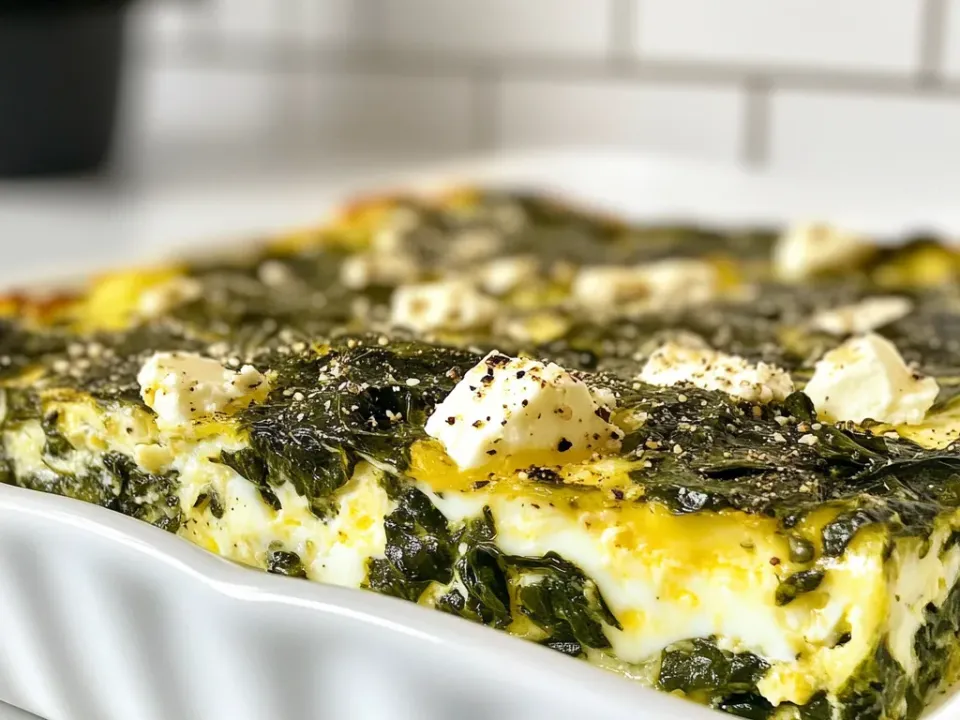
Ten eggs whisked with milk and Greek yogurt, poured over wilted spinach, feta, dill and lemon zest, and baked until the centre just sets.
Fifteen minutes of prep, half an hour in the oven, and a short rest before slicing. Eight squares.
Why This Recipe Works
- Half a cup of Greek yogurt alongside the milk. It brings acidity and body that milk alone does not, and it is a large part of why this sets creamy rather than rubbery.
- The spinach is wilted in batches with the onion and garlic rather than added raw. Ten ounces will not fit in the pan at once, and raw leaves in the custard release their water during the bake.
- Lemon zest and fresh dill go in off the heat. Both are volatile — cooked into the skillet they would be gone by the time the dish reached the table.
- Six ounces of feta is a lot of salt, which is why the added salt is only half a teaspoon. Season at the end rather than the start if you are unsure of your feta.
- 375°F for under half an hour. Egg custards set gently; a hotter oven curdles the edges before the middle is done.
Four Places An Egg Bake Is Decided
Eight steps and nothing difficult in any of them, which is exactly why the few things that matter are easy to skip.
Step 3, after wilting
Cool the spinach slightly and squeeze it if it is very wet.
Hot spinach tipped into ten beaten eggs starts to cook them, and wet spinach releases that water into the custard where it separates out as a layer at the bottom.
Step 4, whisking
Smooth, but NOT frothy.
The recipe says so explicitly. Air beaten into an egg custard puffs in the oven and then collapses, leaving a dense, sunken slab instead of an even set.
Step 5, folding
Feta, scallions, dill and zest folded in before the spinach.
Folding the solids into the custard first distributes them; adding them after the spinach means the spinach clumps and the feta sinks.
Step 7, doneness
Centre set, knife clean — or 165°F on a thermometer.
The recipe gives both, and the thermometer is the reliable one. An egg bake pulled early looks set at the edge and stays liquid two inches in.
Ingredient Notes
- Fresh baby spinach
- Ten ounces, roughly eight packed cups, wilted down to very little. Baby leaves rather than mature — no stems to remove and they wilt in seconds.
- Plain Greek yogurt
- Half a cup, plain and unsweetened. It is doing structural work alongside the milk, not standing in for it.
- Feta cheese, crumbled
- Six ounces. Block feta crumbled by hand holds its pieces better than pre-crumbled, which is drier.
- Fresh dill
- Two tablespoons chopped, with a teaspoon of dried named as the alternative. Dill and feta is the pairing this dish is built on.
- Lemon zest
- One teaspoon, zest only. It lifts a rich egg-and-cheese bake in a way lemon juice would not, since juice would thin the custard.
How to Make It
Heat the oven and grease the dish
Preheat the oven to 375°F (190°C). Grease a 9x13-inch baking dish with olive oil spray or butter.
Soften the onion and garlic
Warm 1 tablespoon olive oil in a large skillet over medium heat. Sauté the onion with a pinch of salt until translucent, 4 to 5 minutes. Stir in the garlic for 30 seconds.
Wilt the spinach in batches
Add the spinach in batches, tossing until just wilted and bright green. Remove from the heat and cool slightly; squeeze out excess moisture if very wet.
Whisk the custard
In a large bowl, whisk the eggs, milk, Greek yogurt, salt, pepper and red pepper flakes until smooth but not frothy.
Fold in the solids
Fold in the feta, scallions, dill and lemon zest. Stir in the wilted spinach and onions until evenly distributed.
Fill the dish and top
Pour the mixture into the prepared dish. Sprinkle the Parmesan over the top if using.
Bake to a set centre
Bake 28 to 32 minutes, until the centre is set and a knife comes out clean (or internal temp 165°F/74°C).
Rest and slice
Rest 5 to 10 minutes before slicing into 8 squares. Serve warm.
Success Tips
- Wilt the spinach in batches — ten ounces will not fit in a skillet at once.
- Let it cool before it meets the eggs.
- Whisk smooth, not frothy; air is the enemy of an even set.
- Go by 165°F rather than by the edges, which set long before the middle.
- Rest before slicing so the squares hold their shape.
Serving Ideas
A brunch dish that cuts into neat squares and is as good at room temperature as it is warm. Bread and fruit alongside.
Storage and Reheating
Refrigerate
Refrigerate up to 4 days, covered. Egg bakes slice more cleanly cold.
Freeze
Freeze cooled squares wrapped individually for up to 2 months. Thaw in the fridge; the texture firms slightly.
Reheat
Covered at 325°F, or a portion in the microwave in short bursts. High heat makes reheated egg rubbery.
Frequently Asked Questions
There was liquid at the bottom.
Water from the spinach. Ten ounces of leaves carry a lot of it — cool the wilted spinach and squeeze it out if it looks wet before it goes into the custard.
Can I use frozen spinach?
Thawed and very thoroughly squeezed, yes. Frozen spinach holds far more water than fresh, so this is the case where the squeezing is not optional.
Can I assemble it the night before?
Yes. Cover and refrigerate, then add a few minutes to the bake since it starts cold, and still check for a set centre or 165°F.
Mine came out rubbery.
Usually overbaking, sometimes over-whisking. Pull it as soon as the centre reads 165°F, and whisk the custard only until it is smooth.