
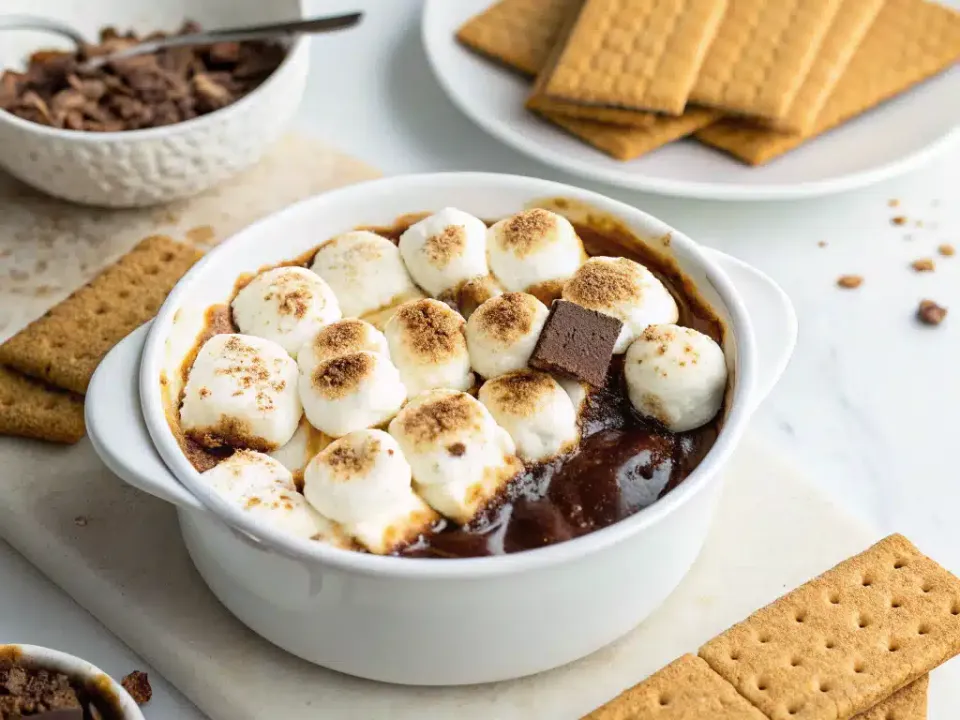
S'mores without the campfire: two chocolates melted in a hot skillet, marshmallows torched under the broiler, graham crackers to scoop.
Twenty minutes, eight ingredients, one pan, and nothing about it is difficult except paying attention at the end.
Why This Recipe Works
- Two chocolates rather than one is the recipe's best decision — semi-sweet carries the depth and milk chocolate brings the sweetness people associate with a s'more.
- Preheating the empty skillet means the chocolate is melting from both directions, which is what makes a three-to-four-minute melt possible.
- Two tablespoons of heavy cream turns melted chocolate into something closer to a ganache, so it stays scoopable rather than seizing as it cools.
- An eighth of a teaspoon of kosher salt in a bowl of chocolate and marshmallow is the reason it does not taste flatly sweet.
The Ninety-Second Window
Twenty minutes total, and only one stage of it moves fast. Everything before the broiler is forgiving; the broiler is not forgiving at all.
The empty skillet
Five minutes on the middle rack at 400°F, before anything goes in
A preheated pan starts melting the chocolate from underneath the moment it lands. Into a cold skillet the same chocolate needs far longer than the 3 to 4 minutes step 3 allows, and by then the top has scorched.
The chocolate, out of the oven
Glossy and beginning to melt — not fully liquid
Three to four minutes only. Chocolate holds its shape long after it has softened, so waiting for it to look melted means taking it much too far. Stir it smooth afterwards for exactly this reason.
The marshmallows
A single layer, evenly spread
Piled up, the bottom ones steam while the top ones brown. A single layer is what gives one uniform golden surface rather than a patchwork.
Under the broiler
45 to 90 seconds, watched the whole time, rotating if needed
This is the window the recipe lives or dies in. Sugar goes from golden to black in a few seconds, and broiler elements are notoriously uneven — rotating the pan is doing real work.
Serving
Immediately, straight from the pan
The dip sets as the skillet cools. Cast iron holds heat well and buys extra time, which is why it is named.
Ingredient Notes
- Two chocolates
- A cup and a half semi-sweet and half a cup milk chocolate. The ratio matters — mostly semi-sweet, with milk chocolate rounding it off rather than leading.
- Heavy cream
- Two tablespoons, marked optional for extra-silky chocolate. Worth including: it is what keeps the dip soft for longer as the pan cools.
- Mini marshmallows
- Three to four cups. Mini rather than standard — they brown evenly in the short window, where large marshmallows char outside before the middle softens.
How to Make It
Preheat the pan
Heat the oven to 400°F (200°C) and place a 10-inch oven-safe or cast-iron skillet on the middle rack to warm for 5 minutes.
Add the chocolate
Carefully remove the warm skillet and grease it with butter. Add the semi-sweet and milk chocolate chips, drizzle over the heavy cream, then add the vanilla and salt. Gently toss to distribute.
Melt
Bake 3 to 4 minutes, just until the chocolate looks glossy and is beginning to melt, then stir it smooth into an even layer.
Add the marshmallows
Top evenly with mini marshmallows in a single layer.
Broil
Switch the oven to broil and broil 45 to 90 seconds, watching closely, until the marshmallows are golden-brown and toasty. Rotate the pan if needed for even colour.
Serve
Straight from the skillet with graham crackers for dipping, plus pretzels, strawberries or sliced bananas if you like.
Success Tips
- Preheat the empty pan. It is the difference between three minutes and ten.
- Take the chocolate out while it still looks under-melted, then stir.
- One layer of marshmallows, not a pile.
- Stand at the oven for the broil. Forty-five seconds is a real possibility, not a lower bound to ignore.
Serving Ideas
Graham crackers first, then the extras — pretzels for salt, strawberries or banana for something fresh against the chocolate. Serve it in the pan on a board or trivet; the skillet stays hot for a long time.
Storage and Reheating
Refrigerate
Best eaten the day it is made. Refrigerate leftovers up to 2 days, though the marshmallow topping loses its texture entirely once cold.
Freeze
Not sensible. Marshmallow and melted chocolate both behave badly after freezing.
Reheat
A low oven softens the chocolate again, but the toasted marshmallow layer will not come back. This is a recipe to make in the quantity you will eat.
Frequently Asked Questions
What if my oven has no broiler?
A kitchen blowtorch does the same job and gives you more control than a broiler does. Failing that, the top oven rack at the highest bake temperature will eventually colour the marshmallows, though it takes longer and dries them more.
My marshmallows went black almost instantly.
Broiler elements vary enormously and some run far hotter than others. Move the rack down a level, start checking at 30 seconds, and rotate the pan — rotating is built into the step because uneven elements are the norm rather than the exception.
Can I make it ahead?
Only partly. You can measure everything and grease the pan in advance, but the melting and broiling need to happen just before serving — this dip is at its best in the first fifteen minutes out of the oven.