
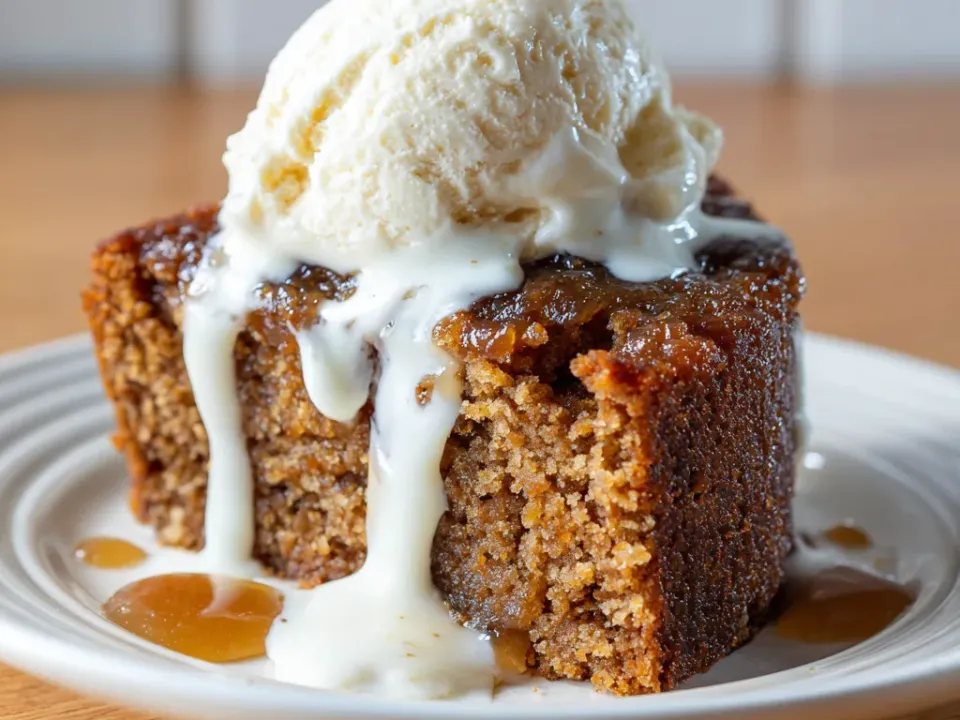
A self-saucing gingerbread pudding: cake on top, warm molasses sauce underneath, and the sauce makes itself.
Two and a half hours in a slow cooker, of which fifteen minutes is work, and it comes out of the crock by the spoonful rather than in slices.
Why This Recipe Works
- Pouring a hot sugar solution onto batter and not stirring is the entire mechanism. The dense liquid sinks and the rising cake separates from it, which is why the sauce ends up beneath rather than mixed through.
- Dark brown sugar in both the batter and the sauce doubles the molasses depth without making either half taste of nothing else.
- Half a cup of molasses in the cake and a quarter cup more in the sauce is a lot of it — this is a properly dark gingerbread rather than a spiced sponge.
- Hot coffee as an alternative to the boiling water is worth taking. It does not taste of coffee in the finished pudding; it deepens the molasses the way it does in a chocolate cake.
Two Layers That Must Not Mix
A pudding cake is one mixture that separates itself into two while it cooks. The whole thing rests on pouring a hot liquid onto raw batter and then leaving it completely alone.
The paper towel, above everything
Laid over the crock before the lid, not touching the batter. A slow cooker lid drips condensation straight back down, and on a cake surface that means wet patches that never set.
What happens underneath
The hot sugar solution is denser than the batter, so it sinks. As the cake sets it rises through and above the liquid, leaving a thin molasses sauce pooled at the bottom of the crock that was never made separately.
The sauce, poured hot and gently
A cup and a quarter of boiling water or hot coffee whisked with more brown sugar, more molasses and butter until dissolved. Poured gently over the batter, and this is explicit: do not stir.
The batter, spread thick
Flour, brown sugar, two leaveners and four spices, with melted butter, molasses, milk, egg and vanilla stirred in just until combined. Thick is the operative word — a loose batter would let the sauce cut straight through it.
Ingredient Notes
- Molasses, in two places
- Half a cup in the batter and a quarter cup in the sauce, both unsulphured. Two lines in the ingredient list and they are not interchangeable quantities.
- Dark brown sugar, in two places
- Half a cup in the batter and half a cup again for the sauce. Dark rather than light, which is what gives both halves their depth.
- Boiling water or hot coffee
- A cup and a quarter, and it must be hot when it goes on. Cold liquid would not dissolve the sugar and would not sink cleanly through the batter.
- Orange zest
- A teaspoon, optional, into the sauce rather than the cake. Orange against molasses and ginger is a classic pairing and it is worth the zesting.
How to Make It
Prepare and preheat the cooker
Lightly grease a 4- to 6-quart slow cooker with butter or nonstick spray, and preheat it on High while you mix the batter.
Whisk the dry ingredients
In a large bowl, whisk the flour, brown sugar, baking powder, baking soda, salt, ginger, cinnamon, cloves and nutmeg.
Whisk the wet ingredients
In a separate bowl, whisk the melted butter, molasses, milk, egg and vanilla until smooth.
Combine
Pour the wet into the dry and stir gently until just combined. Do not overmix.
Spread the batter
Spread the thick batter evenly in the slow cooker.
Make the sauce
In a heatproof measuring cup, whisk the boiling water or hot coffee with the brown sugar, molasses and butter until dissolved, and stir in the orange zest if using.
Pour it over, and stop
Gently pour the hot sauce over the batter. Do not stir — it will sink and create a sauce underneath.
Cover with a towel, then the lid
Lay a paper towel over the crock and cover with the lid to catch condensation. The towel should not touch the batter.
Cook
High for 2 to 2 1/2 hours, or Low for 3 1/2 to 4, until the top looks set and a toothpick in the cake — not the sauce — comes out with a few moist crumbs.
Rest
Turn off the heat and let it stand uncovered 10 to 15 minutes to thicken the sauce.
Serve
Scoop warm portions into bowls, spooning extra sauce from the bottom over each, and top with whipped cream or vanilla ice cream.
Store
Cover and refrigerate leftovers up to 4 days, or freeze up to 2 months.
Success Tips
- Do not stir after the sauce goes on. It is the recipe.
- Use the paper towel, and keep it clear of the batter.
- Test the cake with the toothpick, not the sauce layer underneath it.
- Let it stand uncovered for the full 10 to 15 minutes — the sauce is thin until it does.
Serving Ideas
Whipped cream or vanilla ice cream, and a spoonful of the sauce from the bottom over each portion. Ice cream against a warm molasses pudding is the better of the two.
Storage and Reheating
Refrigerate
Refrigerate covered for up to 4 days. In the fridge the sauce firms; it loosens again when warmed.
Freeze
Freeze up to 2 months. The cake survives it better than the sauce, which can go slightly grainy.
Reheat
A short burst in the microwave per portion brings the sauce back to a pourable state. It is much better warm than at room temperature.
Frequently Asked Questions
What actually happens if I stir it?
You get one wet, heavy cake instead of a cake with a sauce under it. The separation depends on a dense sugar solution sinking through a thick batter while it cooks, and stirring destroys that difference in density before the heat can act on it.
Will it taste of coffee?
No. A cup and a quarter of hot coffee in a pudding this dark and this heavily spiced reads as depth rather than as coffee, in the same way it does in a chocolate cake. Boiling water works perfectly well if you would rather not.
Mine came out dry with no sauce.
Either it was overcooked, or the sauce was stirred in. On High this is done at two hours in many cookers, and there is no visual warning beyond the toothpick. Test the cake portion and take it out as soon as it shows moist crumbs.