
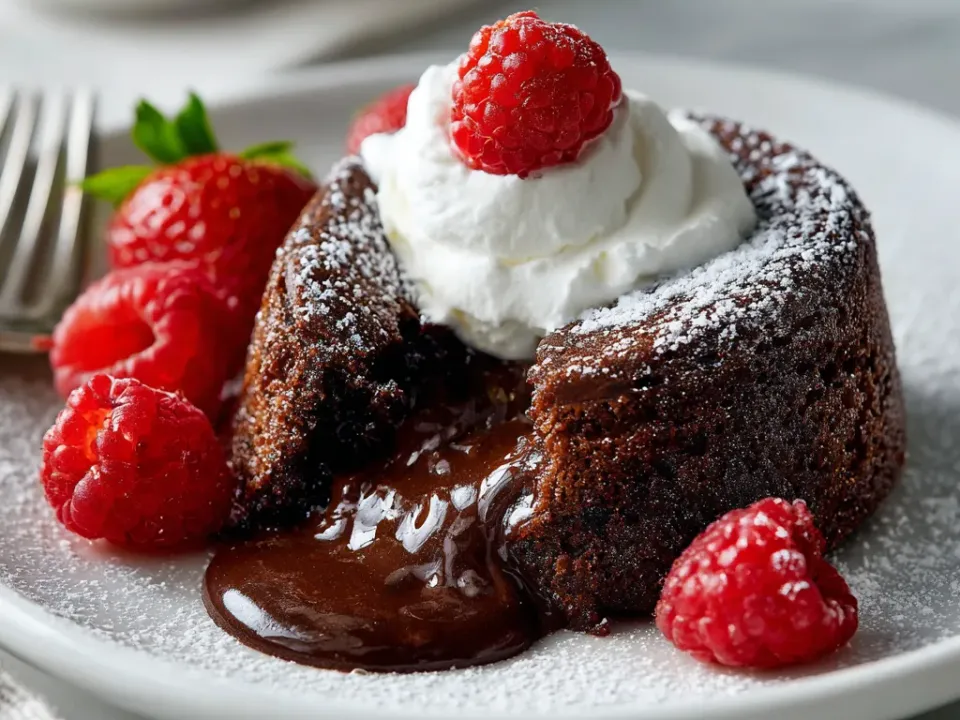
This is six individual cakes, not a pudding scooped from the pot. Six-ounce ramekins sit in a slow cooker with hot water poured around them, which turns the appliance into a gentle water bath rather than a baking dish.
The centre is meant to stay molten, so the recipe uses pasteurized eggs and yolks. That is the honest way to serve an underset egg batter, and it is written into the recipe rather than left to chance.
Why This Recipe Works
- A water bath surrounds the ramekins with heat that never exceeds boiling, so the edges set slowly while the middles lag behind.
- Melting the butter and chocolate together and cooling five minutes stops the hot mixture scrambling the eggs.
- Only a quarter cup of flour goes in — just enough structure to hold a cake around a liquid centre.
- A five-minute rest lets each cake firm at the edge enough to invert without collapsing.
Ingredient Notes
- Pasteurized eggs and yolks
- Two whole and two yolks, both pasteurized. This matters because the centre is intentionally molten.
- Semisweet chocolate
- Six ounces, chopped and melted with the butter, then cooled five minutes before it meets the eggs.
- Hot water
- A cup and a half, poured around the ramekins rather than into them, to about one-third up their sides.
How to Make It
Prepare and melt
Butter six 6-ounce heatproof ramekins. Melt butter and chocolate together and cool 5 minutes.
Mix the batter
Whisk eggs, yolks, sugar, vanilla and salt until smooth. Whisk in chocolate, then fold in flour.
Set up the water bath
Divide batter among ramekins. Set ramekins in a 6-quart slow cooker and carefully pour hot water around them to come about one-third up the sides.
Cook on High, checking early
Cover and cook on High 1 1/2 to 2 hours, checking early; edges should be set while centers remain soft.
Rest, invert, serve
Lift ramekins out, rest 5 minutes, invert each cake onto a plate, and serve with whipped cream, raspberries and powdered sugar.
A Centre That Is Meant to Stay Soft
Almost every doneness cue in cooking says keep going until the middle is set. This recipe says the opposite, so it handles the consequence up front instead of at the end.
- The eggs are chosen for itTwo pasteurized whole eggs and two pasteurized yolks. A molten centre means the egg in it is never brought to a set, so the recipe specifies eggs that were made safe before they reached the bowl.
- The chocolate is cooled first6 tbsp butter and 6 oz semisweet chocolate melted together and left 5 minutes. Whisked in hot, it would cook the eggs on contact and cost the batter its smoothness.
- The heat is indirectSix 6-ounce ramekins in a 6-quart cooker with 1 1/2 cups of hot water poured around them, a third of the way up. The water bath is what lets the edges set while the middles lag.
Check before you continue
Edges set, centres still soft — Your eyes, on the edges - not a thermometer in the centre
1 1/2 to 2 hours on HIGH, checking early. A probe through the middle would tell you nothing useful here: the middle is supposed to be liquid. The edge is the only reliable read, and the window between molten and fully baked is narrow.
- Five minutes, then invertRamekins lifted clear of the water and rested 5 minutes, which firms the edge just enough to turn each cake out whole. Whipped cream, raspberries and powdered sugar as the finished plate shows.
Success Tips
- Cool the melted chocolate the full five minutes. Hot chocolate straight into eggs will scramble them.
- Pour the water carefully and around the outside — a splash into a ramekin ruins that cake.
- Start checking well before the two-hour mark. The window between molten and fully set is short.
Serving Ideas
Six individual cakes, each inverted onto a plate and served with whipped cream, raspberries and a dusting of powdered sugar.
Frequently Asked Questions
Why pasteurized eggs?
The centre of a lava cake is deliberately left molten, so the eggs in it never fully cook. Pasteurized eggs are how the recipe handles that honestly.
Can I bake it as one big cake in the crock?
No. This is six portioned cakes in ramekins, inverted onto plates.
How do I know when to stop?
The edges should be set and the cakes hot while the centres are still soft. Check early rather than trusting the clock.