
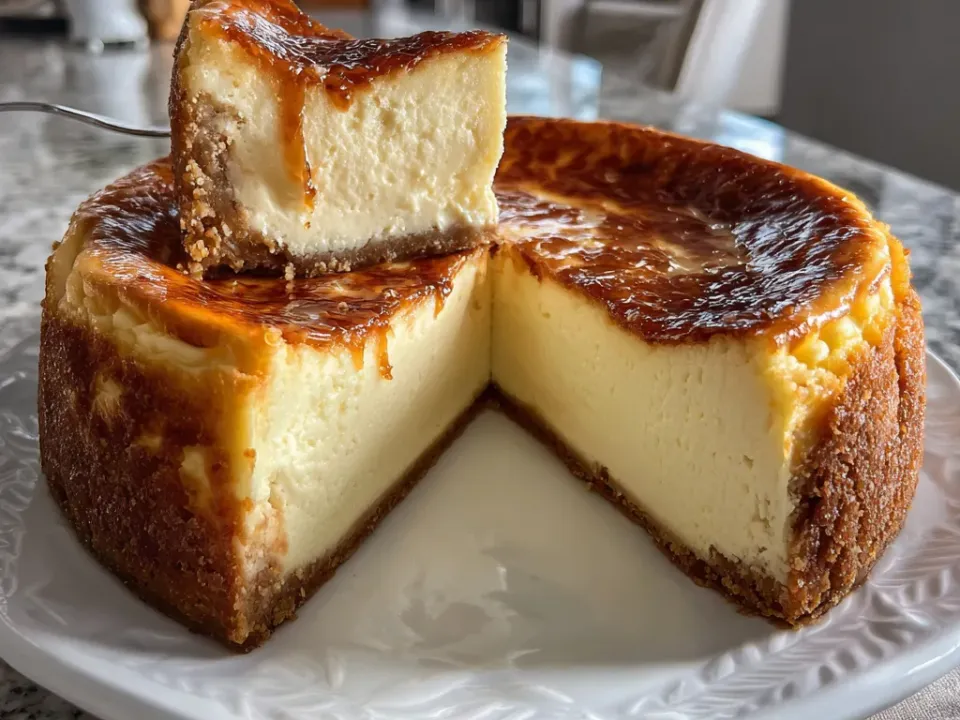
A proper baked cheesecake made in a slow cooker, which turns out to be an unusually good tool for it — humid, gentle and impossible to run too hot.
Eight and a half hours in total, but only twenty-five minutes of work. The rest is cooking, resting and an overnight chill.
Why This Recipe Works
- A slow cooker is a naturally humid, low-temperature environment, which is exactly what a cheesecake wants and what an oven has to be tricked into providing with a roasting-tin water bath.
- A tablespoon of cornstarch in the filling stabilises the custard, making it more forgiving of slight overcooking than a pure cream cheese and egg mixture would be.
- Freezing the crust while the filling is mixed sets the butter, so the crust holds its shape against a wet filling instead of floating up into it.
- The extra yolk beyond the two whole eggs adds richness and emulsifying power without adding more white, and it is the whites that make a cheesecake souffle up and then sink.
Seven Defences Against One Crack
A cheesecake cracks when the outside sets and contracts while the middle is still expanding. Almost every unusual instruction in this recipe is aimed at that single mechanism, and skipping any one of them makes a crack more likely.
Everything at room temperature
Cream cheese, sour cream, eggs and yolk
Four separate ingredient lines specify it. Cold cream cheese needs more beating to smooth out, and more beating means more air — and air pockets expanding in the oven are what push a surface apart.
Mixing speed
Medium-low for the cheese, then LOW for everything after
The whole point is to combine without aerating. Eggs in particular go in one at a time on low, only until no streaks remain — a cheesecake beaten like a cake batter is a cheesecake that will crack.
After mixing
Tap the bowl 8 to 10 times, then tap the filled pan again
Two separate de-bubbling steps, with the taps counted. Every bubble left in the batter is a void that expands with heat and collapses as it cools.
The water bath
1 to 1 1/2 cups hot water, pan raised on a rack ABOVE it
Above, not in. The water makes the crock humid so the surface stays moist and flexible while the centre cooks; the double foil wrap and the rack keep the water out of the crust.
Doneness
Outside 2 inches set, centre jiggling like gelatin
A cheesecake baked until the middle is firm is overbaked, and overbaked is the other main cause of cracking. The centre finishes setting during the rest and the chill.
The rest
45 to 60 minutes in the switched-off cooker, lid ajar
This is the gradual cool-down that prevents thermal shock. Lid ajar rather than off or on: fully off cools it too fast, fully on traps steam onto the surface.
Before cooling
Run a thin knife around the edge
The last defence. A cheesecake shrinks as it cools, and if the edge is still stuck to the pan it pulls against itself — which tears the middle. Loosening the edge lets it contract evenly.
Ingredient Notes
- Full-fat cream cheese
- 24 ounces at room temperature. Full-fat specifically — reduced-fat cream cheese carries more water and gives a looser set that is more prone to cracking.
- Two eggs plus one yolk
- All at room temperature. The extra yolk is deliberate: richness and emulsification without the extra white that would make it puff and fall.
- Cornstarch
- One tablespoon. A stabiliser that makes the custard more tolerant of being slightly overcooked, which is the commonest route to a crack.
- Lemon juice
- A teaspoon, marked optional for brightness. Small, and in a filling this rich it is the only thing cutting through.
How to Make It
Prepare the pan
Lightly grease a 6- to 7-inch springform and line the bottom with a round of parchment. Wrap the outside with a double layer of foil to prevent leaks.
Make the crust
Stir the graham crumbs, 2 tablespoons of sugar and the melted butter until it resembles wet sand. Press firmly into the bottom and 1 inch up the sides, then freeze while you make the filling.
Set up the water bath
Pour 1 to 1 1/2 cups of hot water into the slow cooker and set a small rack or a ring of crumpled foil in the bottom to lift the pan above the water. Preheat on High while you mix.
Mix the filling
Beat the cream cheese on medium-low until smooth and creamy, 1 to 2 minutes. Add the sugar, sour cream, cornstarch, vanilla, lemon juice and salt and mix on low just until combined, scraping the bowl. Add the eggs and yolk one at a time, mixing on low only until no streaks remain.
Remove air bubbles
Tap the bowl on the counter 8 to 10 times. Pour the batter into the crust, smooth the top and tap the filled pan several times to release more bubbles.
Cook
Place the pan on the rack. Drape a clean towel or a double layer of paper towels under the lid to catch condensation. Cook on High for 1 hour 45 minutes to 2 hours 30 minutes, until the outside 2 inches are set and the centre jiggles like gelatin.
Rest in the cooker
Turn off the slow cooker. Remove the lid and towel, then loosely replace the lid slightly ajar, and let the cheesecake rest in the warm cooker for 45 to 60 minutes.
Cool
Transfer the pan to a rack, run a thin knife around the edge, and cool to room temperature, 1 to 2 hours.
Chill
Cover and refrigerate at least 6 hours, preferably overnight, until fully set.
Serve
Unmould, slice with a hot, dry knife, and top as you like — berries, caramel, chocolate or fresh fruit.
Success Tips
- Room temperature everything, and mix on low. Air is the enemy.
- Tap the bowl and then tap the pan. Both, as counted.
- Take it out while the centre still jiggles like gelatin.
- Run a knife around the edge before it cools, not after.
Serving Ideas
Berries, caramel, chocolate or fresh fruit. A hot, dry knife between slices is the detail worth following — it is the difference between clean edges and dragged ones.
Storage and Reheating
Refrigerate
Refrigerate covered up to 5 days. Cheesecake is arguably better on day two, once the flavours have settled and it has firmed completely.
Freeze
Freeze whole or in slices up to 2 months, wrapped well. Thaw overnight in the fridge rather than at room temperature to avoid condensation on the surface.
Reheat
Never. This is a chilled dessert and it is fully set only when cold.
Frequently Asked Questions
Mine cracked anyway. What happened?
The three commonest causes are overmixing after the eggs go in, overcooking past the gelatin jiggle, and cooling too fast. The knife around the edge is the one people skip most often — without it the cheesecake pulls against a pan it is still stuck to as it contracts.
What if I have no springform that fits?
It is the one piece of equipment this recipe genuinely requires, since the cheesecake has to sit raised inside the cooker with the lid closed. A 6- or 7-inch springform is a small and inexpensive pan, and nothing else releases a cheesecake cleanly.
Can I serve it the same day?
Not really. The six-hour chill is not resting time, it is setting time — the custard is still soft when it comes out of the cooker and only firms properly when fully cold. Overnight is recommended and it is the honest answer.