
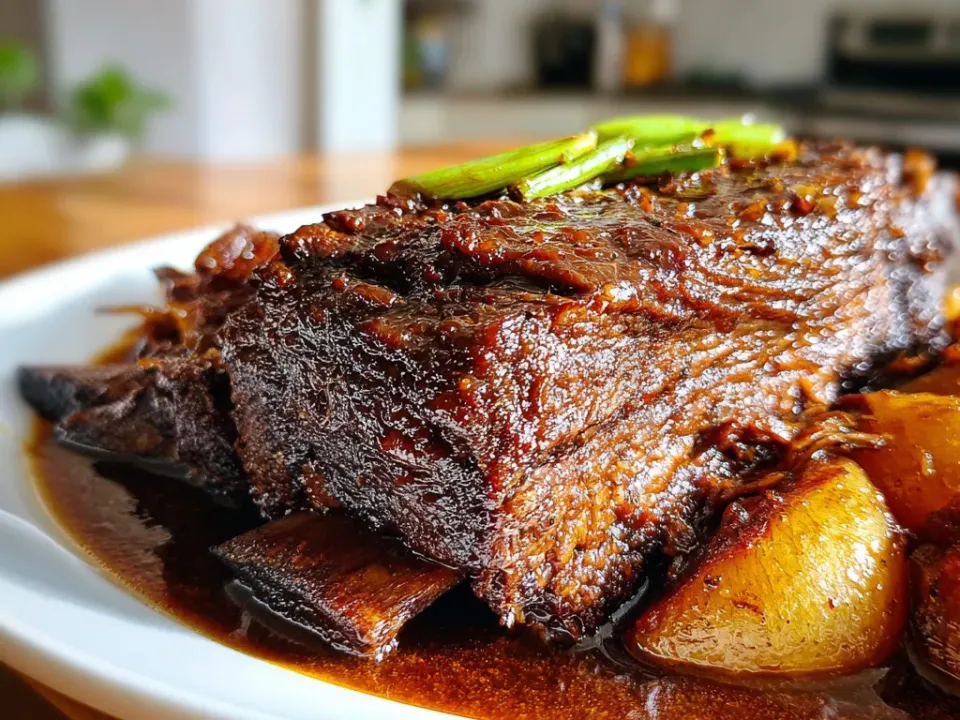
A whole brisket rubbed with nine dry seasonings, seared hard, then cooked slowly with onions, garlic and broth until a fork goes through it without resistance.
Half an hour of work at the front, most of a day unattended, and a gravy strained and reduced while the meat rests.
Why This Recipe Works
- The fat cap is trimmed to about a quarter inch rather than removed. That quarter inch bastes the meat through eight hours; taken off entirely the top of the brisket dries out.
- Nine dry seasonings in the rub, including a tablespoon of brown sugar. The sugar helps the crust form during the sear and it is a small enough quantity that the finished meat is not sweet.
- Searing three to four minutes per side before the long cook. A slow cooker cannot brown anything, and this is the only chance the recipe has to build that crust and the fond the onions then deglaze.
- The cooking liquid is strained and reduced separately at the end rather than served as it comes. Eight to twelve minutes on the hob turns a thin braising liquid into a gravy that clings.
- A tablespoon of cider vinegar in a pot with two tablespoons of Worcestershire and tomato paste. It is the acid that keeps a very rich, very savoury gravy from tasting heavy.
Two Vessels, One Recipe
Step 4 gives two complete cooking methods and this is the only real choice in the recipe. Everything before it and everything after it is identical.
The seared brisket is in its vessel with the onions, broth and aromatics poured over. Which do you cook it in?
Slow cooker
Cook on Low 8 to 10 hours, or High 5 to 6, until fork-tender.
Hands-off and very forgiving. A slow cooker holds liquid rather than evaporating it, so you finish with more cooking liquid to strain and reduce — which this recipe wants anyway.
Dutch oven
Cover tightly and bake at 300°F (150°C) for 3 1/2 to 4 1/2 hours.
Less than half the time, and the dry oven heat concentrates the liquid as it goes, so the gravy needs a shorter reduction. The lid has to be genuinely tight or it reduces too far.
Either way
Go by fork-tender rather than by the clock.
Both windows are ranges because briskets differ. A stubborn cut needs more time at the same temperature, never a hotter one — the connective tissue has not finished breaking down.
Ingredient Notes
- Beef brisket, fat cap trimmed
- Four to five pounds, trimmed to about a quarter inch. Not trimmed bare — that fat is what keeps the top of the joint from drying over a long cook.
- Low-sodium beef broth
- A cup and a half, with a gluten-free note attached. Low-sodium matters because the liquid is reduced at the end, which concentrates whatever salt is in it.
- Tomato paste
- Two tablespoons, added to the skillet and simmered a minute before it goes over the meat. It reads as depth in the finished gravy rather than as tomato.
- Liquid smoke or espresso powder
- Half a teaspoon or a teaspoon respectively, and the recipe marks both optional. Either adds darkness; neither is required for the dish to work.
- Bay leaves
- Two, whole, and strained out at step 5 along with the onions and aromatics before the liquid is reduced.
How to Make It
Trim, rub and season
Pat the brisket dry and trim the fat cap to about 1/4 inch. Mix the salt, pepper, smoked paprika, brown sugar, garlic powder, onion powder, cumin, chili powder and thyme. Rub all over the brisket.
Sear it hard
Heat the olive oil in a large skillet over medium-high. Sear the brisket 3 to 4 minutes per side until deeply browned. Transfer to the slow cooker (or Dutch oven).
Build the braising liquid
Add the onions to the skillet; sauté 3 to 4 minutes, scraping up the browned bits. Stir in the garlic for 30 seconds. Add the broth, tomato paste, Worcestershire and vinegar; simmer 1 minute. Pour over the brisket and add the bay leaves.
Cook until fork-tender
Slow cooker: cook on Low 8 to 10 hours (or High 5 to 6) until fork-tender. Oven: cover the Dutch oven tightly and bake at 300°F (150°C) for 3 1/2 to 4 1/2 hours.
Rest the meat and reduce the gravy
Rest the brisket 20 minutes on a board, tented. Strain the cooking liquid; discard the bay leaves. Reduce the liquid on the stove 8 to 12 minutes to a glossy gravy.
Slice against the grain
Slice the brisket against the grain into 1/4-inch slices (or shred). Serve with the warm gravy and onions.
Success Tips
- Note which way the grain runs before the brisket is cooked and dark.
- Get a genuine crust in the sear; the slow cooker cannot make one later.
- Deglaze the skillet properly — everything on its base belongs in the gravy.
- Rest the meat the full twenty minutes while the gravy reduces.
- Go by the fork, not the clock; a stubborn brisket wants longer, never hotter.
Serving Ideas
Sliced with the gravy and the softened onions, alongside mashed potato or bread. It also makes exceptional sandwiches the next day.
Storage and Reheating
Refrigerate
Refrigerate the sliced brisket in its gravy for up to 4 days. Keeping them together is what stops the slices drying out.
Freeze
Freezes well for up to 3 months, again in the gravy. Thaw overnight in the fridge.
Reheat
Gently, covered, in the gravy. Slices reheated dry will toughen however tender they started.
Frequently Asked Questions
Slow cooker or Dutch oven?
Both are in the recipe and both work. The slow cooker is 8 to 10 hours on Low and completely hands-off; the Dutch oven is 3 1/2 to 4 1/2 hours at 300°F and gives a slightly more concentrated gravy.
My brisket is still tough.
Give it longer at the same temperature. Toughness at that stage means the connective tissue has not finished breaking down, and a hotter oven makes it worse rather than faster.
Why does slicing against the grain matter so much?
Brisket has long, pronounced muscle fibres. Cut along them and every slice is a bundle of long strands that eat chewy; cut across them and the same meat is tender.
Should I trim off all the fat?
No — the recipe says a quarter inch. That cap renders slowly and bastes the joint from above for the whole cook, and a bare brisket dries on top.