
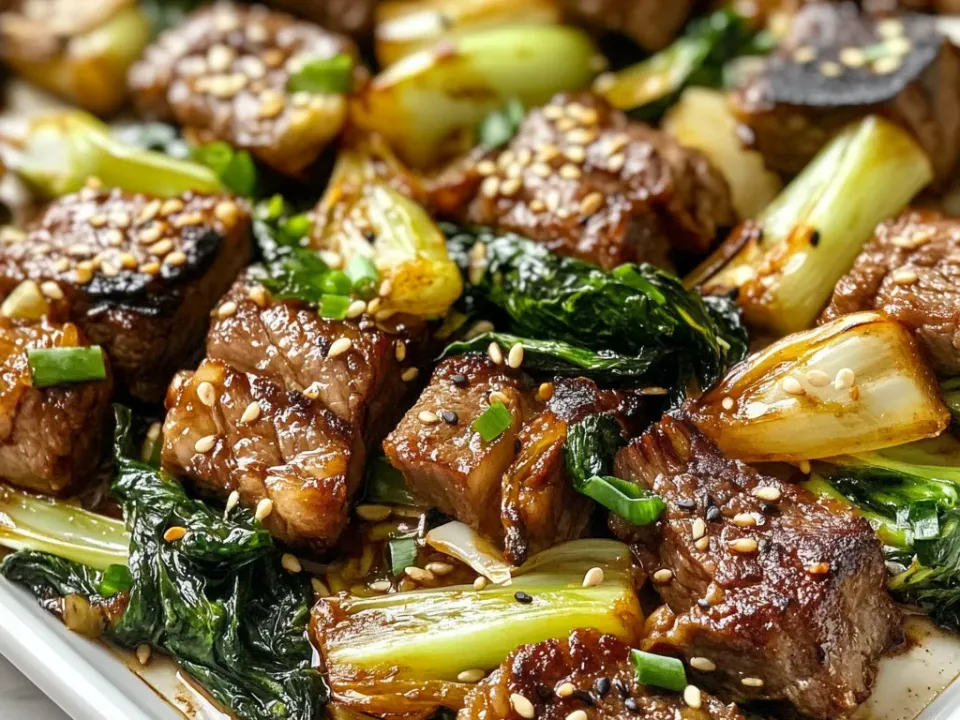
One sauce — soy, brown sugar, sesame oil, rice vinegar, garlic, ginger and a teaspoon of gochujang — split two ways.
Two thirds tosses a pound and a half of thinly sliced flank steak; the last third dresses a pound of halved baby bok choy, and both broil on the same pan for seven to nine minutes.
Why This Recipe Works
- A broiler rather than an oven. Flank steak sliced thin wants intense heat from close range for a few minutes; a conventional roast at any temperature would grey it before it browned.
- Six inches from the element, stated exactly. Closer and the brown sugar in the glaze scorches before the beef cooks; further and nothing chars.
- The sauce is split rather than doubled. Two thirds seasons the beef, a third dresses the bok choy, and one bowl does both — the vegetable gets the same flavour without a separate dressing.
- Neutral oil on the bok choy as well as the sauce. Sesame oil has a low smoke point and would burn under a broiler; the neutral oil carries the heat and the sesame flavour rides in on the sauce.
- A teaspoon of gochujang is small and load-bearing. It brings the fermented chilli depth that makes this read as Korean-style rather than as a generic soy glaze.
One Pan, Two Halves, One Sauce
The beef and the bok choy cook side by side under the same element for the same seven to nine minutes, but they are not doing the same thing — and the sauce is split two-thirds to one-third for exactly that reason.
The beef half of the pan
- Before it goes in
Thin slices tossed with two thirds of the soy, brown sugar, sesame oil, vinegar, garlic, ginger and gochujang, then spread in a single layer. Single layer is not a nicety — overlapping slices steam and go grey.
- 4 minutes, then tossed
The toss at the halfway mark is what gets colour on the second side. Broiler heat is entirely from above, so an untossed pan browns one face and poaches the other.
The bok choy half
- Before it goes in
Halved baby bok choy tossed with a tablespoon of neutral oil and the remaining third of the sauce. Neutral oil as well as the sauce, because sesame oil alone smokes at broiler heat.
- 4 minutes, then turned
Turned rather than tossed, so the cut faces meet the pan and char. That charring at the leaf edges is the point of using a broiler at all.
The last 3 to 5 minutes
Both halves go back under together until the beef is browned and the bok choy is charred at the edges. Sesame seeds and scallions go on off the heat, and it is served immediately — this is a dish that does not hold.
Ingredient Notes
- Flank steak, thinly sliced against the grain
- A pound and a half. Against the grain is the whole difference between tender and chewy in a cut this fibrous; partly freezing it for twenty minutes makes thin slicing far easier.
- Gochujang
- One teaspoon. Fermented Korean chilli paste — sweet, savoury and only mildly hot at this quantity. It is a defining ingredient, not a chilli substitute.
- Baby bok choy, halved
- A pound, halved lengthwise so the cut face can char. Full-sized bok choy would need quartering and longer.
- Fresh ginger, grated
- Two teaspoons, grated. Ginger is named in the recipe title and this is where it lives — ground ginger is not a substitute.
- Neutral oil
- A tablespoon, for the bok choy. Separate from the sesame oil in the sauce, which is a flavouring rather than a cooking fat here.
How to Make It
Set up the broiler
Heat the broiler to HIGH and place a rack 6 inches from the heat. Line a rimmed sheet pan with foil.
Make the sauce and dress the beef
Whisk soy sauce, brown sugar, sesame oil, rice vinegar, garlic, ginger and gochujang. Toss the beef with two-thirds of the sauce.
Dress the bok choy
Toss the bok choy with neutral oil and the remaining sauce and spread it on one side of the pan.
Add the beef
Spread the beef in a single layer on the other side.
Broil, turning at four minutes
Broil for 4 minutes, toss the beef and turn the bok choy, then broil for 3 to 5 minutes more, until the beef is browned and the bok choy is charred at the edges.
Finish and serve
Sprinkle with sesame seeds and scallions and serve immediately.
Success Tips
- Partly freeze the flank steak for twenty minutes before slicing it thin.
- Line the pan with foil — a brown sugar glaze under a broiler is otherwise a scrubbing job.
- Keep the beef in one layer and give the bok choy its own half of the pan.
- Stay at the oven; four minutes under a broiler moves fast.
- Serve it straight away — the char softens within minutes of leaving the pan.
Serving Ideas
Steamed short-grain rice and kimchi. It is a fast, sharp plate and it wants a plain starch beside it rather than another sauce.
Storage and Reheating
Refrigerate
Refrigerate in an airtight container for up to 2 days. The bok choy loses its char in the fridge and does not get it back.
Freeze
Freezing is not recommended. Thin broiled beef goes tough and bok choy collapses entirely.
Reheat
Reheat quickly in a very hot skillet rather than a microwave, just to warm through. Anything longer cooks the beef a second time.
Frequently Asked Questions
Can I roast it instead of broiling?
You would lose the char that the dish is built on. If your oven has no broiler, use the highest setting with the pan on the top shelf and expect less colour.
The beef came out chewy.
Almost always sliced with the grain rather than against it, or sliced too thick. Flank has long fibres and the knife is what tenderises it.
What if I cannot find gochujang?
It is a defining ingredient and there is no exact substitute. A little sriracha plus a pinch of miso gets closer than chilli flakes, but it is a different glaze.
Can I use another green?
Bok choy is named in the recipe and its halved stems are what hold up under a broiler. Broccolini behaves similarly if you cannot get it.