
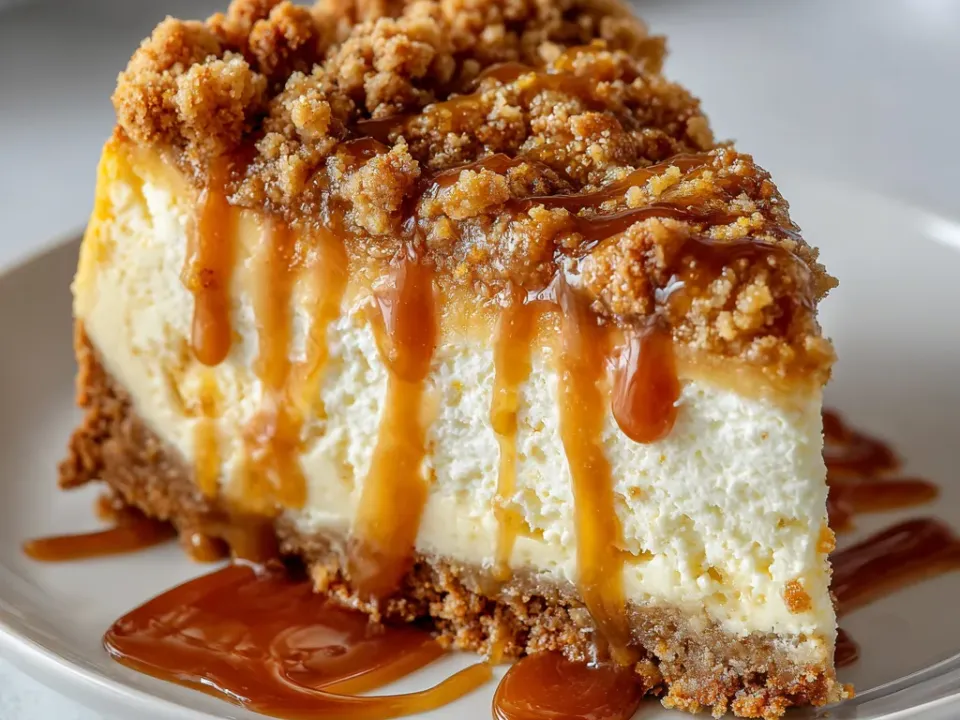
A baked cheesecake on a graham crust, with cinnamon-cooked apples and an oat crumble baked on top of it, finished after chilling with thick caramel and flaky salt.
Forty minutes of assembly, an hour and a quarter in a low oven, then a slow cool and a long chill. Twelve slices.
Why This Recipe Works
- Beating on LOW is stated explicitly, and it is the single most important instruction in the recipe. Air beaten into a cheesecake batter expands in the oven and then collapses as it cools, which is what cracks the surface.
- 325°F is a gentle oven for a cheesecake, and the doneness cue is a set edge with a slight wobble in the centre. A cheesecake baked until the middle is firm is already overbaked — it sets further as it cools.
- Turning the oven off and cracking the door for an hour is a controlled cool-down. A cheesecake taken straight from oven heat to room temperature contracts fast and splits down the middle.
- The apples are cooked first for five to seven minutes so they are just tender. Raw diced apple would release water into the filling during the bake and never soften properly under the crumble.
- Lemon juice with the apples does two things: it keeps them from browning while everything else is prepared, and its acidity sharpens what would otherwise be a very sweet layer.
The Five Layers, Bottom To Top
Four separate mixtures go into one tin, and each has to be ready at the right moment. Read from the base of the springform upward.
The caramel and salt, at the end
Half a cup of thick caramel and half a teaspoon of flaky sea salt, added after the four-hour chill and not before. Caramel drizzled onto a warm cheesecake simply runs off the edge.
The oat crumble
Flour, oats, brown sugar, cinnamon and cold cubed butter rubbed to coarse crumbs and scattered over the apples. This is the layer that makes it read as a pie rather than a plain cheesecake.
The cooked apples
Two firm apples diced and cooked with butter, brown sugar, cinnamon and lemon juice for five to seven minutes, then COOLED before they go on. Warm apples would begin setting the filling from above.
The cheesecake filling
Three blocks of cream cheese beaten with three quarters of a cup of sugar on LOW, then eggs one at a time, then sour cream and vanilla. Low speed throughout — whipped-in air is what makes a cheesecake rise, crack and then sink.
The graham crust
Two cups of crumbs with five tablespoons of melted butter and two of sugar, pressed in and blind-baked for ten minutes. That ten minutes sets the butter so the crust does not go soggy under the filling.
Ingredient Notes
- Cream cheese, three 8-ounce packages
- Full-fat block cream cheese, properly softened. Cold cream cheese will not beat smooth on low speed, and turning the mixer up to compensate is exactly what causes cracks.
- Firm apples
- Two medium, peeled and diced. Firm is the specification — a soft eating apple collapses to sauce in the five-to-seven-minute cook and again under the crumble.
- Cold unsalted butter, cubed
- Four tablespoons for the crumble, and cold. It is what keeps the topping in distinct crumbs rather than melting into a sheet.
- Thick caramel sauce
- Half a cup, and thick matters — a thin caramel runs straight off the crumble and pools at the base of the slice.
- Flaky sea salt
- Half a teaspoon, plus more to taste, scattered at the very end. Flaky rather than fine: you want visible crystals that dissolve on the tongue against the caramel.
How to Make It
Heat the oven and prepare the pan
Heat oven to 325°F. Wrap the outside of a 9-inch springform pan in heavy foil if using a water bath.
Press and bake the crust
Mix the graham crumbs, melted butter and 2 tablespoons sugar; press into the pan. Bake 10 minutes and cool slightly.
Cook the apples
Cook the diced apples with 2 tablespoons butter, 2 tablespoons brown sugar, cinnamon and lemon juice for 5 to 7 minutes, until just tender. Cool.
Beat the filling on low
Beat the cream cheese and 3/4 cup sugar on low until smooth. Beat in the eggs one at a time, then the sour cream and vanilla. Avoid whipping in excess air.
Fill and top with apples
Pour the filling over the crust and spoon the cooled apples over the top.
Make and scatter the crumble
Mix the flour, oats, 1/3 cup brown sugar, cinnamon and cold butter into coarse crumbs; scatter over the apples.
Bake, then cool in the oven
Bake 65 to 75 minutes, until the edges are set and the centre still has a slight wobble. Turn the oven off, crack the door, and cool 1 hour.
Chill thoroughly
Cool to room temperature, then refrigerate at least 4 hours.
Finish with caramel and salt
Drizzle with the caramel and sprinkle lightly with flaky sea salt before slicing.
Success Tips
- Soften the cream cheese properly and keep the mixer on low from start to finish.
- Add the eggs one at a time and stop as soon as each disappears.
- Cool the apples completely before they go on the filling.
- Judge doneness by the wobble in the centre, not by a firm top.
- Give it the full four hours in the fridge — a warm cheesecake will not slice cleanly whatever else you do.
Serving Ideas
Cold, in thin slices, with extra caramel and a little more flaky salt at the table. A hot knife wiped between cuts gives clean edges.
Storage and Reheating
Refrigerate
Refrigerate up to 5 days, covered. Add the caramel and salt shortly before serving if you want the crumble to stay crisp.
Freeze
Freeze the undrizzled cheesecake, whole or in slices, for up to 2 months. Thaw overnight in the fridge, then finish with caramel and salt.
Reheat
None — this is served cold. Twenty minutes out of the fridge takes the hard chill off without softening the set.
Frequently Asked Questions
Is this a no-bake cheesecake?
No. It is baked at 325°F for sixty-five to seventy-five minutes, cooled for an hour in the switched-off oven and then chilled for at least four hours. Every one of those stages is part of how it sets.
Do I need a water bath?
The recipe treats it as optional — that is why step 1 says to foil the pan 'if using a water bath'. It gives a gentler, more even bake and reduces the chance of cracking, but the slow oven cool-down does much of the same job.
My cheesecake cracked. What went wrong?
Usually air beaten into the batter, or cooling too fast. Keep the mixer on low the whole way, and do not skip turning the oven off and cracking the door for an hour. A crack under the crumble is largely hidden in any case.
Can I slice it after two hours in the fridge?
It will not hold a clean slice. Four hours is the minimum stated and overnight is better — this is a tall, soft-set cheesecake and the chill is what firms it.