
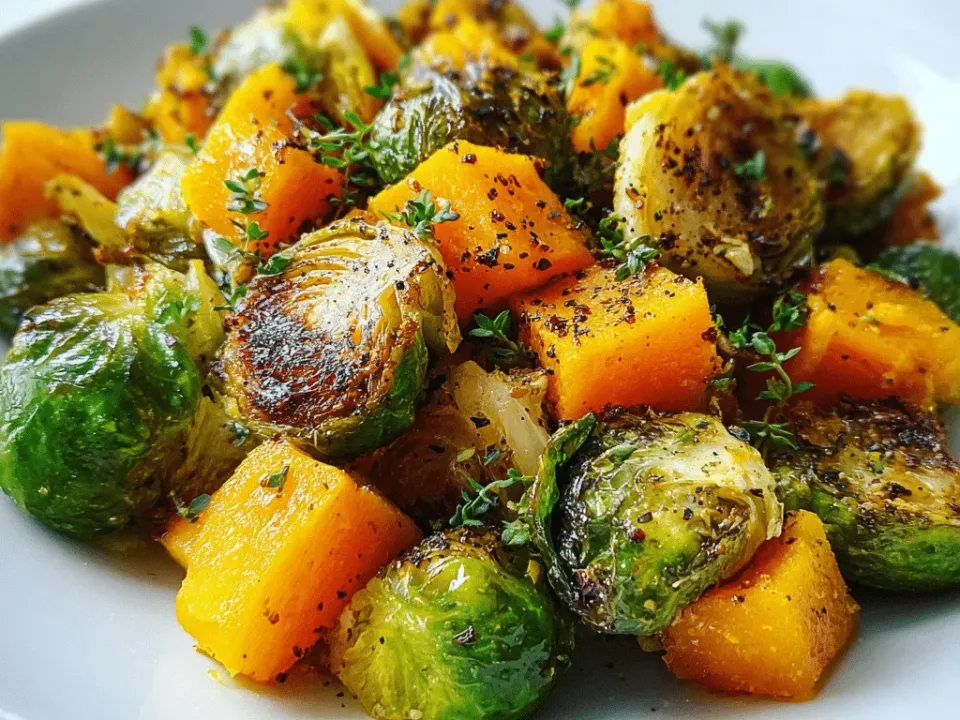
Halved Brussels sprouts and cubed butternut squash roasted on a preheated sheet pan until both are properly browned, then glazed with equal parts maple syrup and balsamic vinegar.
Fifteen minutes of trimming and chopping, half an hour of roasting, and a three-to-five-minute glaze at the end.
Why This Recipe Works
- Preheating the empty sheet pan means the vegetables start searing the instant they land. On a cold pan they spend the first ten minutes releasing moisture and steaming in it, which is how sprouts end up soft and grey.
- A single layer is not a presentation note. Vegetables touching each other trap steam between them, and steam is the enemy of the browning that makes this dish worth cooking.
- The glaze goes on at the end for three to five minutes only. Maple syrup and balsamic both contain enough sugar to burn over half an hour at 425°F, and both need only a brief heat to become sticky.
- Equal parts maple and balsamic keep this a savoury side. A tablespoon of each against two and a half pounds of vegetables is a seasoning quantity, not a sauce.
- Sprouts halved and squash cubed to three-quarters of an inch is what lets two very different vegetables finish at the same time in one pan.
Why This Is Not A Sweet Side
There is maple syrup in this recipe and it is emphatically not a sweet dish. Each axis below is holding another one down, and the balance is what keeps it on the savoury side of the table.
- Bitter and green1 lb Brussels sprouts, trimmed and halved
- Sprouts are the backbone. Halved rather than whole, so every one has a flat cut face that browns hard — and roasted browning is what converts their bitterness into something nutty rather than merely masking it.
- Sweet and starchy1 1/2 lbs butternut squash in 3/4-inch cubes
- The squash supplies the sweetness the sprouts do not have, which is why this pan needs no sugar of its own. A pound and a half against a pound of sprouts keeps the squash a partner rather than the star.
- Acid1 tbsp balsamic vinegar
- Equal to the maple, and that equality is the whole design. Balsamic on its own would be too sharp against sprouts; maple on its own would tip the pan into dessert territory.
- Herb and warmth1 tsp dried thyme, 1/2 tsp black pepper
- Both go on before roasting so they toast into the oil. Thyme is the savoury anchor here, and a full half teaspoon of pepper is more than most vegetable sides carry — deliberately.
Whisk the maple and balsamic together before they go near the pan, and add them only in the last three to five minutes. Poured on at the start, the sugar in both would burn long before the vegetables were tender.
Ingredient Notes
- Brussels sprouts, trimmed and halved
- A pound. Halved rather than quartered or whole — the flat face is what makes contact with the hot pan, and that contact is the entire technique.
- Butternut squash, 3/4-inch cubes
- A pound and a half, cut to roughly the thickness of a halved sprout so the two cook at the same rate.
- Pure maple syrup
- One tablespoon, and pure rather than pancake syrup — there is nowhere for an artificial flavour to hide in a two-ingredient glaze.
- Balsamic vinegar
- One tablespoon, matched exactly to the maple. An older, thicker balsamic clings better but a standard supermarket one is what the quantities assume.
- Olive oil
- Two and a half tablespoons for two and a half pounds of vegetables — enough to coat without pooling. Pooled oil fries rather than roasts.
How to Make It
Preheat the oven with the pan inside
Heat oven to 425°F and place a large rimmed sheet pan in the oven while it heats.
Season the vegetables
Toss the Brussels sprouts and squash with the olive oil, salt, pepper and thyme.
Spread them on the hot pan
Carefully spread the vegetables on the hot sheet pan in a single layer.
Roast
Roast 25 to 30 minutes, turning once, until browned and tender.
Whisk the glaze
Whisk the maple syrup and balsamic vinegar together.
Glaze and return to the oven
Drizzle over the roasted vegetables, toss, and return to the oven for 3 to 5 minutes.
Finish and serve
Finish with the optional pecans and serve.
Success Tips
- Put the empty pan in as the oven starts heating so it is genuinely hot, not merely warm.
- Season and toss the vegetables in a bowl while the pan heats, so they can go straight on.
- Listen for a sizzle as they land — no sizzle means the pan was not hot enough.
- Turn them once at the halfway mark and then leave them alone.
- Hold the glaze back until the last few minutes; early sugar is burnt sugar.
Serving Ideas
A roast-dinner side that also does well on a holiday table. The glaze means it holds up next to strong flavours rather than getting lost beside them.
Storage and Reheating
Refrigerate
Refrigerate up to 3 days. The glaze keeps the vegetables from drying out in the fridge.
Freeze
Not recommended. Both sprouts and squash go limp and watery after freezing.
Reheat
Spread on a pan in a hot oven for five to eight minutes to bring back some crisp edges. The microwave will heat it but the texture goes.
Frequently Asked Questions
Do I really need to preheat the pan?
It is the difference between browned and beige. A hot pan sears the cut faces immediately; a cold one lets the vegetables release moisture and steam in it for the first ten minutes. You can skip it, but you will notice.
Should there be cranberries or feta in this?
No. That is the honey-roasted squash recipe, which has no sprouts. This one is savoury, with a maple-balsamic glaze and optional pecans as the only additions.
Why did my sprouts come out soft rather than crisp?
Almost always overcrowding. Two and a half pounds of vegetables needs a genuinely large pan, and if they are touching everywhere they will steam. Use two pans rather than piling one.
Can I use frozen sprouts or squash?
They carry far too much water for this method and will not brown at all. This recipe depends on dry surfaces meeting a hot pan.