
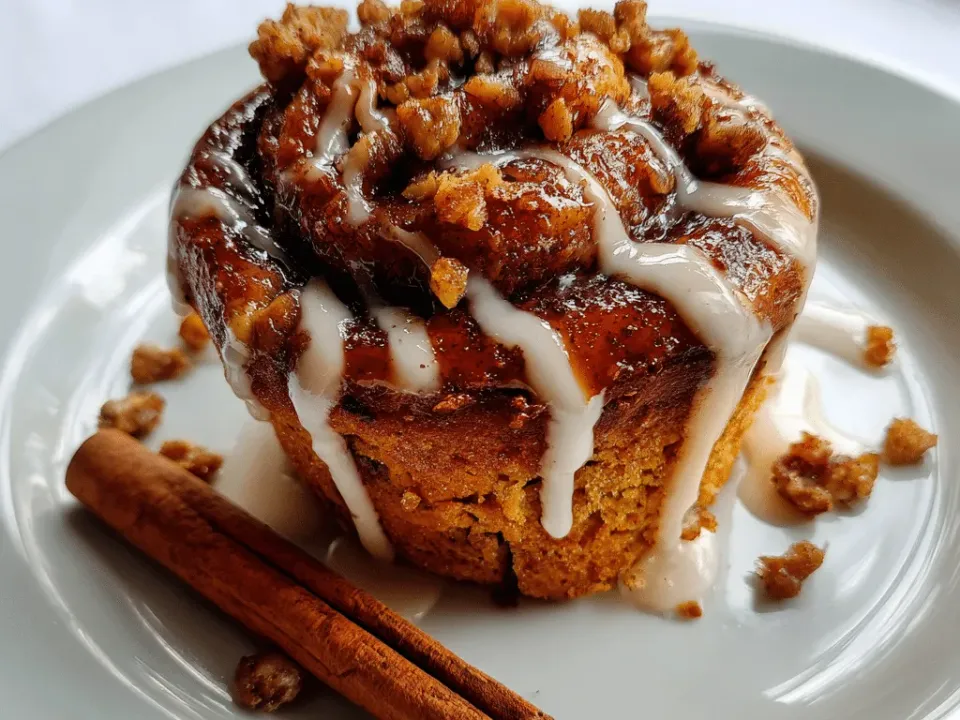
The flavour of a pumpkin cinnamon roll in a muffin — a swirl of brown sugar and cinnamon layered through the batter and a vanilla glaze over the top.
About forty-five minutes start to finish, and no yeast, no rising and no rolling.
Why This Recipe Works
- Oil rather than butter in the batter keeps the crumb soft for days, which matters in a muffin that carries a glaze and is likely to be eaten over more than one morning. The butter in this recipe is in the swirl, where it belongs.
- Both baking powder and baking soda appear here. The soda reacts with the pumpkin and brown sugar; the powder provides a second, later lift that keeps the crumb open around a heavy sugar layer.
- The swirl repeats cinnamon from the batter at three times the strength — a teaspoon in the batter, a teaspoon and a half in the swirl alone. That contrast is what makes the stripe taste like a distinct layer rather than more of the same.
- The glaze is thin by design: three quarters of a cup of powdered sugar to one or two tablespoons of milk. Thick glaze on a muffin reads as frosting and turns it into a cupcake.
How the Swirl Gets Inside
A cinnamon roll gets its spiral from rolled dough. A muffin cannot be rolled, so the effect is built in layers instead — and step 4 does three separate things that are easy to read as one.
Half-fill the cups
Batter to halfway, not to the top. This is the floor of the muffin and it needs to be deep enough to hold the swirl above the base rather than letting it sink to the bottom and burn against the tin.
A layer of swirl
Brown sugar, cinnamon and melted butter spooned across the batter. The melted butter is what makes this a swirl rather than a dry seam — it keeps the sugar from simply dissolving into the crumb and disappearing.
The remaining batter over the top
Sealing the swirl inside. At this point there are three distinct layers in the cup and the muffin would bake perfectly well like that, with a hidden stripe through the middle.
Swirl the top with a knife
One or two passes, no more. This is what brings some of the cinnamon layer up to the surface so the baked muffin looks marbled rather than plain. Over-swirl and the layers blend into a uniformly brown batter and the effect is lost entirely.
The glaze goes on cooled, never warm. Poured onto a hot muffin it thins, runs off the sides and soaks in; on a cooled one it sets as a white line, which is what makes it read as a cinnamon roll.
Ingredient Notes
- Brown sugar and cinnamon appearing twice
- Not a duplication. The recipe has three components — batter, swirl and glaze — and lists them separately for that reason.
- Melted butter in the swirl
- Two tablespoons, and the only butter in the recipe. It binds the sugar into a layer instead of letting it dissolve away.
- Neutral oil
- Half a cup, in the batter. Neutral rather than olive, and oil rather than butter, for a crumb that stays soft.
- 1 to 2 tablespoons of milk in the glaze
- A range because glaze consistency is judged by eye. Start at one and add the second only if it is too stiff to drizzle.
How to Make It
Mix the swirl
Combine the 1/3 cup brown sugar, 1 1/2 tsp cinnamon and melted butter.
Whisk dry and wet separately
Whisk the flour, baking powder, baking soda, salt, cinnamon and pumpkin pie spice in one bowl; the eggs, pumpkin, brown sugar, sugar, oil and vanilla in another.
Fold
Fold the two together just until combined.
Layer and swirl
Half-fill the muffin cups, add the swirl mixture, top with the remaining batter and swirl the tops with a knife.
Bake
Bake at 350°F for 18 to 21 minutes.
Cool
Cool the muffins completely.
Glaze
Whisk the powdered sugar, milk and vanilla and drizzle over.
Success Tips
- Have the swirl mixed before the batter is.
- Fold only until the flour disappears.
- One or two knife passes for the swirl, not ten.
- Cool completely before glazing.
Serving Ideas
Warm, with coffee, on a morning when actual cinnamon rolls are too much work. They keep well enough to bake the night before.
Storage and Reheating
Refrigerate
Airtight at room temperature up to 3 days. The glaze softens slightly but stays put on an oil-based crumb.
Freeze
Freeze unglazed up to 3 months, then thaw and glaze fresh. A frozen glaze goes cloudy and weeps as it thaws.
Reheat
A few seconds in a microwave. Longer than that and the glaze melts off entirely.
Frequently Asked Questions
The cinnamon layer sank to the bottom.
The cups were not filled deeply enough before the swirl went in, or the batter was too loose from overmixing. Half-fill properly and stop folding as soon as the flour disappears — a slightly thick batter holds the layer where you put it.
My muffins came out uniformly brown with no marbling.
Over-swirled. One or two passes with a knife is the whole instruction; anything more mixes the layers into a single shade. The effect comes from leaving most of the swirl intact.
The glaze slid straight off.
The muffins were still warm. Glaze thins on contact with heat and soaks in rather than setting — cool them completely, which the method specifies as its own step for exactly this reason.