
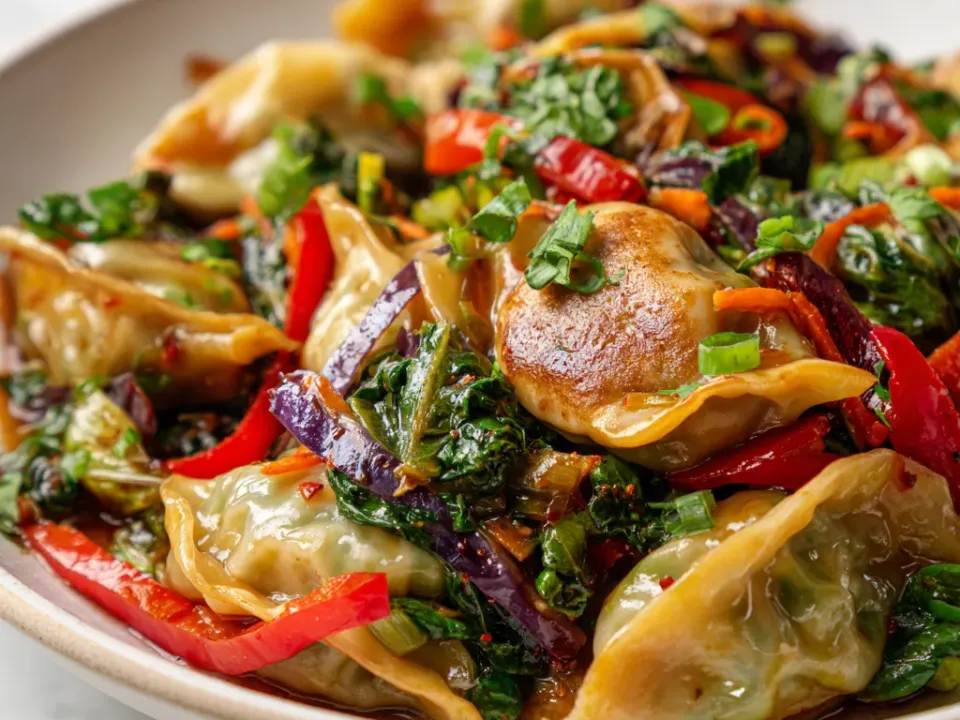
The sauce is whisked first — soy, rice vinegar, hoisin, brown sugar, broth and optional chilli-garlic — and set aside before anything is cooked.
Frozen potstickers are seared flat-side down, steamed under a lid with a quarter cup of water and moved to a plate; onion, cabbage, bell pepper and snap peas take their place, then garlic and ginger, and the potstickers come back for the sauce and slurry.
Why This Recipe Works
- The potstickers go in frozen. There is no thawing step anywhere in the recipe — straight from the freezer, flat-side down, is how the wrapper crisps before the filling has to heat through.
- Sear then steam, in that order and in the same pan. It is the classic potsticker method: a crisp base from dry heat, then steam to cook the filling and the top of the wrapper.
- They come out before the vegetables go in. Two or three minutes of stir-frying with cabbage and peppers would tear them; setting them aside is what lets the vegetables be cooked properly.
- A separate cornstarch slurry rather than cornstarch in the sauce. The sauce goes in first and coats everything, and only then is it thickened — which is how the vegetables and dumplings end up glazed rather than sitting in gravy.
- White and green parts of the spring onions are separated in the ingredient list. Whites cook with the aromatics for thirty seconds; greens go on raw at the end.
- Sesame oil twice: a teaspoon early in the list and more to finish. Toasted sesame oil loses its aroma over heat, so the finishing drizzle goes on with the burner already off.
One Pan, The Potstickers Twice
Everything happens in the same skillet, but the potstickers go through it twice and the vegetables only once. Laid out as two passes, the reason for the plate in the middle of the recipe becomes obvious.
Pass one — the potstickers
- 2–3 minutes
Frozen, flat-side down in hot neutral oil, until golden. Nothing else is in the pan.
- 2–3 minutes
A quarter cup of water in, lid on, steamed through. Then out to a plate to keep warm.
Pass two — the vegetables
- 2–3 minutes
Onion, cabbage, bell pepper and snap peas in the same skillet until crisp-tender, with a drizzle more oil if needed.
- 30 seconds
Garlic, ginger and the white parts of the green onions, until fragrant.
Back together for the sauce
The potstickers return to the pan, the whisked sauce goes in and everything is tossed gently to coat. The cornstarch slurry follows and simmers 1–2 minutes until the sauce is glossy and clings. Heat off, sesame oil drizzled over, green onion tops and sesame seeds on.
How to Make It
Whisk the sauce first
In a bowl, combine the soy sauce, rice vinegar, hoisin, brown sugar, broth and chili-garlic sauce. Set aside.
Sear the potstickers
Heat the neutral oil in a large nonstick skillet over medium-high. Arrange the frozen potstickers flat-side down; cook 2–3 minutes until golden.
Steam them briefly
Add 1/4 cup water, cover and steam 2–3 minutes. Transfer the potstickers to a plate and keep warm.
Stir-fry the vegetables
In the same skillet, add a drizzle of oil if needed. Cook the onion, cabbage, bell pepper and snap peas 2–3 minutes until crisp-tender. Add the garlic, ginger and white parts of the green onions; cook 30 seconds until fragrant.
Sauce it
Return the potstickers to the pan. Pour in the sauce and toss gently to coat.
Thicken
Stir in the cornstarch slurry; simmer 1–2 minutes until the sauce is glossy and clings to the potstickers and vegetables.
Finish and serve
Turn off the heat, drizzle with sesame oil and sprinkle the green onion tops and sesame seeds. Serve with lime wedges and rice if desired.
Ingredient Notes
- Frozen potstickers (pork, chicken, or veggie)
- A pound, used frozen. The recipe names all three fillings as equal options, so the dish is straightforwardly vegetarian with the veggie ones and vegetable broth.
- Water (for steaming potstickers)
- A quarter cup, and it has its own line because it is a method ingredient rather than part of the sauce. It goes into a hot pan under a lid.
- Cornstarch mixed with water (slurry)
- A teaspoon in a tablespoon of water, added after the sauce rather than mixed into it. That order is what gives a glaze instead of a gravy.
- Toasted sesame oil, plus more to finish
- A teaspoon in the cooking and more at the end. The finishing drizzle goes on with the heat off, where its aroma survives.
- Green onions, white and green parts separated
- Three, and the separation is written into the ingredient line. Whites are an aromatic; greens are a garnish.
- Sauce: low-sodium soy sauce or tamari
- A third of a cup. Low-sodium matters against a third of a cup plus hoisin — this is the salt in the whole dish.
Success Tips
- Have the sauce whisked before the pan is hot; there is no pause later.
- Arrange the potstickers flat-side down and leave them alone for the full sear.
- Stand back when the water goes into the hot pan, and get the lid on quickly.
- Toss gently once the dumplings are back — they tear easily.
- Save the sesame oil drizzle until the burner is off.
Serving Ideas
Lime wedges and rice, as the last step offers. The sauce is generous enough that plain rice earns its place, and the lime cuts the hoisin.
Storage and Reheating
Refrigerate
Refrigerate in an airtight container for up to 2 days. The wrappers soften in the sauce overnight, which is the limit on how well this keeps.
Freeze
Not recommended. The potstickers have already been cooked from frozen once and the wrappers do not survive a second round.
Reheat
Reheat quickly in a hot pan rather than a microwave, adding a splash of water to loosen the sauce.
Frequently Asked Questions
Should I thaw the potstickers?
No — the recipe uses them frozen and sears them straight from the freezer. Thawed dumplings stick and tear when you try to turn them.
Can this be vegetarian?
Yes. The recipe names veggie potstickers as one of the three options and offers vegetable broth in the sauce.
Is a bagged coleslaw mix acceptable?
The recipe offers it directly — two cups of shredded cabbage or coleslaw mix, either one.
The sauce stayed thin.
The slurry needs a simmer to work. Step 6 gives it 1 to 2 minutes, and the cue is that the sauce turns glossy and clings rather than pooling.