
Eleven ingredients and eight hours and twenty minutes, twenty of which you are in the room for.
The potatoes go in whole and come out whole. The roast goes in whole and is served that way.
Why This Recipe Works
- Searing before the cooker goes on is the only browning the beef will get.
- Eight hours on LOW takes chuck past tough and into pulling at the edges.
- Whole small potatoes survive that long where cut ones would fall apart.
- Thick carrot batons hold their shape and their colour across the same time.
- A small amount of slurry gives a gravy that pools rather than coats.
Ingredient Notes
- Chuck roast
- Three and a half pounds, seared before it goes in. A slow cooker cannot brown anything, so this is the only chance the beef has to build colour.
- Small Yukon Gold potatoes, left whole
- A pound, uncut. Whole is what lets them last eight hours and still be lifted onto the plate intact.
- Carrots, cut into thick batons
- Four large ones. Thick rather than sliced — thin rounds disappear entirely over a long cook.
- Cornstarch and cold water
- Two tablespoons each, and only a little of it is used. This gravy is meant to pool on the plate rather than coat the meat.
How to Make It
Chuck roast seasoned and seared deeply on all sides
Season chuck roast with salt and pepper and sear it in olive oil until deeply browned on all sides.
The whole roast into the cooker with broth and Worcestershire
Place the whole roast in a slow cooker with broth and Worcestershire sauce.
Whole potatoes and thick carrot batons arranged around it
Add whole small potatoes and thick carrot batons around the roast.
Cooked on LOW eight hours until fork-tender at the edges
Cook on LOW 8 hours, until the beef is well beyond the minimum temperature and fork-tender at the edges.
Everything to a platter, a little slurry whisked in for a thin gravy
Transfer roast and vegetables to a platter. For a thin pooling gravy, whisk only a small amount of cornstarch slurry into the cooking liquid and simmer briefly rather than thickening heavily.
Served as one piece, pulled slightly at the edges, parsley over
Serve the roast as one piece, pulling slightly at the edges, with whole potatoes, carrots, thin gravy, and chopped parsley.
Five Points Where This Roast Could Become a Different One
This pot roast arrives at the table whole and pulling in a thin gravy. The recipe protects that in a single sentence: DO NOT SHRED OR SLICE THE ROAST BEFORE PRESENTATION; KEEP THE GRAVY THIN AND THE POTATOES WHOLE. Each checkpoint below is a place where an ordinary habit would quietly change the dish.
Before the cooker is switched on
Is the 3 1/2 lb CHUCK ROAST DEEPLY BROWNED ON ALL SIDES in 1 tbsp OLIVE OIL?
A slow cooker holds a gentle wet heat and cannot brown anything at all. Whatever colour the beef has when the lid goes on is the colour it will have eight hours later, and you want a deeply browned exterior. Season with 1 1/2 tsp KOSHER SALT and 1 tsp BLACK PEPPER first and take the sear further than feels necessary.
As the vegetables go in
Are the potatoes WHOLE and the carrots in THICK BATONS, arranged AROUND the roast?
1 lb of SMALL YUKON GOLD POTATOES LEFT WHOLE and 4 LARGE CARROTS CUT INTO THICK BATONS. Cutting either one down is the habit to resist: eight hours on LOW would reduce halved potatoes and sliced carrots to fragments in the liquid, and you want whole golden potatoes and thick orange batons sitting intact on the plate.
At eight hours
Is the beef FORK-TENDER AT THE EDGES?
COOKED ON LOW 8 HOURS, UNTIL THE BEEF IS WELL BEYOND THE MINIMUM TEMPERATURE AND FORK-TENDER AT THE EDGES. USDA gives whole-cut beef a 145°F minimum with a 3-MINUTE REST, and a pot roast runs well past it. Tenderness is the cue here rather than a number - the roast is done when its edges give and begin to pull.
When the gravy is made
Was only A SMALL AMOUNT of the slurry used, and simmered BRIEFLY?
2 tbsp CORNSTARCH whisked with 2 tbsp COLD WATER, and the recipe says to whisk ONLY A SMALL AMOUNT of it into the cooking liquid RATHER THAN THICKENING HEAVILY. This is the point where a pot roast usually turns into something else. Here the gravy stays THIN AND POOLING on the plate. Add it a spoonful at a time; you cannot take it back out.
On the plate
Is the roast still ONE PIECE?
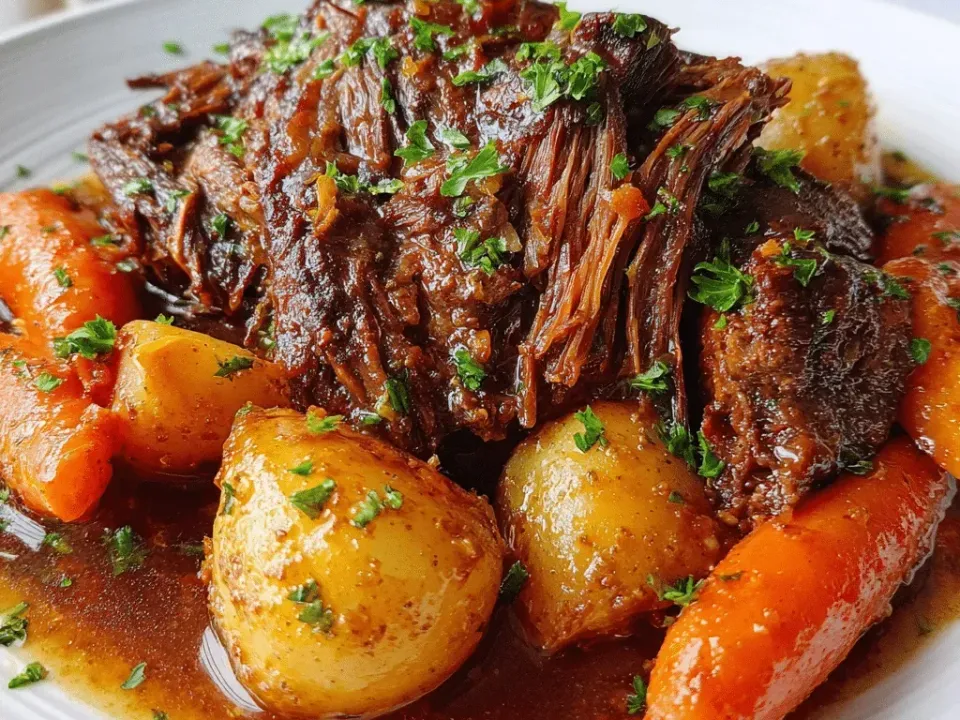
SERVED AS ONE PIECE, PULLING SLIGHTLY AT THE EDGES. Not shredded and not sliced. The roast goes onto the platter whole, the whole potatoes and carrots go around it, the thin gravy pools, and 1/4 cup of CHOPPED PARSLEY is scattered heavily over - a component the title does not name.
Success Tips
- Take the sear as far as it will go before the roast goes in the cooker.
- Leave the potatoes whole; halving them costs you the shape on the plate.
- Add the slurry a spoonful at a time — this gravy is easy to overthicken.
Serving Ideas
Six servings from one whole braised roast, deeply browned and pulling into strands at its edges, surrounded by whole soft golden potatoes and thick orange carrot batons in a thin brown gravy pooling on the plate, scattered heavily with chopped parsley.
Frequently Asked Questions
Should I shred the roast before serving?
No. It is served as one piece, pulling slightly at the edges. Shredding it, or slicing it, makes a different dish — the whole roast surrounded by whole vegetables is what this recipe produces.
Why is the gravy so thin?
Deliberately. Only a small amount of the cornstarch slurry goes in and it is simmered briefly. The gravy is meant to pool around the roast and the vegetables rather than coat them.
How do I know when it is done?
Fork-tender at the edges. Whole-cut beef has a 145 degrees Fahrenheit minimum with a three-minute rest, but a pot roast is taken well past that point — tenderness is the cue, not the thermometer.