
Eleven items and forty minutes, starting in an oven-safe pan and finishing in the oven.
The two vegetables that need cooking get it before any egg arrives. Everything else is arranged rather than cooked.
Why This Recipe Works
- Softening the red onion first takes its raw bite out of a set egg.
- Wilting spinach only briefly stops it releasing water into the custard.
- Milk whisked into the eggs keeps the set tender rather than rubbery.
- Feta scattered on top stays in visible white crumbles instead of dissolving.
- Twenty to twenty-five minutes at 375°F sets the centre without browning the edges hard.
Ingredient Notes
- Roasted red pepper strips
- Half a cup. Pepper rather than tomato — strips, arranged in the pan before the egg goes in so they stay visible at the surface.
- Pitted Kalamata olives
- Half a cup, whole rather than sliced. The title names no olive, and they are among the most visible things in the finished wedge.
- Crumbled feta
- Three quarters of a cup, scattered over the top rather than stirred through, so it stays in white crumbles.
- Baby spinach
- Two cups, wilted only just. Cooked further it releases water and the custard sets loose.
How to Make It
Oven to 375°F
Heat oven to 375°F.
Eggs whisked with milk, salt and pepper
Whisk eggs, milk, salt, and pepper.
Red onion softened in an oven-safe round pan, spinach just wilted
Cook red onion in oil in an oven-safe round skillet or dish until softened; add spinach just to wilt.
Peppers and olives arranged, egg poured in, feta over the top
Arrange roasted red pepper strips and olives, pour in egg mixture, and scatter feta over the top.
Baked twenty to twenty-five minutes to a fully set 160°F centre
Bake 20 to 25 minutes until fully set and the center reaches 160°F.
Rested five minutes, cut into wedges, rosemary on the plate
Rest 5 minutes, cut into wedges, and garnish with rosemary.
Cooked Twice, and Only Two Things Need the First Round
Eleven items go into this and only two of them are ever cooked before the oven. Knowing which two - and why the other four are simply arranged - is most of what separates a frittata that sets clean from one that weeps water into the plate.
Stage 1 of 5
The custard - 8 eggs and MILK, whisked first
Steps 2–2 of 6
8 large EGGS with 1/3 cup MILK, 1/2 tsp salt and 1/4 tsp pepper, whisked before the pan is even hot. The milk is not padding: eggs baked alone set firm and faintly rubbery, and a third of a cup across eight eggs is what keeps the finished wedge tender enough to cut cleanly. Whisked properly, too - streaks of unmixed white show up as pale patches in a set custard.
- Eggs whisked with milk, salt and pepperWhisk eggs, milk, salt, and pepper.
Stage 2 of 5
The only two things that get cooked
Steps 3–3 of 6
1/2 a RED ONION, thinly sliced, cooked in 1 tbsp of oil UNTIL SOFTENED - raw onion in a set egg stays sharp and crunches. Then 2 cups of BABY SPINACH added JUST TO WILT. Just is the whole instruction: spinach holds a great deal of water, and every extra minute in the pan pushes more of it into a custard that has to set. Wilted means collapsed and no further. This all happens in an OVEN-SAFE round skillet or dish, because the pan does not change hands later.
- Red onion softened in an oven-safe round pan, spinach just wiltedCook red onion in oil in an oven-safe round skillet or dish until softened; add spinach just to wilt.
Stage 3 of 5
The other three are ARRANGED, not cooked
Steps 4–4 of 6
1/2 cup of ROASTED RED PEPPER STRIPS - roasted pepper, not tomato - and 1/2 cup of WHOLE pitted KALAMATA OLIVES, laid in place BEFORE the egg is poured over them. Arranged rather than stirred is what keeps them visible in the finished wedge instead of buried. Then the egg goes in, and 3/4 cup of crumbled FETA is scattered ON TOP, where it stays in white crumbles rather than dissolving into the custard. Olives, feta and red onion are three components the title names none of.
- Peppers and olives arranged, egg poured in, feta over the topArrange roasted red pepper strips and olives, pour in egg mixture, and scatter feta over the top.
Stage 4 of 5
The bake - to a NUMBER, not a look
Steps 5–5 of 6
20 to 25 MINUTES at 375°F, UNTIL FULLY SET AND THE CENTER REACHES 160°F. Both halves of that are the safety standard for a baked egg dish, and the centre is the part worth measuring - the edges of a round dish set well before the middle does, so a frittata that looks done at the rim can still be liquid at its centre. 375F rather than hotter is deliberate: a fierce oven browns the outside before the middle catches up.
- Baked twenty to twenty-five minutes to a fully set 160°F centreBake 20 to 25 minutes until fully set and the center reaches 160°F.
Stage 5 of 5
5 minutes' rest, then WEDGES
Steps 6–6 of 6
Rested before it is cut. A frittata straight from the oven is still firming and tears rather than slices. Then CUT INTO WEDGES - baked round in the dish and cut, never folded over like an omelette. ROSEMARY SPRIGS go on the plate at the end as a garnish. This is Mediterranean-STYLE cooking, not a traditional regional recipe.
- Rested five minutes, cut into wedges, rosemary on the plateRest 5 minutes, cut into wedges, and garnish with rosemary.
Success Tips
- Wilt the spinach only until it collapses — longer and it waters down the egg.
- Use a genuinely oven-safe pan; this goes from the hob straight into a 375°F oven.
- Check the centre with a thermometer rather than by eye; 160°F is the endpoint.
Serving Ideas
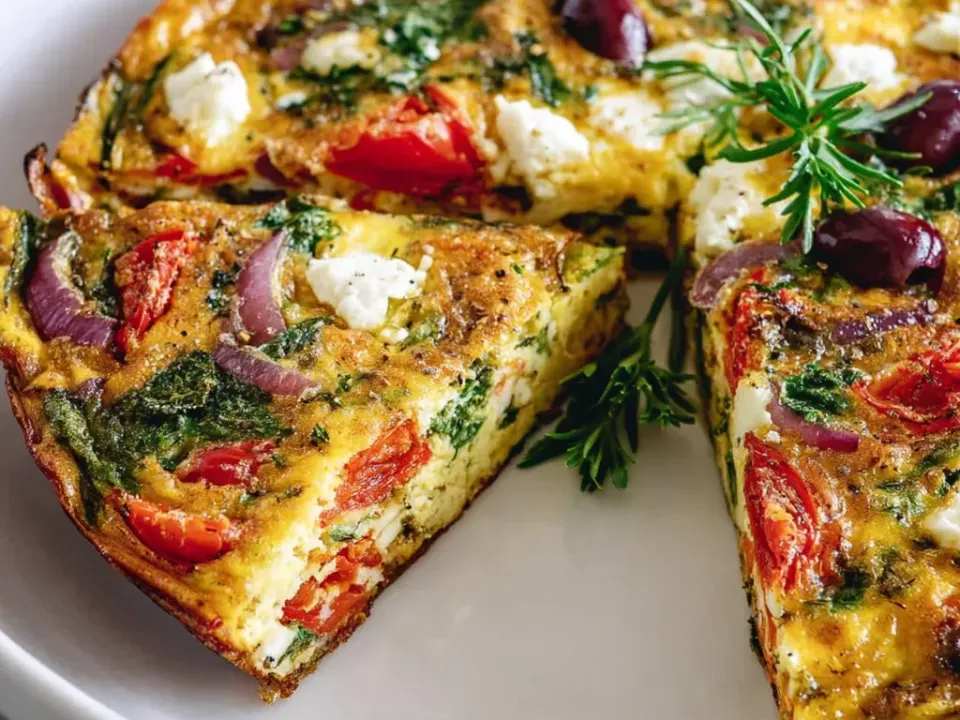
Six wedges from a round dish, deeply golden at the edges, with crumbled feta, whole dark olives, roasted red pepper strips, sliced red onion and wilted spinach through the set egg, rosemary sprigs on the plate.
Frequently Asked Questions
Are the red strips pepper or tomato?
Roasted red pepper. Half a cup of strips, arranged in the pan before the egg is poured over so they stay at the surface.
Is this folded like an omelette?
No. It is baked round in the dish and cut into wedges — the finished frittata is a set round with one wedge lifted out.
Is this a traditional Mediterranean recipe?
It is Mediterranean-style. This recipe makes no claim of region, tradition or authenticity.