
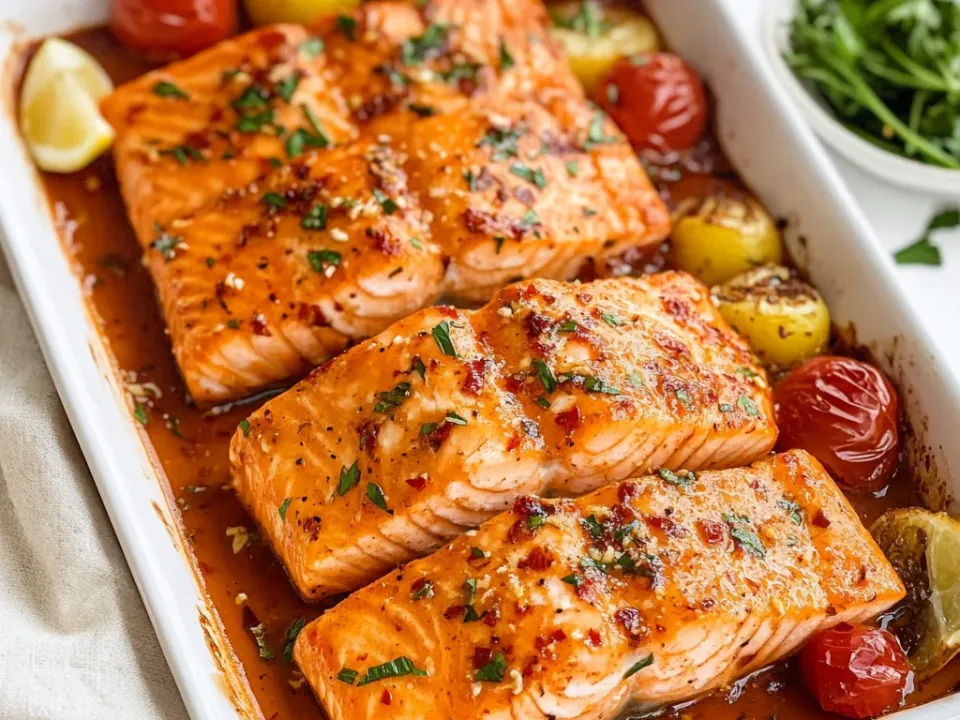
Maple syrup, Dijon, soy sauce, olive oil, garlic and smoked paprika whisked into a glaze, brushed generously over four salmon fillets on a lined sheet pan.
Ten to fourteen minutes at 425°F with a second brushing halfway, out at 145°F, and lemon wedges at the table.
Why This Recipe Works
- 425°F and a short roast. Salmon at a high heat sets its surface quickly and stays moist inside; a gentler oven gives the glaze time to dry out before the fish is done.
- The glaze goes on twice. The first coat cooks into the fillet and the second, at the halfway mark, is what gives the finished lacquer — one heavy coat at the start would scorch.
- Dijon is doing structural work as well as flavour. Mustard is an emulsifier, and it is what holds oil and maple syrup together as a glaze that brushes rather than separates.
- Skin-side down, on parchment. The skin protects the underside from the pan's direct heat, and parchment means a sugar glaze does not weld itself to the tray.
- A temperature, not a time. Step 4 gives a four-minute range because fillet thickness varies more than ovens do, and step 5 gives the number that actually decides.
Five Things In A Glaze, And What Each One Stops
The glaze is the recipe — the salmon is just roasted. Two tablespoons of maple syrup on their own would be sweet and one-note, and each of the other four ingredients exists to stop that happening.
- Sweet, and the lead2 tablespoons pure maple syrup
- The largest measure and deliberately so: this is a maple-forward glaze. Pure maple rather than pancake syrup, which is corn syrup with flavouring and caramelises differently.
- Sharp1 tablespoon Dijon mustard
- Equal parts with the soy against twice as much maple. It cuts the sweetness and, just as usefully, emulsifies the glaze so it clings to the fillet instead of running off it.
- Salt and depth1 tablespoon low-sodium soy sauce
- The only salt in the recipe. Low-sodium matters at this ratio — a standard soy in a two-tablespoon glaze would overwhelm the maple it is meant to support.
- Smoke1/2 teaspoon smoked paprika
- Half a teaspoon does the work a grill would. It is what keeps an oven-roasted glazed salmon from tasting purely of syrup.
- Fresh acidity, at the table1 lemon, cut into wedges
- Not in the glaze — squeezed over at serving. Acid added before roasting would be cooked away; added after, it lifts the whole plate.
There is no added salt beyond the soy sauce. Taste the glaze before it goes on if your soy is a strong one.
Ingredient Notes
- Pure maple syrup
- Two tablespoons, and pure rather than pancake syrup. It is the lead flavour and the thing the recipe is named for.
- Salmon fillets, 5 to 6 ounces
- Four of them. Even thickness matters more than exact weight, because thickness is what the ten-to-fourteen-minute range is about.
- Dijon mustard
- A tablespoon. It sharpens the glaze and emulsifies it; wholegrain would not bind the oil and syrup the same way.
- Low-sodium soy sauce
- A tablespoon, and the only salt in the dish. A standard soy at this ratio dominates.
- Lemon wedges
- Served alongside rather than cooked in. This is the fresh acidity, and it belongs at the table.
How to Make It
Heat the oven and line the pan
Heat the oven to 425°F and line a rimmed sheet pan with parchment.
Whisk the glaze
Whisk the maple syrup, Dijon, soy sauce, olive oil, garlic, paprika and pepper.
Brush the salmon
Place the salmon skin-side down on the pan and brush generously with the glaze.
Roast, brushing again halfway
Roast for 10 to 14 minutes, depending on thickness, brushing once more halfway through.
Take it out at temperature
Remove when the thickest part reaches 145°F.
Serve
Serve with lemon wedges.
Success Tips
- Keep half the glaze back for the second brushing.
- Pat the fillets dry before the first coat so the glaze clings.
- Line the pan — a maple glaze on bare metal is a scrubbing job.
- Start checking at ten minutes if your fillets are thin.
- Probe the thickest part; the thin tail end will always read higher.
Serving Ideas
Rice or roasted potatoes and a green vegetable. The glaze is sweet-savoury enough that plain sides are the right answer.
Storage and Reheating
Refrigerate
Refrigerate cooked salmon in an airtight container for up to 2 days. It is very good cold, flaked into a salad.
Freeze
Freezing cooked salmon is not recommended — the texture turns dry and fibrous on thawing.
Reheat
Reheat gently, covered, at 275°F just until warm. High heat cooks it a second time and dries it out.
Frequently Asked Questions
Can I serve it with a cream sauce?
The recipe is built to be maple-forward, and a cream sauce would bury the glaze it is named for. Lemon at the table is the finish it is designed around.
The glaze caught and darkened.
Usually all the glaze applied at once. Brush half at step 3 and the rest at the halfway mark, as written — a sugar glaze needs a shorter time at heat than the fish does.
Skin on or off?
Skin on and skin-side down. It shields the underside from the hot pan, and it lifts away easily after roasting if you would rather not eat it.
Can I use frozen fillets?
Thaw them fully and pat them dry first. Glaze will not adhere to a wet surface, and a partly frozen fillet cooks unevenly at 425°F.