
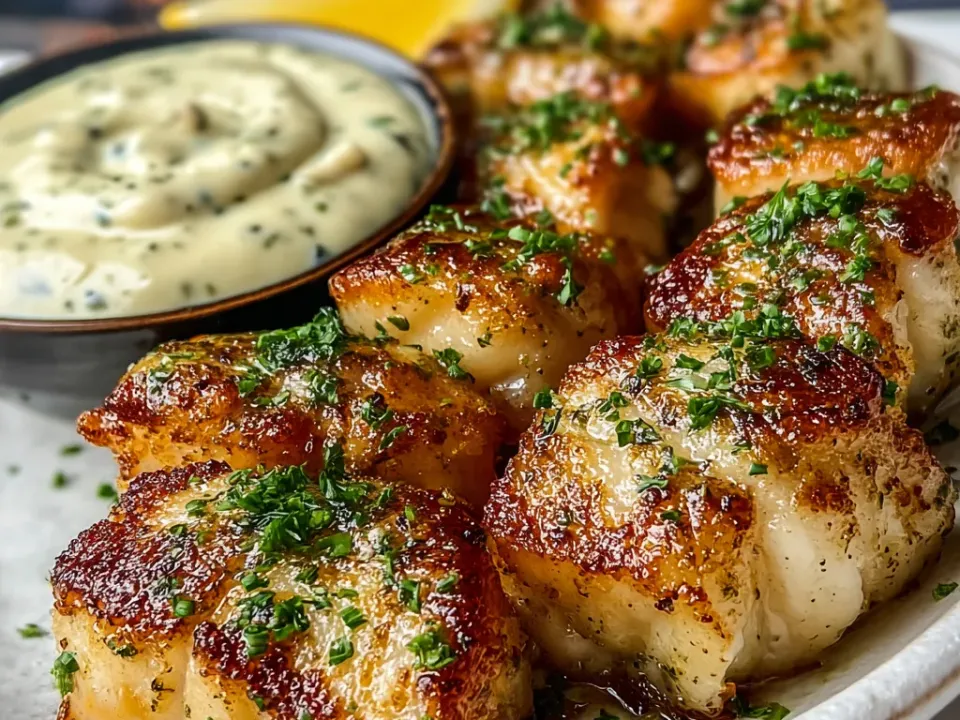
Firm white fish, cut into inch pieces and patted very dry, tossed with olive oil, lemon zest, garlic powder, smoked paprika, salt and pepper.
Seared in a single layer until browned outside and opaque through the centre, then finished with butter and lemon juice over lower heat, and served hot alongside a cold aioli of mayonnaise, grated garlic, lemon juice and parsley.
Why This Recipe Works
- Cod or haddock, both named as options — firm white fish that hold their shape as one-inch cubes and cook through evenly in two to three minutes a side without falling apart.
- The fish is dried before it is seasoned, which is what actually lets it brown rather than steam once it hits the hot skillet.
- Butter and lemon juice go in AFTER the heat drops, as a finishing step rather than a cooking medium. Added at searing temperature, butter would brown too fast and the acid in the lemon would cook off harder than the recipe intends.
- The aioli is entirely no-cook, built on mayonnaise rather than a from-scratch emulsion, which makes it genuinely quick to mix while the fish is still in the pan.
- Lemon appears in three different forms across the recipe — zest in the seasoning, juice in the pan finish, and more juice in the cold aioli — each one doing a slightly different job.
What To Actually Watch For
This is a fast recipe with a narrow window for error, and it gives clear signals at each stage rather than relying on the clock alone.
Before the pan
Fish patted very dry
A wet surface steams instead of browning — the recipe leads with drying the fish for that reason.
During the sear
Browned outside AND opaque through the centre
Both signals matter, not just the outside colour. The recipe states this pairing explicitly rather than relying on a timer alone, which is what makes it a genuine food-safety check.
The butter-and-lemon finish
Heat lowered before butter and lemon juice go in
Added at full heat, the butter would brown too fast and the lemon juice would reduce hard rather than coating the fish gently.
Serving
Fish served hot, aioli served cold
The temperature contrast is deliberate — a mayonnaise-based aioli is not meant to be warmed, and the recipe pairs it with the fish straight from the pan.
How to Make It
Season the fish
Pat fish very dry and toss with olive oil, lemon zest, garlic powder, paprika, salt, and pepper.
Sear
Heat a large skillet over medium-high heat. Cook fish in a single layer for 2 to 3 minutes per side until browned and opaque through the center.
Finish in butter and lemon
Lower heat, add butter and 1 tablespoon lemon juice, and toss briefly to coat.
Mix the aioli
Stir mayonnaise, grated garlic, 1 teaspoon lemon juice, and parsley together.
Serve
Serve hot fish bites with the garlic aioli.
Ingredient Notes
- Firm white fish such as cod or haddock
- A pound and a half, cut into one-inch pieces. Either named fish holds together well through a hot sear, unlike a flakier variety.
- Lemon zest and juice, used three times
- Zest in the dry seasoning, one tablespoon of juice in the pan finish, one teaspoon more in the aioli — three separate placements of the same citrus.
- Mayonnaise
- A third of a cup, the base of the aioli. It is what makes the sauce genuinely no-cook, needing only to be stirred together.
- Garlic clove, finely grated
- One small clove, grated rather than minced so it disperses through the cold aioli evenly instead of sitting as a raw chunk.
Success Tips
- Dry the fish thoroughly before it is seasoned.
- Do not crowd the skillet — cook in batches if needed.
- Check for opaque all the way through, not just a browned outside.
- Lower the heat before the butter and lemon go into the pan.
- Serve the fish hot and the aioli cold, straight from mixing.
Serving Ideas
Serve hot fish bites alongside the chilled aioli, exactly as the recipe finishes. They work well on their own as an appetizer or over rice or a simple salad as a light meal.
Storage and Reheating
Refrigerate
Refrigerate fish and aioli separately in airtight containers for up to 2 days.
Freeze
Not recommended. This delicate a cut of cooked fish tends to dry out and change texture after freezing and reheating.
Reheat
Reheat gently in a skillet over low heat just until warmed through; high heat will toughen the fish. Serve the aioli cold, unheated.
Frequently Asked Questions
Can I use a different white fish?
Any firm white fish that holds together when cubed and seared, such as halibut or pollock, can stand in for cod or haddock — just watch for the same browned-and-opaque cue rather than relying on the stated time alone.
Can the aioli be made ahead?
Yes — it is entirely no-cook and can be mixed hours in advance and refrigerated; the flavour, if anything, settles in nicely with a little extra time.
My fish pieces broke apart in the pan.
This usually means the pieces were turned too soon, before a crust had formed to hold them together, or the fish was cut smaller than the recipe's one-inch pieces.
Can I add more garlic to the aioli?
The recipe uses one small clove, finely grated for even distribution; adding more is simply a matter of taste and does not change how the sauce comes together.