
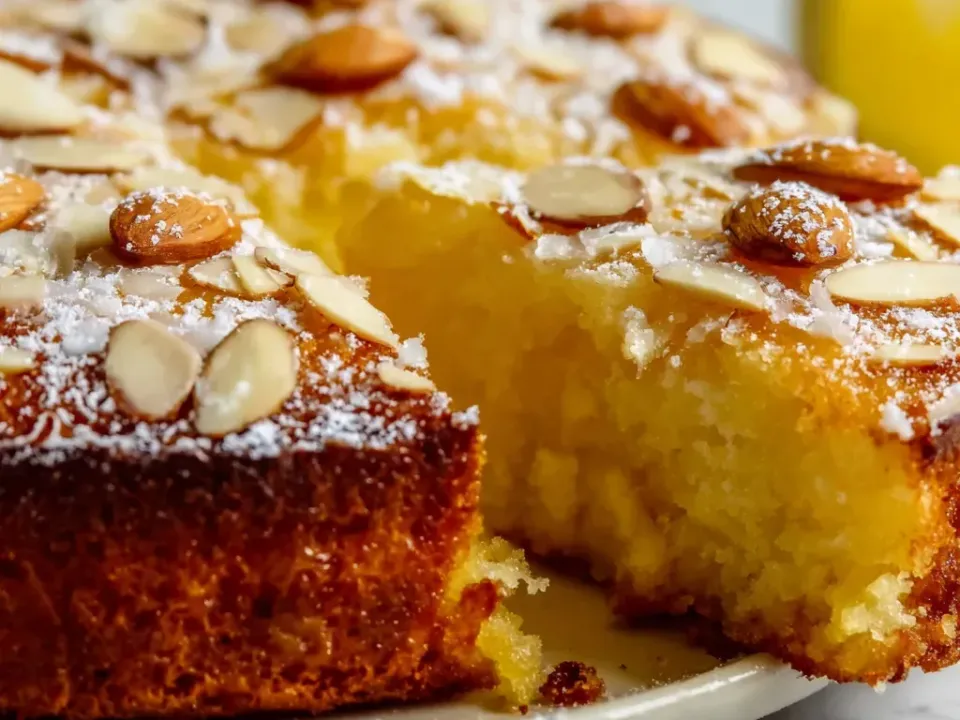
Twelve items and under an hour, in one 8-inch round tin.
There are two flours here. Almond flour brings the moisture and the flavour; a little plain flour gives the crumb enough structure to hold a wedge.
Why This Recipe Works
- Almond flour keeps the crumb moist where plain flour alone would dry.
- A half cup of plain flour gives the gluten needed to hold a clean slice.
- Adding eggs one at a time keeps the creamed butter from splitting.
- Almonds scattered before baking toast into the surface rather than sitting on it.
- A dusting of powdered sugar finishes it without needing any frosting.
Ingredient Notes
- Almond flour
- A cup and a half, the larger share of the flour. A defining tree-nut ingredient and the reason the crumb stays moist.
- All-purpose flour
- Half a cup. Small but structural — almond flour has no gluten, and without this the cake would not hold a wedge.
- Lemon juice and zest
- Two tablespoons and a tablespoon. The zest carries most of the aroma; the juice mostly carries the tartness.
- Sliced and whole almonds
- A third of a cup and two tablespoons, both on top before baking. A second tree-nut component.
How to Make It
Oven to 350°F, an 8-inch round pan greased
Heat oven to 350°F and grease an 8-inch round pan.
Flours, baking powder and salt whisked
Whisk flours, baking powder, and salt.
Butter and sugar beaten, eggs one at a time, then lemon
Beat butter and sugar, add eggs one at a time, then lemon juice and zest.
Dry ingredients folded in and spread into the pan
Fold in dry ingredients and spread into the pan.
Almonds over the top, baked thirty-two to thirty-six minutes
Top with sliced and whole almonds and bake 32 to 36 minutes until set.
Cooled and dusted with powdered sugar, cut into wedges
Cool and dust with powdered sugar before cutting into wedges.
Two Flours, and Why the Small One Matters Most
This is a plain cake in the best sense - one layer, no filling, no frosting, nothing piped or poured. What holds it together is a quiet piece of engineering in the flour: a cup and a half of ground almonds that cannot form any structure at all, rescued by half a cup of ordinary flour that can.
Stage 1 of 5
The dry mix - 1 1/2 cups ALMOND, 1/2 cup PLAIN
Steps 2–2 of 6
Whisked with 1 tsp BAKING POWDER and 1/4 tsp salt. Almond flour is ground nuts: it carries fat and moisture, which is exactly why the crumb stays moist, but it contains no gluten whatsoever and on its own it produces something closer to a dense torte that crumbles under a knife. The 1/2 cup of ALL-PURPOSE is the smaller quantity doing the structural work, and it is the reason this cake can be cut into ten clean wedges. Almond flour is also the first of two TREE NUT components here and cannot be substituted out.
- Flours, baking powder and salt whiskedWhisk flours, baking powder, and salt.
Stage 2 of 5
Creaming - and eggs ONE AT A TIME
Steps 3–3 of 6
1/2 cup softened BUTTER beaten with 3/4 cup SUGAR, then 3 EGGS ADDED ONE AT A TIME, then 2 tbsp LEMON JUICE and 1 tbsp ZEST. One at a time is not fussiness: three eggs tipped into creamed butter at once is more liquid than the fat can take, and the mixture splits into a curdled mess that bakes greasy. The zest goes in with the juice and does most of the aromatic work - lemon oil lives in the peel, and juice alone gives tartness without much smell.
- Butter and sugar beaten, eggs one at a time, then lemonBeat butter and sugar, add eggs one at a time, then lemon juice and zest.
Stage 3 of 5
FOLDED, not beaten
Steps 4–4 of 6
The dry ingredients folded into the wet and spread into a greased 8-inch round. Folding protects the little gluten there is from being developed into toughness - with only half a cup of plain flour in the whole cake, over-beating turns a tender crumb rubbery for no gain in structure.
- Dry ingredients folded in and spread into the panFold in dry ingredients and spread into the pan.
Stage 4 of 5
The almonds go on BEFORE the oven
Steps 5–5 of 6
1/3 cup SLICED ALMONDS and 2 tbsp WHOLE ALMONDS scattered on top, then BAKED 32 TO 36 MINUTES UNTIL SET. Before rather than after is what the photograph shows: almonds that bake with the cake sink slightly into the rising surface, toast to a deeper colour and stay attached. Scattered onto a finished cake they would simply sit loose and fall off at the first slice. This is the second tree-nut component.
- Almonds over the top, baked thirty-two to thirty-six minutesTop with sliced and whole almonds and bake 32 to 36 minutes until set.
Stage 5 of 5
COOL, then dust - and stop there
Steps 6–6 of 6
Cooled and DUSTED WITH POWDERED SUGAR before cutting into wedges. Cooled first, because powdered sugar on a warm surface dissolves into invisible syrup. And the dusting is where this cake ends: it is a SINGLE ROUND LAYER with NO FILLING AND NO FROSTING, so nothing is split, sandwiched or covered. The icing-sugar dusting and the whole almonds are both visible components the title names neither of.
- Cooled and dusted with powdered sugar, cut into wedgesCool and dust with powdered sugar before cutting into wedges.
Success Tips
- Add the eggs one at a time so the creamed butter does not split.
- Fold the flours in rather than beating, to keep the crumb tender.
- Cool before dusting; powdered sugar on a warm cake dissolves and vanishes.
Serving Ideas
Ten wedges from a round single-layer cake with a moist yellow crumb, the top covered in flaked and whole almonds and dusted with icing sugar.
Frequently Asked Questions
Why two different flours?
Almond flour gives the moisture and flavour but has no gluten. The half cup of plain flour is what holds the crumb together enough to cut a clean wedge.
Does it need frosting?
No. This is a single layer with no filling and no frosting — the almonds baked onto the top and a dusting of powdered sugar are the whole finish.
Does this contain nuts?
Yes, substantially. Almond flour is most of the flour and there are sliced and whole almonds on top — all defining tree-nut ingredients.