
Eleven ingredients and just over half an hour for twenty-four cookies.
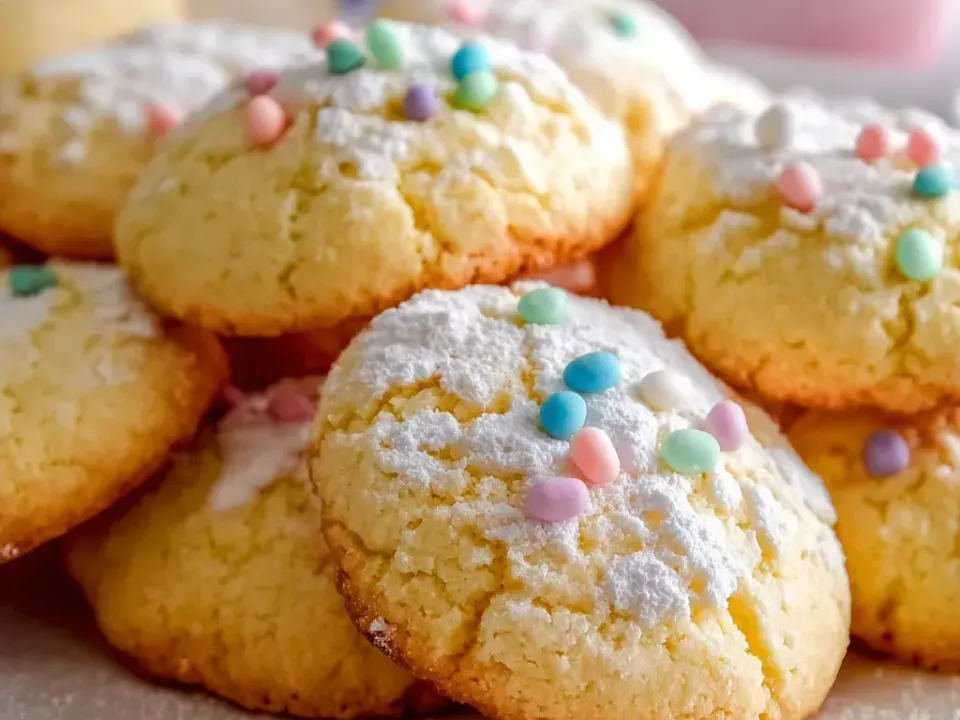
The finish is a heavy dusting of powdered sugar rather than a poured icing, and the sprinkles go on over it.
Why This Recipe Works
- Ricotta keeps the crumb soft and gives these cookies their domed shape.
- Folding just until combined avoids the toughness overworking would bring.
- Ten to twelve minutes sets the dome while leaving the edges only lightly golden.
- Cooling completely is what stops the powdered sugar dissolving on contact.
- Sprinkles scattered after the dusting sit on top rather than sinking in.
Ingredient Notes
- Whole-milk ricotta
- Three quarters of a cup. It is what makes these soft and domed, and it is not visible in the finished cookie.
- Powdered sugar
- A third of a cup, dusted heavily over cooled cookies. A dusting rather than a glaze — nothing is poured or set.
- Pastel nonpareils
- Two tablespoons, scattered over the dusting. A visible component the title never names.
- Lemon zest
- A teaspoon, finely grated. It and the vanilla are the flavouring; there is no anise or almond here.
How to Make It
Oven to 350°F, two sheets lined
Heat oven to 350°F and line two baking sheets.
Dry ingredients whisked
Whisk flour, baking powder, and salt.
Creamed, then ricotta, vanilla and lemon zest
Cream butter and granulated sugar, then beat in egg, ricotta, vanilla, and lemon zest.
Dry folded in just until combined
Fold in the dry ingredients just until combined.
Scooped and baked ten to twelve minutes
Scoop rounded tablespoons and bake 10 to 12 minutes until domed with lightly golden cracked edges.
Cooled, dusted heavily, sprinkled — and not glazed
Cool completely, dust heavily with powdered sugar, and scatter with pastel nonpareils; do not glaze.
The Order In, and the Finish That Is Not an Icing
This cookie usually arrives under a set white glaze. This version is different - a heavy DUSTING of powdered sugar sitting loose on the dome. The timeline below ends on that finish, and the two steps before it are what make it possible.
First, whisked dry
2 cups flour, 1 1/2 tsp baking powder, 1/4 tsp salt
1 1/2 tsp of baking powder is generous for two cups of flour and it is doing something specific: these cookies are meant to be DOMED, and the lift has to come from chemical leavening because there is no egg foam or creamed-in air to rely on once ricotta arrives.
Second, creamed then enriched
1/2 cup softened butter and 3/4 cup granulated sugar, then 1 egg, 3/4 cup RICOTTA, 1 tsp vanilla and 1 tsp lemon zest
The ricotta is the reason this dough behaves as it does - it keeps the crumb soft and helps hold the dome - and it is invisible in the finished cookie. The vanilla and the zest are the whole flavouring: there is no anise or almond, which this cookie sometimes carries.
Third, and gently
the dry mixture, FOLDED IN JUST UNTIL COMBINED
Folded, not beaten, and stopped early. A wet ricotta dough develops gluten quickly once flour is in, and an overworked batch bakes flat and tough instead of soft and domed.
10 to 12 minutes at 350F
rounded tablespoons onto two lined sheets
The endpoint is visual and modest: DOMED, with LIGHTLY GOLDEN CRACKED EDGES. Not browned - these are pale cookies, and the crack at the edge is the dome setting rather than a sign of over-baking.
Then wait - COMPLETELY cool
nothing
The most skippable step and the one the finish depends on. Powdered sugar dusted onto a warm cookie dissolves into a damp translucent film - which is, in effect, an accidental glaze, and precisely what these cookies are not meant to have.
Last, in this order
1/3 cup powdered sugar DUSTED HEAVILY, then 2 tbsp pastel nonpareils
Dusting first and sprinkles second, so the nonpareils sit ON the sugar where the photograph shows them rather than being buried by it. And step 6's closing instruction: DO NOT GLAZE.
Success Tips
- Fold the flour in only until it disappears; ricotta dough turns tough quickly.
- Let the cookies cool completely — powdered sugar melts straight into a warm dome.
- Dust first and sprinkle second, so the nonpareils sit on the sugar.
Serving Ideas
Twenty-four domed cookies on a white plate, edges lightly golden and cracked, under a heavy dusting of powdered sugar scattered with pastel nonpareils.
Frequently Asked Questions
Should these have a white icing glaze?
Not this one. The finish is a heavy powdered-sugar dusting sitting on the dome, and step 6 rules a glaze out by name.
Can I taste the ricotta?
Not directly — it is there for texture. It keeps the crumb soft and is what gives these their domed shape.
Is there anise or almond in these?
No. The flavouring is lemon zest and vanilla.