
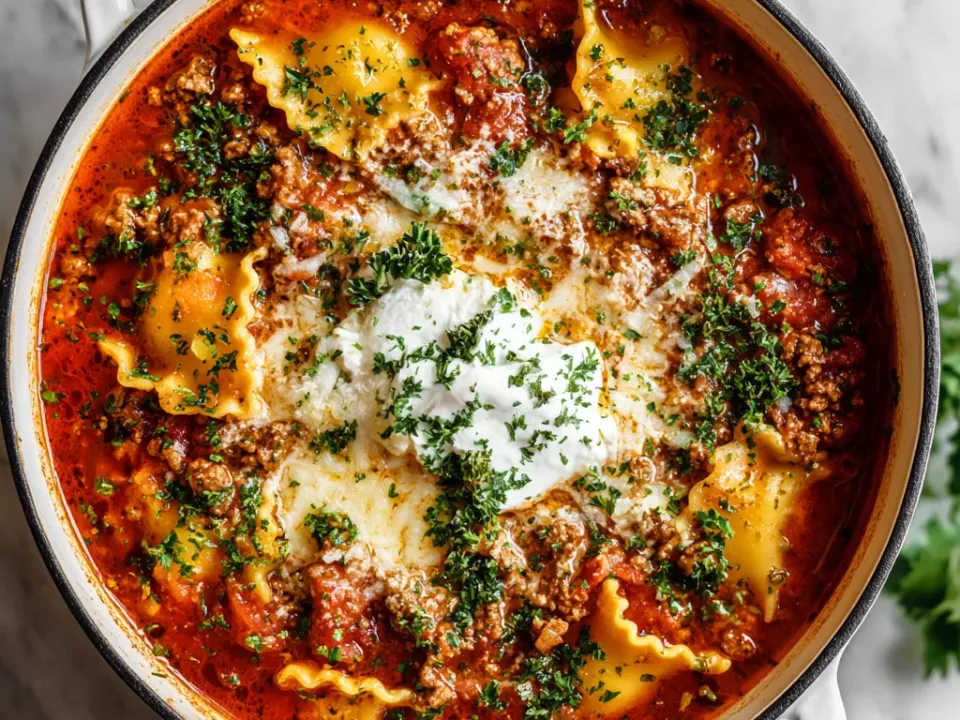
Lasagna taken apart and made into a soup — sausage, crushed tomatoes and broken noodles in one pot, with the ricotta layer dolloped on at the table.
Forty minutes, one Dutch oven, and one small bowl for the cheese.
Why This Recipe Works
- Toasting the tomato paste with the dried herbs for a minute is a small step with a large effect. It deepens the paste from sharp to savoury and blooms the oregano and basil in the fat.
- Cooking the noodles in the soup itself means their starch thickens the broth, which is what gives this the body a thin tomato soup would lack.
- The ricotta, mozzarella and Parmesan mixed separately and dolloped on top recreates the cheese layer of a lasagna. Stirred into the pot it would just disappear.
- A teaspoon of balsamic at the end lifts a long-simmered tomato base. It is optional, and it is the difference between good and flat.
What Changes, and What That Changes
Three ingredients here are specified gluten-free, and two of them behave differently from what they replace. This is what to buy and what to expect from it in the pot.
| In the recipe | Usually | Here | Why it matters |
|---|---|---|---|
| The noodles | Wheat lasagna sheets | 8 oz gluten-free lasagna noodles, broken into bite-size pieces | Rice- and corn-based noodles release more starch into the broth and keep absorbing it after the pot comes off the heat. That thickens the soup as it sits — pleasant on the night, and the reason leftovers need loosening. |
| The sausage | Any Italian sausage | GF-certified Italian sausage, casings removed | Use certified sausage, because binders and fillers in sausage vary by producer. This is a label-reading step, not a cooking one — the sausage behaves identically in the pan. |
| The broth | Any chicken broth | Low-sodium chicken or vegetable broth | Low-sodium is the important half of that line here. Six cups of broth plus a teaspoon of salt plus Parmesan is already a lot of salt, and unlike a drained pasta this soup keeps every bit of it. |
| The thickening | A flour roux | Tomato paste toasted in the pan, and the noodles' own starch | There is no flour in this recipe at all. Two tablespoons of tomato paste toasted for a minute gives depth and body, and the rest of the thickening comes from the pasta — which is also why step 10 offers a five-minute simmer rather than a thickener. |
Ingredient Notes
- Gluten-free lasagna noodles
- Eight ounces, broken into bite-size pieces before they go in. Break them by hand into a bowl rather than into the pot — the shards travel.
- Tomato paste
- Two tablespoons, toasted rather than stirred in. This is the only thickening step in a soup with no flour in it.
- Ricotta
- Half a cup, mixed with half the mozzarella and half the Parmesan. Whole-milk ricotta holds together as a dollop; low-fat tends to slump into the broth.
- Balsamic vinegar
- A teaspoon, optional, off the heat at the end. Small enough to be invisible and large enough to notice if you leave it out.
How to Make It
Soften the onion
Warm the olive oil in a large Dutch oven over medium heat, add the onion and cook until translucent, 4 to 5 minutes, then stir in the garlic for 30 seconds.
Brown the sausage
Add the sausage and cook, breaking it into small pieces, until browned and cooked through, 5 to 6 minutes. Spoon off excess fat if needed.
Toast the paste and herbs
Stir in the tomato paste, oregano, basil, red pepper flakes, salt and pepper and toast 1 minute until fragrant.
Build the soup
Pour in the crushed tomatoes and broth, add the bay leaf and bring to a gentle boil.
Cook the noodles in the pot
Add the broken gluten-free lasagna noodles, reduce to a lively simmer and cook, stirring occasionally, until al dente, 10 to 12 minutes — check your package time.
Mix the cheese, meanwhile
In a small bowl, mix the ricotta with half the mozzarella and half the Parmesan until creamy.
Season and finish the pot
When the noodles are tender, remove the bay leaf, adjust the salt and pepper, and stir in the balsamic vinegar if using.
Ladle and dollop
Ladle into bowls, dollop each with a spoonful of the ricotta mixture and sprinkle over the remaining mozzarella and Parmesan.
Serve
Finish with fresh basil and let the cheeses melt slightly in the hot soup before serving. For a thicker soup, simmer 5 minutes longer or stir a handful of mozzarella directly into the pot.
Success Tips
- Go by your package time, not only by the recipe's 10 to 12 minutes.
- Pull the noodles at al dente. They keep softening in the hot broth after the pot is off the heat.
- Keep the cheese mixture out of the pot. It is a topping, and stirring it in wastes it.
- Stir occasionally while the noodles cook — gluten-free pasta settles and sticks to the base more readily than wheat pasta does.
Serving Ideas
Extra fresh basil and more Parmesan at the table. It is a full bowl on its own; if you want something alongside, a sharp green salad does more for it than bread would.
Storage and Reheating
Refrigerate
Refrigerate up to 3 days. The noodles keep drinking the broth, so what was soup on the night is closer to a thick stew the next day — this is expected, not a fault.
Freeze
Not recommended with the noodles in. If you want to freeze it, hold the noodles back and cook them fresh into the reheated base.
Reheat
Gently on the stove with an extra splash of broth or water to bring it back to a soup. Add the ricotta topping fresh rather than reheating it in the pot.
Frequently Asked Questions
Can I make it ahead?
Make the soup base through the tomatoes and broth ahead, and cook the noodles into it when you reheat. That avoids the only real drawback of this recipe, which is how much liquid the pasta takes up overnight.
Can I make it without sausage?
Yes. Use vegetable broth and replace the sausage with mushrooms browned hard for depth, or with a plant-based sausage. You will want to be more generous with the oregano and red pepper flakes, since the sausage was carrying most of the seasoning.
It went too thick. Can I fix it?
Add hot broth or water a splash at a time until it loosens, then taste for salt — thinning dilutes the seasoning as well as the starch. This happens most often when the soup has stood for a while, and it is entirely normal.