
Six bagels from six ingredients, two of which are optional or only for brushing. Forty-eight minutes start to finish, with no proving and no boiling pot.
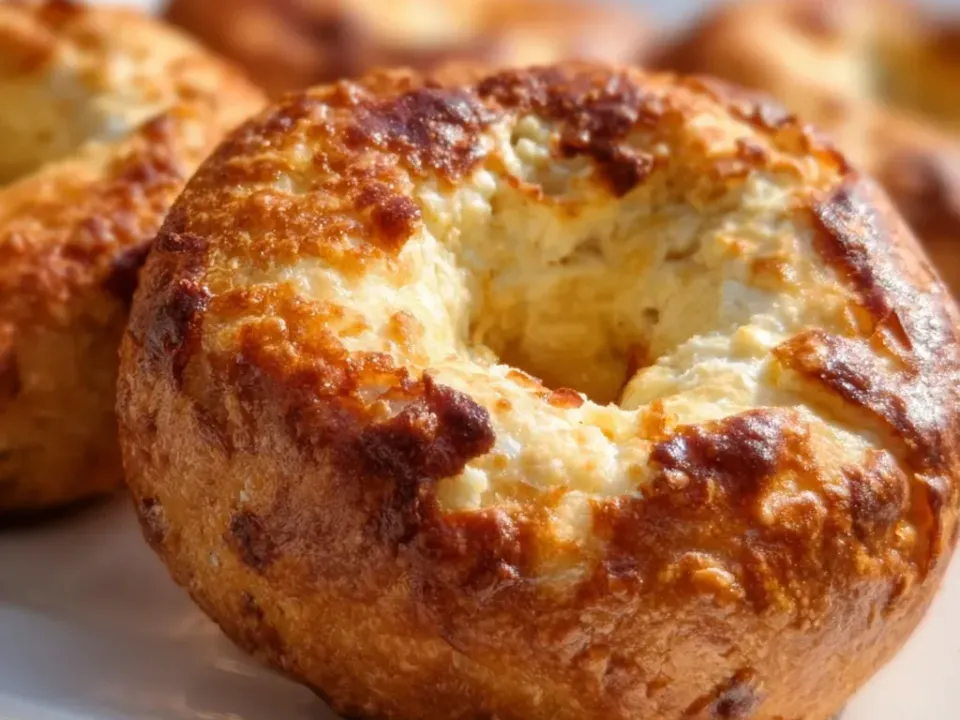
A hot oven is what this recipe is really built on. Twenty-four to thirty minutes at 400 degrees Fahrenheit is what produces the deeply browned, craggy, blistered crust the finished bagels have.
Why This Recipe Works
- Blending the cottage cheese turns curds and whey into one smooth liquid that hydrates the flour evenly.
- A tablespoon of baking powder raises the dough in the oven, so there is no proving stage.
- Joining the ends firmly is what stops the ring opening as the bagel expands.
- 400 degrees Fahrenheit browns the crust deeply in under half an hour rather than merely setting it.
- Fifteen minutes of cooling lets the inside finish before a knife goes near it.
Ingredient Notes
- Small-curd cottage cheese
- A cup and a half, blended until mostly smooth before it meets the flour. Small-curd blends down more readily than large.
- Gluten-free baking powder
- A tablespoon, and the only raising agent in the recipe. Baking powder is not automatically gluten-free and the tin should be checked.
- Sesame or everything seasoning
- A tablespoon, and the recipe marks it optional. It is what makes these savoury rather than plain.
How to Make It
Hot oven, lined pan
Heat oven to 400 degrees Fahrenheit and line a sheet pan with parchment.
Blend the cottage cheese
Blend cottage cheese until mostly smooth.
Dry, then the blended cheese
Mix flour, baking powder, and salt. Stir in blended cottage cheese until a soft dough forms.
Six ropes, ends joined firmly
Divide dough into 6 pieces, shape into thick ropes, and join the ends firmly.
Egg wash and seasoning
Brush with beaten egg and add seasoning if using.
Bake deeply, then cool
Bake 24 to 30 minutes until deeply browned and craggy. Cool at least 15 minutes before slicing.
Four Things That Decide the Crust
Six ingredients leave very little to hide behind. Each of these is a single instruction in the recipe, and each one shows in the finished bagel.
Step 2 - the blend
The cottage cheese is mostly smooth before it touches the flour.
1 1/2 cups of small-curd cottage cheese is the entire liquid in this dough. Blended, it hydrates 2 cups of flour evenly; left as curds, it leaves dry patches next to wet ones and the baked crumb shows both.
Step 3 - the dough
Stir only until a soft dough forms.
There is no gluten to develop and nothing to gain from working it further. Soft is the target texture, and it is soft enough to shape straight away because a tablespoon of baking powder needs no proving time.
Step 4 - the join
The two ends of each rope are pressed together firmly.
The bagel expands as the baking powder works. A join made lightly opens in the oven and what comes out is a rope rather than a ring.
Step 6 - the bake
Deeply browned and craggy, not merely set. 24 to 30 minutes at 400F.
This is the step that matters: an oven bake, not a steam. The blistered golden crust in the photograph is what a hot dry oven does over half an hour, and it is what separates these from a pale bagel.
Success Tips
- Blend the cottage cheese properly — mostly smooth is the instruction, and lumps show up in the baked crumb.
- Pinch the joined ends together firmly; a loose join opens into a rope in the oven.
- Let the oven come fully up to 400 before the tray goes in. The crust is the point.
Serving Ideas
Six deeply browned, craggy bagels on a white plate, cooled for at least fifteen minutes before they are sliced.
Frequently Asked Questions
Can I skip blending the cottage cheese?
It is the second step for a reason. Unblended curds hydrate the flour unevenly and leave wet pockets in the baked bagel.
How do these differ from the Greek yogurt bagels?
Different dairy base and a different character: cottage cheese with an optional savoury seasoning, baked hotter to a deeply browned craggy crust, against a yogurt dough with cinnamon and raisins and a paler matte one.
Should I add steam or boil them first?
No. The crust here comes from a dry 400 degree Fahrenheit oven; steaming would work against the blistered surface these are meant to have.