
Two instructions in this recipe would look like mistakes in a wheat-based version. The dough is rolled between sheets of parchment rather than on a floured counter, and the proof ends when the rolls look puffy rather than doubled — they will not double.
Both follow from the same fact: there is no gluten network here. Psyllium husk and xanthan gum are standing in for it, and they produce a dough that is soft and sticky rather than elastic.
Why This Recipe Works
- Psyllium husk powder holds water and gives the dough enough structure to be rolled into a log without tearing.
- Blooming the yeast in warm milk with a tablespoon of sugar confirms it is alive before it meets a flour blend that gives no other visual cue.
- Rolling between parchment means the dough never needs extra flour worked into it, which would dry out a blend that is already thirsty.
- Apple cider vinegar sharpens the yeast's lift, a common gluten-free technique the recipe uses rather than relying on rise time alone.
Ingredient Notes
- Gluten-free flour blend
- A 1:1 blend that already contains xanthan gum. Three cups, and the blend choice matters more here than in most recipes.
- Psyllium husk powder
- A tablespoon, optional but recommended for softness. It is the closest thing this dough has to gluten.
- Apple cider vinegar
- A tablespoon into the dough, not the glaze. It is a lift aid rather than a flavour.
How to Make It
Grease the pan, hold the oven
Grease a 9x13-inch pan. The oven is not preheated yet — the recipe holds that until the proof is nearly done.
Bloom the yeast
Whisk the warm milk (about 110F) with a tablespoon of the sugar, sprinkle over the instant yeast and leave 5 to 10 minutes until foamy.
Combine the dry
In a stand mixer bowl, combine the gluten-free flour, psyllium husk powder, remaining sugar, baking powder and salt.
Mix the dough
Add the eggs, melted butter, vanilla, vinegar and the foamy milk, and mix with the paddle on medium for 2 to 3 minutes.
Roll between parchment
Lay the dough on parchment lightly dusted with gluten-free flour, top with a second sheet, and roll or pat it out. The top sheet is what lets you roll a sticky dough at all.
Fill
Spread the very soft butter over the dough, then scatter the brown sugar, cinnamon and a pinch of salt evenly across it.
Roll into a log
Use the bottom parchment to help roll it tightly from the long side. If it is sticky, chill the log 10 minutes before going on.
Slice twelve
Cut 12 even rolls with a serrated knife or unflavoured dental floss, and arrange them in the pan spaced slightly apart.
Proof until puffy
Cover loosely and rise somewhere warm 30 to 45 minutes until puffy — not doubled. Preheat the oven to 350F (175C) during this time.
Bake to 195F
Bake 22 to 26 minutes, until lightly golden and the centre reaches about 195F. The recipe is explicit about not overbaking.
Glaze warm
Beat the cream cheese, powdered sugar, milk, vanilla and a pinch of salt until smooth, and spread over the rolls while they are still warm.
Reading a Dough With No Gluten
Most cinnamon roll instincts come from wheat dough and mislead here. These are the three moments where the recipe asks you to ignore them.
What is the dough or the roll doing right now?
The dough is sticky and will not roll on the counter
Roll it between two sheets of parchment, dusted lightly with GF flour.
Adding flour to correct stickiness dries out a blend that is already absorbing hard.
The rolls have proofed 45 minutes and have not doubled
Bake them. Puffy is the target.
The recipe states they will not double; waiting longer overproofs them.
The tops are golden but you are unsure inside
Check for about 195F at the centre rather than adding minutes.
Gluten-free crumb dries fast past done, so do not overbake.
Success Tips
- Do not wait for the rolls to double during the proof — the recipe says they will not, and waiting turns a 45-minute rise into an overproofed one.
- Chill the log for 10 minutes if it fights you at the slicing stage; floss cuts a soft log more cleanly than a knife.
- Take the internal temperature. At 195F they are done, and gluten-free rolls dry out quickly past that point.
Serving Ideas
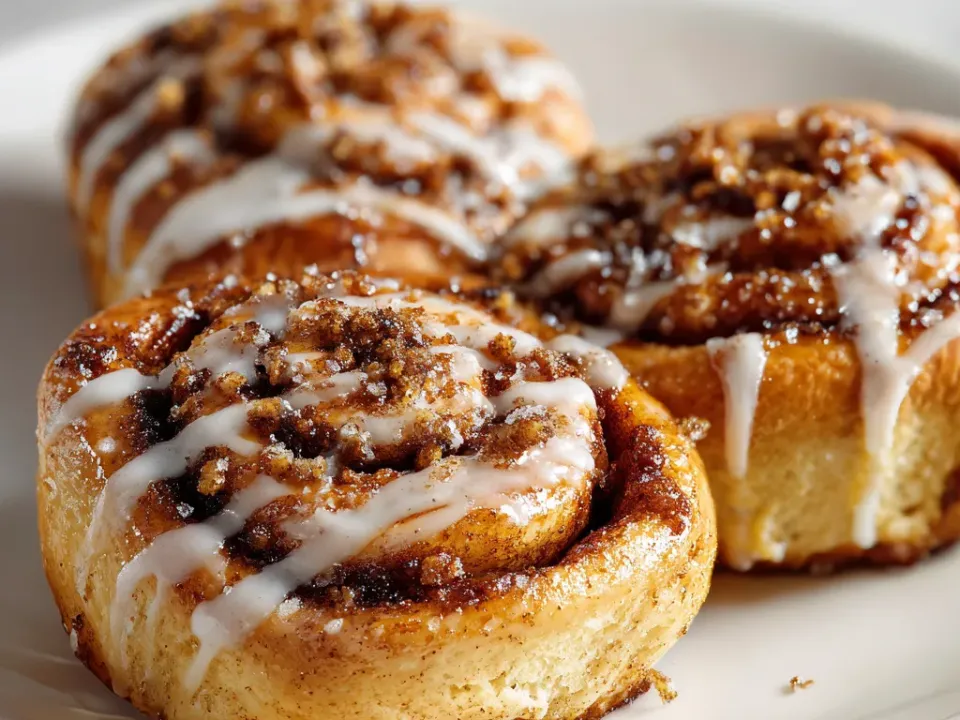
Twelve rolls from a 9x13 pan, glazed while warm — the point at which cream cheese glaze melts into the spiral.
Frequently Asked Questions
My rolls did not double during the proof. Is that wrong?
No. The recipe states directly that they will not double. Proof 30 to 45 minutes until they look puffy.
Can these be dairy-free?
Yes — the recipe offers unsweetened almond milk, dairy-free butter and dairy-free cream cheese at each point.
The dough is too sticky to roll. What do I do?
Roll it between two sheets of parchment, as the recipe directs, rather than adding more flour. If the rolled log is sticky, chill it 10 minutes.