
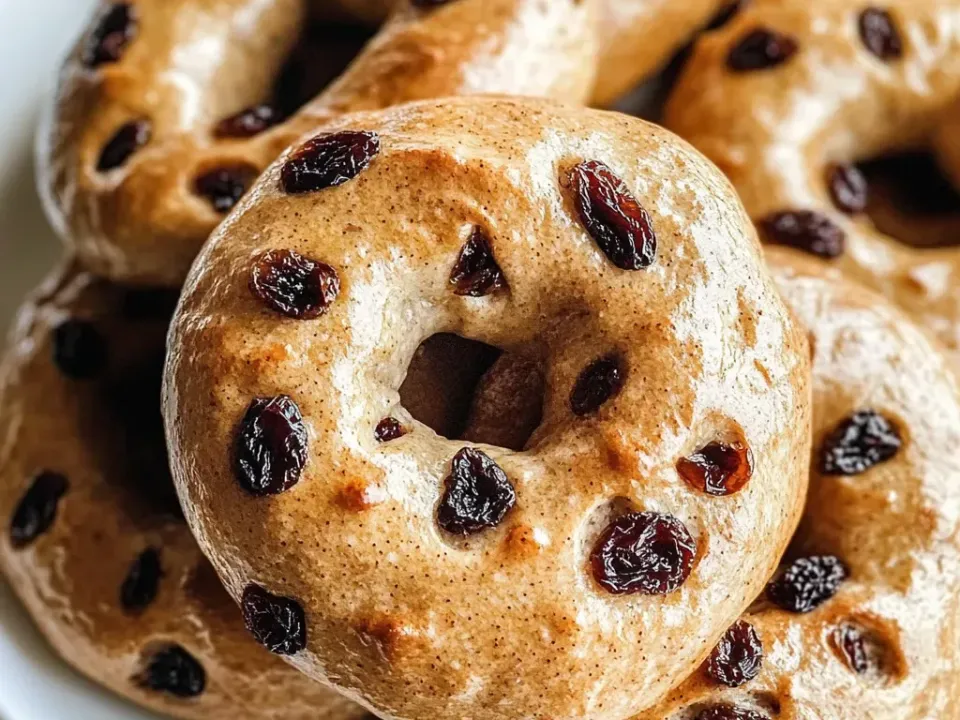
Eight ingredients and forty-five minutes from cupboard to cooled bagel, because this dough skips the two things that make bagels an all-day project: proving and boiling.
What holds it together is a cup and a half of plain Greek yogurt against two cups of gluten-free flour. That single ratio is the recipe — the cinnamon and raisins are what make it this bagel rather than a plain one.
Why This Recipe Works
- A tablespoon of baking powder raises the dough in the oven, so no proving time is needed.
- Thick Greek yogurt supplies both the liquid and the acid the baking powder reacts with.
- Kneading only until smooth enough to shape keeps a gluten-free dough from turning tough.
- Rolling ropes and joining the ends gives an even ring, which bakes more evenly than a punched hole.
- Fifteen minutes of cooling before slicing lets the crumb finish setting.
Ingredient Notes
- Plain Greek yogurt
- A cup and a half, and it is doing three jobs: liquid, acid for the baking powder, and the tenderness that stands in for gluten. Plain, not flavoured or thinned.
- Gluten-free baking powder
- A tablespoon — a large amount, because it is the only rise in the recipe. Baking powder is not automatically gluten-free; the tin has to be checked.
- Raisins
- Half a cup, folded in after the dough comes together rather than whisked in with the flour, so they stay whole and studded through the finished bagel.
How to Make It
Oven on, sheet lined
Heat oven to 375 degrees Fahrenheit and line a sheet pan with parchment.
Dry, then yogurt
Whisk flour, baking powder, salt, and cinnamon. Stir in Greek yogurt until a shaggy dough forms.
Raisins, then knead lightly
Fold in raisins, then knead gently with lightly floured hands just until smooth enough to shape.
Six ropes, six rings
Divide into 6 pieces, roll each into a rope, and join the ends to form bagels.
Brush lightly
Brush lightly with beaten egg and sprinkle with a little coarse sugar if desired.
Bake, then cool
Bake 22 to 27 minutes until set and lightly browned; cool 15 minutes before slicing.
The Whole Dough, in Proportion
Most bagel recipes are a method. This one is a ratio: two parts flour to one and a half parts yogurt, and everything else is seasoning or decoration. Seeing the proportions is seeing the recipe.
- Gluten-free 1:1 flour2 cups
- Plain Greek yogurt1 1/2 cups
- Raisins1/2 cup
- Gluten-free baking powder1 tbsp
- Ground cinnamon2 tsp
- Kosher salt1/2 tsp
The bar shows relative volume only, and the two bars at the top are the dough itself. Note how large the baking powder is for a raising agent - a full tablespoon - because there is no yeast and no proving time to help it. The beaten egg and the optional teaspoon of coarse sugar are not in the dough at all; they go on the outside in step 5, and lightly, which is why the finished bagels are matte rather than glossy.
Success Tips
- Flour your hands lightly rather than the worktop; this dough is soft and takes on extra flour easily.
- Stop kneading as soon as it will hold a rope.
- Brush the egg on lightly — the finished bagels are matte rather than glossy.
Serving Ideas
Six pale bagels studded with raisins, cooled and piled in a white bowl, sliced once they have had their fifteen minutes.
Frequently Asked Questions
Is there no yeast or boiling?
Neither. A tablespoon of baking powder does the raising and the yogurt does the rest, which is why this takes forty-five minutes rather than a day.
How is this different from the cottage cheese bagels?
Different dairy and a different identity: Greek yogurt with cinnamon and raisins here, cottage cheese with sesame or everything seasoning there. One is sweet, one is savoury.
Could these be made in a slow cooker?
No. They are oven-baked; the set crust comes from twenty-two to twenty-seven minutes of dry heat at 375 degrees Fahrenheit.