
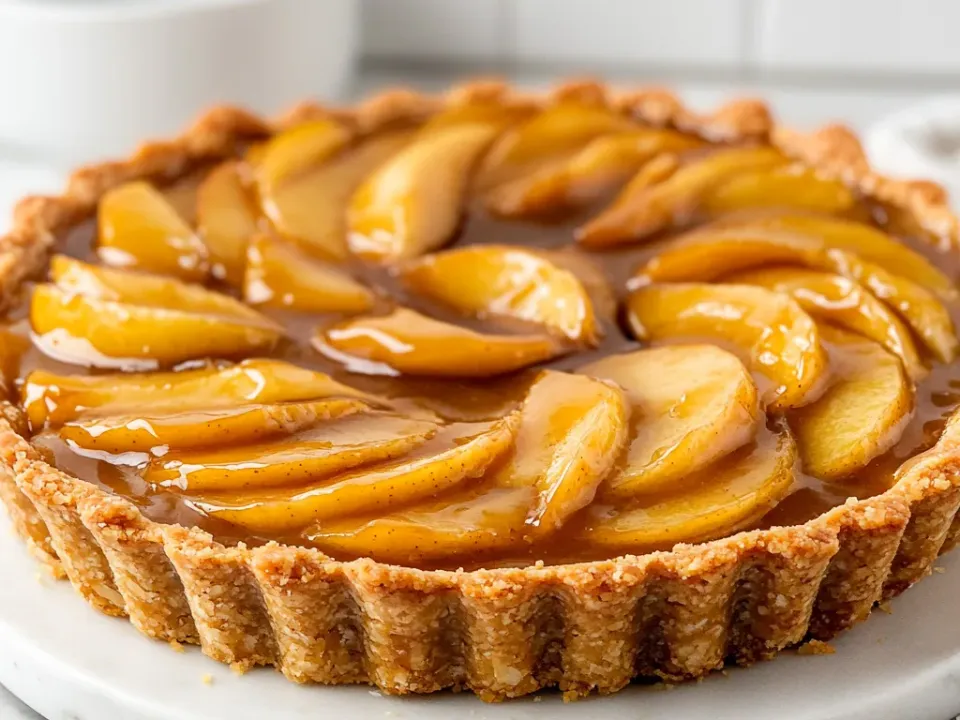
A press-in crust of fine almond flour, tapioca starch, sugar and melted butter, part-baked for ten minutes at 350°F.
Four apples tossed with lemon, brown sugar, cinnamon and cornstarch go on top for thirty to thirty-five minutes, and caramel sauce is drizzled over once the tart has cooled twenty minutes.
Why This Recipe Works
- The crust is part-baked before the fruit goes on. Ten minutes sets it against a filling that will release a good deal of juice, and it is the difference between a crisp base and a damp one.
- Two tablespoons of lemon juice on the apples. It stops them browning while they are being sliced, and its acidity keeps a tart with brown sugar and caramel from tasting flatly sweet.
- A tablespoon of cornstarch tossed through the apples. Four apples give up a surprising amount of liquid at 350°F, and the starch turns that into a glaze rather than a puddle.
- Melted butter rather than cold. There is no gluten to develop and no flakiness to protect, so melted butter mixed straight through gives an even, pressable crumb.
- The caramel goes on after twenty minutes of cooling. On a hot tart it slides off the apples entirely; on a warm one it sets in place and stays glossy.
What Each Gluten-Free Ingredient Is Doing
This is a pastry tart rebuilt without pastry, and each substitution has one specific job. Knowing which is which is what stops a swap going wrong — and two of them decide whether the gluten-free claim holds at all.
| In the recipe | Usually | Here | Why it matters |
|---|---|---|---|
| The bulk of the crust | Plain flour in a shortcrust | 2 cups fine almond flour | Fine rather than coarse ground almonds. It gives a short, sandy crust that presses rather than rolls — there is no dough to roll here and no need for one. |
| The binding | Gluten | 1/4 cup tapioca starch and 6 tablespoons melted butter | Tapioca gives a little chew and stretch that almond flour has none of; the melted butter is what sets the crust firm as it cools. This is one of the two items that must be certified. |
| The rolling and blind-baking | Chilling, rolling, docking and baking beans | Press in, then a 10-minute part-bake | Ten minutes sets the base before wet apples land on it. Without it the fruit's juice soaks straight into raw crumb and the bottom never crisps. |
| The thickener for the fruit | Flour tossed with the apples | 1 tablespoon cornstarch | It thickens the apple juices as they release so the tart slices cleanly rather than running. Check the packet: cornstarch is usually gluten-free but not always certified. |
| The finish | An apricot glaze brushed hot | 1/3 cup caramel sauce, certified gluten-free | Drizzled after twenty minutes of cooling, not before. Caramel on a hot tart runs straight off; on a warm one it sets where it lands. Commercial caramel frequently contains wheat-derived ingredients, so this is the second item that decides the claim. |
Ingredient Notes
- Fine almond flour
- Two cups, finely ground and blanched. Coarse almond meal gives a heavier, greasier crust that does not hold a fluted edge.
- Caramel sauce, certified gluten-free
- A third of a cup. Commercial caramel often contains wheat-derived ingredients, and this is one of the two items that decide whether the gluten-free claim holds.
- Tapioca starch
- A quarter cup, in the crust. It supplies the bit of chew that almond flour lacks; certified if the page claims gluten-free.
- Apples, peeled and thinly sliced
- Four medium. Thin and even is what lets them soften in thirty-five minutes and lie flat enough to glaze.
- Cornstarch
- One tablespoon, tossed with the apples rather than into the crust. Check the packet — cornstarch is not always certified.
How to Make It
Heat the oven and grease the pan
Heat the oven to 350°F and grease a 9-inch tart pan with a removable bottom.
Press in the crust
Mix the almond flour, tapioca starch, granulated sugar, salt and melted butter until evenly moistened. Press firmly into the bottom and up the sides of the pan.
Part-bake it
Bake the crust for 10 minutes.
Toss and arrange the apples
Toss the apples with lemon juice, brown sugar, cinnamon and cornstarch. Arrange them over the warm crust.
Bake
Bake for 30 to 35 minutes, until the apples are tender and the crust is golden.
Cool, then caramel
Cool for 20 minutes, then drizzle with caramel sauce before slicing.
Success Tips
- Press the crust firmly and take it properly up the sides.
- Slice the apples thin and even; a mandoline earns its keep here.
- Arrange the apples on the crust while it is still warm from the part-bake.
- Let it cool the full twenty minutes before the caramel goes anywhere near it.
- Cool it completely in the tin before lifting the ring away.
Serving Ideas
Cream, crème fraîche or a scoop of vanilla ice cream. It is sweet and caramel-glazed, so what it wants alongside is something plain and cold.
Storage and Reheating
Refrigerate
Keep covered at room temperature for up to 2 days, or refrigerate for up to 4. The crust softens slightly in the fridge.
Freeze
Freeze the baked tart, without the caramel, for up to 2 months. Thaw at room temperature and drizzle fresh caramel over.
Reheat
Warm slices at 300°F for 8 to 10 minutes. An almond crust crisps up again nicely with gentle heat.
Frequently Asked Questions
Is this genuinely gluten-free?
Only if the packaged ingredients are. The caramel sauce and the starches are the ones that vary by brand, and commercial caramel in particular often contains wheat-derived ingredients.
The base was soft underneath.
Usually a skipped or shortened part-bake. Ten minutes before the apples go on is what sets the crust against the juice they release.
The crust fell apart when I unmoulded it.
It was not pressed firmly enough, or it was unmoulded warm. There is no gluten holding it together — pressure and cool butter are what set it, so let it cool completely in the tin.
Can I add the caramel before baking?
It would darken and catch at the edges over thirty-five minutes. The recipe drizzles it after a twenty-minute cool, which is where the glossy finish comes from.