
Beef stew is one of the easier dishes to make gluten-free, but the two places gluten hides are not obvious: the broth and the Worcestershire sauce. Both come in certified versions and both are specified here.
The third place — the thickener — is handled by cornstarch rather than a flour roux, added for the last fifteen to twenty minutes to turn the braising liquid into a brown gravy.
Why This Recipe Works
- Browning the beef in batches builds colour that eight covered hours cannot.
- Two tablespoons of tomato paste give the gravy depth and darkness without any flour.
- Yukon Golds in chunks hold their shape across a very long braise.
- Cornstarch added at the end thickens without the raw taste an uncooked roux would leave.
Ingredient Notes
- Certified gluten-free beef broth
- Four cups. Commercial broths frequently contain wheat derivatives, so the certification matters.
- Certified gluten-free Worcestershire sauce
- One tablespoon. Standard Worcestershire often contains malt vinegar made from barley.
- Beef chuck
- Two and a half pounds in 1 1/2-inch cubes. Chunks, browned in batches before they go in.
How to Make It
Brown in batches
Brown the beef in the oil in batches and transfer to the slow cooker.
Build the stew
Add the potatoes, carrots, onion, garlic, broth, tomato paste, Worcestershire, thyme, bay leaf, salt and pepper.
Eight hours on Low
Cover and cook on Low for about 8 hours, until the beef is fork-tender and the vegetables are tender.
Thicken to a gravy
Discard the bay leaf. Stir the cornstarch and cold water together and add for the final 15 to 20 minutes to turn the broth into a brown gravy.
The Three Places Gluten Gets Into a Beef Stew
A stew is naturally close to gluten-free already. These are the three points where it usually is not, and what this recipe does instead.
| In the recipe | Usually | Here | Why it matters |
|---|---|---|---|
| The broth | Ordinary beef broth, stock cubes or stock pots | Certified gluten-free low-sodium beef broth, 4 cups | Wheat derivatives are used as thickeners and flavour carriers in many commercial broths. At 4 cups it is the largest single ingredient, so it is the one worth checking first. |
| The Worcestershire | Standard Worcestershire sauce | Certified gluten-free Worcestershire sauce, 1 tbsp | Most versions are made with malt vinegar, which is derived from barley. It is a small quantity and an easy one to overlook. |
| The thickener | A flour roux, or beef dredged in flour before browning | 2 tbsp cornstarch slaked in 2 tbsp cold water, added for the final 15 to 20 minutes | The most common way a stew acquires gluten. Cornstarch at the end thickens just as well and leaves no raw-flour taste. |
| The body | Adding flour or a commercial gravy mix for richness | 2 tbsp tomato paste, in from the start | The paste supplies the depth and dark colour that flour-based versions get from a roux, and it cooks for the full eight hours. |
Success Tips
- Brown in batches even though it takes longer — a crowded pan steams and gives no colour.
- Cut the potatoes and carrots into chunks rather than dice so they survive eight hours.
- Read the labels on both the broth and the Worcestershire rather than assuming.
Serving Ideas
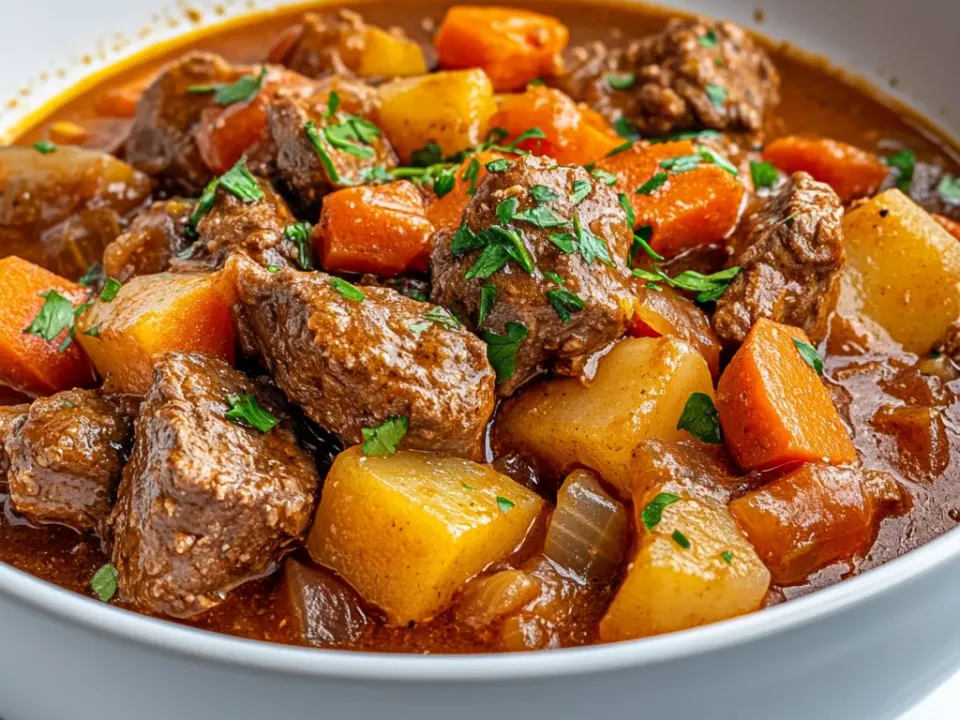
Six servings of browned beef chunks with carrot, potato and onion in the brown gravy.
Frequently Asked Questions
Is Worcestershire sauce not gluten-free?
Not always. Many versions use malt vinegar made from barley, so the recipe specifies a certified gluten-free one.
Can I thicken with gluten-free flour instead?
The recipe uses two tablespoons of cornstarch with cold water, added at the end.
Can I add peas or mushrooms?
The visible core is beef, carrot, potato, onion and brown gravy.