
Twelve ingredients and an hour and twenty minutes, of which the bake is only twelve.
The cake is rolled up the moment it leaves the oven, with nothing in it. Sponge cooled flat and rolled afterwards splits along every fold.
Why This Recipe Works
- Beating eggs and sugar until thick is what gives the sponge its flexibility.
- A thin sponge baked twelve minutes stays pliable rather than setting brittle.
- Rolling warm teaches the cake the curve it will hold when it is refilled.
- A heavily sugared towel stops the sponge sticking as it cools rolled.
- Chilling the filled roll firms the cream cheese so slices cut cleanly.
Ingredient Notes
- Eggs and granulated sugar
- Four eggs and three quarters of a cup, beaten until thick. That aeration is the only lift this sponge has beyond a quarter teaspoon of baking powder.
- Ground ginger, cinnamon and cloves
- A teaspoon, a teaspoon and a quarter teaspoon. Ground rather than fresh — there are no visible spice pieces in the finished slice.
- Cream cheese and butter
- Eight ounces and four tablespoons, both softened. This is the filling, and it is what makes the roll a cold item.
- Powdered sugar
- A cup in the filling, plus more for dusting the outside. Some of the filling is also kept back to pipe along the top.
How to Make It
Oven to 375°F, a jelly-roll pan lined
Heat oven to 375°F and line a jelly-roll pan.
Eggs and sugar beaten thick, dry ingredients folded in
Beat eggs and sugar until thick; fold in flour, spices, baking powder, and salt.
Spread and baked ten to twelve minutes until it springs back
Spread in the pan and bake 10 to 12 minutes until the sponge springs back.
Inverted onto a sugared towel, rolled warm, cooled completely
Invert onto a heavily sugared towel and roll while warm; cool completely.
Filling beaten, cake unrolled, spread and rerolled
Beat cream cheese, butter, powdered sugar, and vanilla; unroll cake, spread filling, and reroll.
Chilled thirty minutes, dusted, piped and sliced
Chill at least 30 minutes; dust with powdered sugar and pipe a little filling decoratively over the top before slicing.
Rolled Twice, and the First Time It Is Empty
Everything that goes wrong with a cake roll goes wrong in about a ninety-second window just after the pan leaves the oven. The sponge is only flexible while it is warm, and the recipe's answer is to roll it immediately with nothing inside - a shape it then keeps while it cools, so that filling it later is a matter of reopening rather than bending.
Stage 1 of 5
The sponge - AERATION is the only structure
Steps 2–2 of 6
4 EGGS beaten with 3/4 cup of SUGAR UNTIL THICK, then 3/4 cup flour, 1 tsp GINGER, 1 tsp CINNAMON, 1/4 tsp CLOVES, 1/4 tsp baking powder and 1/4 tsp salt FOLDED in. Beaten until thick is not a loose instruction - with only a quarter teaspoon of baking powder in the whole cake, the air beaten into those eggs is doing nearly all the lifting. And FOLDED rather than stirred, because beating the flour in knocks that air straight back out. The spices are all GROUND: the finished slice shows no visible spice pieces.
- Eggs and sugar beaten thick, dry ingredients folded inBeat eggs and sugar until thick; fold in flour, spices, baking powder, and salt.
Stage 2 of 5
A THIN bake - 10 to 12 minutes only
Steps 3–3 of 6
Spread across a jelly-roll pan and baked UNTIL THE SPONGE SPRINGS BACK. Thin and quick is the whole design. A cake that spends twenty-five minutes in the oven dries at the edges and sets rigid, and rigid sponge cannot be rolled at all. Springs back is the cue to trust over the clock - a minute or two past it is the difference between pliable and cracking.
- Spread and baked ten to twelve minutes until it springs backSpread in the pan and bake 10 to 12 minutes until the sponge springs back.
Stage 3 of 5
The critical window - ROLL IT WARM, and EMPTY
Steps 4–4 of 6
INVERTED ONTO A HEAVILY SUGARED TOWEL and ROLLED WHILE WARM, then COOLED COMPLETELY in that shape. This is the step the whole recipe turns on. Warm sponge is flexible and takes a curve; cooled flat, it has set straight and splits along every fold when you try to bend it. Rolling it empty means it is learning the shape without a filling being squeezed out. HEAVILY sugared is literal - a bare towel bonds to a warm sponge and tears the surface off when you unroll it.
- Inverted onto a sugared towel, rolled warm, cooled completelyInvert onto a heavily sugared towel and roll while warm; cool completely.
Stage 4 of 5
Unroll, fill, REROLL - and keep some back
Steps 5–5 of 6
8 oz of SOFTENED CREAM CHEESE beaten with 4 tbsp softened BUTTER, 1 cup POWDERED SUGAR and 1 tsp VANILLA. This cream-cheese filling is why the finished roll is a cold item. The cake unrolls easily because it has been sitting in that curve; spread and reroll. Keep a little filling back - it is needed in the next step.
- Filling beaten, cake unrolled, spread and rerolledBeat cream cheese, butter, powdered sugar, and vanilla; unroll cake, spread filling, and reroll.
Stage 5 of 5
CHILL, then dust and pipe
Steps 6–6 of 6
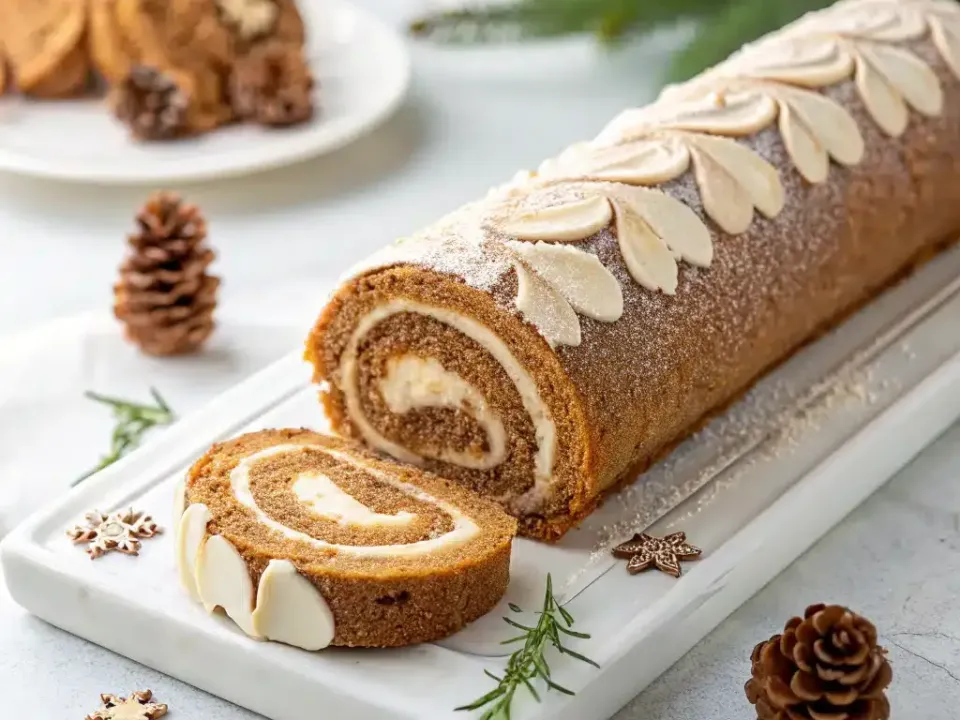
AT LEAST 30 MINUTES in the fridge before anything else. Two reasons: a freshly filled roll squashes out of shape under the knife, and cream-cheese frosting needs to firm to cut cleanly. Then DUSTED with POWDERED SUGAR and the reserved filling PIPED DECORATIVELY ALONG THE TOP - both are visible components the title names neither of. And the chilling is not only cosmetic: for safety, keep this roll at 40°F OR BELOW because of the cream cheese in it.
- Chilled thirty minutes, dusted, piped and slicedChill at least 30 minutes; dust with powdered sugar and pipe a little filling decoratively over the top before slicing.
Success Tips
- Sugar the towel heavily; a bare cloth welds itself to a warm sponge.
- Roll it the moment it is out of the pan — even a few minutes cooling costs you.
- Chill before slicing and wipe the knife between cuts for a clean spiral.
Serving Ideas
Ten slices from a mid-brown spiral-rolled sponge dusted with icing sugar, filled with thick pale cream-cheese frosting and decorated along its length with piped cream.
Frequently Asked Questions
What is the pale filling?
Cream cheese beaten with butter, powdered sugar and vanilla. Because it is cream cheese, the finished roll keeps at 40 degrees Fahrenheit or below.
How do I stop the cake cracking?
Roll it warm and empty, straight from the pan, and let it cool in that shape. A sponge cooled flat has set by the time you try to curve it.
Are the pinecones and rosemary part of it?
No. Those are seasonal props around the board in the photograph — nothing of the kind goes into or onto the cake.