
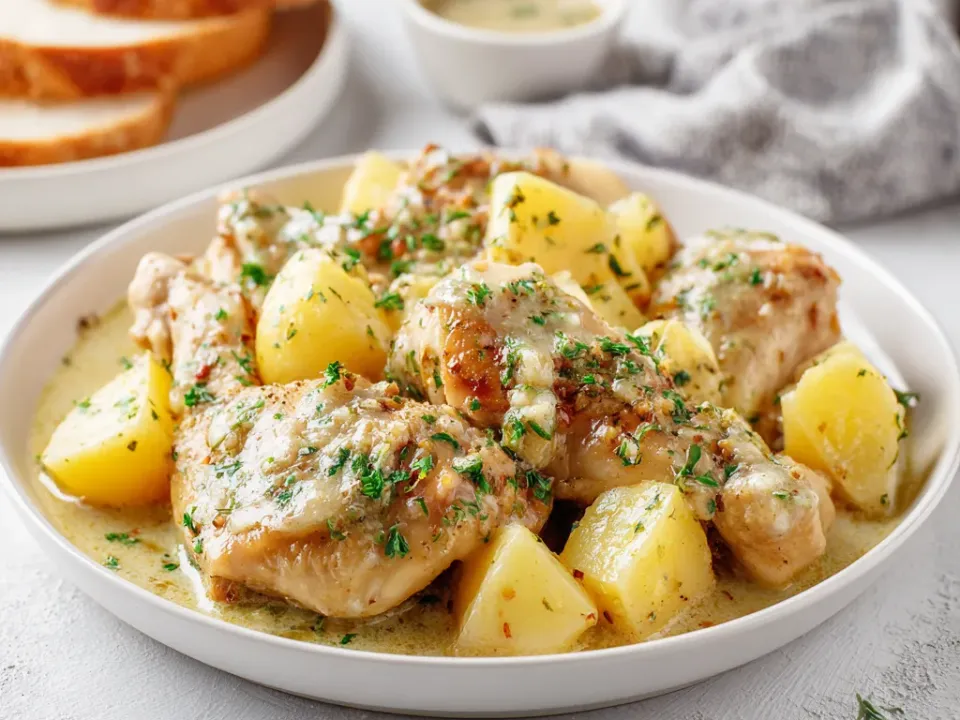
A whole dinner in one crock: chicken thighs and baby potatoes braised together, then pulled into a garlic-Parmesan cream sauce at the end.
Ten minutes of work, four to five hours on Low, and the searing step is genuinely optional.
Why This Recipe Works
- Thighs are the right cut for a long braise. They have enough fat to stay tender across four hours, where breast in the same pot is at its best for a much narrower window — and breasts can be used, so this is worth knowing before you choose.
- The Italian seasoning is split: half a teaspoon on the chicken, the rest in the liquid. Seasoning the meat directly is what stops the chicken tasting like it was cooked in flavoured water.
- Adding the cream and Parmesan at the end, over low heat, is what keeps the sauce smooth. Parmesan is a hard cheese and it splits readily at high temperatures.
- The cornstarch slurry is offered rather than required, and that is the right call — how thin the sauce is depends on how much liquid the chicken and potatoes gave up, which varies.
Why the Layers Are in That Order
This looks like a dump-and-go recipe and mostly is, but the order things go into the crock is doing real work. Reverse two of these layers and you get boiled chicken sitting on hard potatoes.
Cream and Parmesan, at the very end
Twenty to thirty minutes on Low after everything else is cooked. Adding dairy at the start of a four-hour braise is how you get a grainy, separated sauce — this is the only stage where it can go in and stay smooth.
Chicken, nestled on top
Above the liquid line, not in it. Thighs sitting on the potatoes cook in the steam and drip their fat down into them; thighs submerged in broth poach, go stringy and give their flavour to the liquid instead of keeping it.
The seasoned braising liquid, poured over the potatoes
Broth whisked with garlic, melted butter, Italian seasoning, onion powder and red pepper flakes. Pouring it over the potatoes rather than over the chicken means the seasoning ends up in the layer that would otherwise taste of nothing.
Potatoes, on the bottom
Baby golds, halved, straight onto the greased base. They need direct contact with the hot floor of the crock and they need to be submerged in the broth — potatoes are the slowest thing in this pot and the only thing that genuinely needs liquid around it.
Ingredient Notes
- Chicken thighs, or breasts
- Two pounds. Thighs are the more forgiving choice over four hours; breasts work but are worth checking earlier, since they go from done to dry quickly.
- Baby gold potatoes
- A pound and a half, halved. Waxy golds hold together through a long braise where a floury baking potato would break down into the sauce.
- Freshly grated Parmesan
- Half a cup, freshly grated. Pre-grated Parmesan is coated with anti-caking starch, which is exactly what makes a cream sauce turn gritty.
- Lemon zest and baby spinach
- Both optional, both added at the very end. The zest brightens a rich sauce; the spinach wilts in residual heat and mostly adds colour.
How to Make It
Season the chicken
Pat the chicken dry and season it with salt, pepper and 1/2 teaspoon of the Italian seasoning. Searing it in a tablespoon of olive oil until golden is optional.
Potatoes first
Coat the slow cooker with the remaining olive oil or nonstick spray and add the halved potatoes to the bottom.
Mix and pour the braising liquid
Whisk the broth, garlic, melted butter, remaining Italian seasoning, onion powder and red pepper flakes together, pour it over the potatoes, and nestle the chicken on top.
Cook
Low for 4 to 5 hours, or High for 2 to 3, until the chicken is tender and the potatoes are fork-soft.
Check the chicken
An instant-read thermometer in the thickest thigh must read 165°F (74°C). Tenderness and fork-soft potatoes are cues about texture, not about doneness.
Make it a sauce
Stir in the heavy cream and Parmesan and cook on Low 20 to 30 minutes more, until the sauce is smooth. For a thicker sauce, stir in the cornstarch slurry and cook on High 10 to 15 minutes.
Finish
Stir in the parsley, lemon zest and spinach if using, just before serving.
Season and serve
Taste, adjust the salt and pepper, and serve the chicken and potatoes with plenty of the sauce.
Success Tips
- Keep the chicken above the liquid, not in it.
- Halve the potatoes to an even size.
- Check the chicken at 165°F rather than judging by tenderness alone.
- Grate the Parmesan yourself if you can — it is the difference between smooth and gritty.
Serving Ideas
It is already a complete plate, so it wants something green and plain rather than another starch. Steamed green beans, broccoli, or a sharp salad. Extra Parmesan at the table, and bread if there is sauce left.
Storage and Reheating
Refrigerate
Refrigerate up to 3 days. The sauce thickens considerably once cold and the potatoes firm up again, which is normal.
Freeze
Not recommended as a whole dish. Cream sauces separate on thawing and cooked potatoes turn grainy — this is one to eat within a few days instead.
Reheat
Gently on the stove or in a low oven with a splash of broth or cream, kept below a boil so the sauce does not split.
Frequently Asked Questions
Is searing the chicken worth it?
It adds colour and a little depth, and it is optional for good reason — with garlic, butter, Parmesan and Italian seasoning in the pot, the difference is smaller here than in a plainer braise. Skip it on a weeknight without guilt.
My sauce turned grainy.
Usually pre-grated Parmesan, whose anti-caking starch does not melt smoothly, or the crock still being on High when the dairy went in. Both are avoidable: grate your own and drop to Low before the cream.
Can I use chicken breasts instead?
Yes. Check them at the earlier end of the range — around 3 to 4 hours on Low — because breast has far less fat to protect it and will dry out in the time thighs are still improving.