
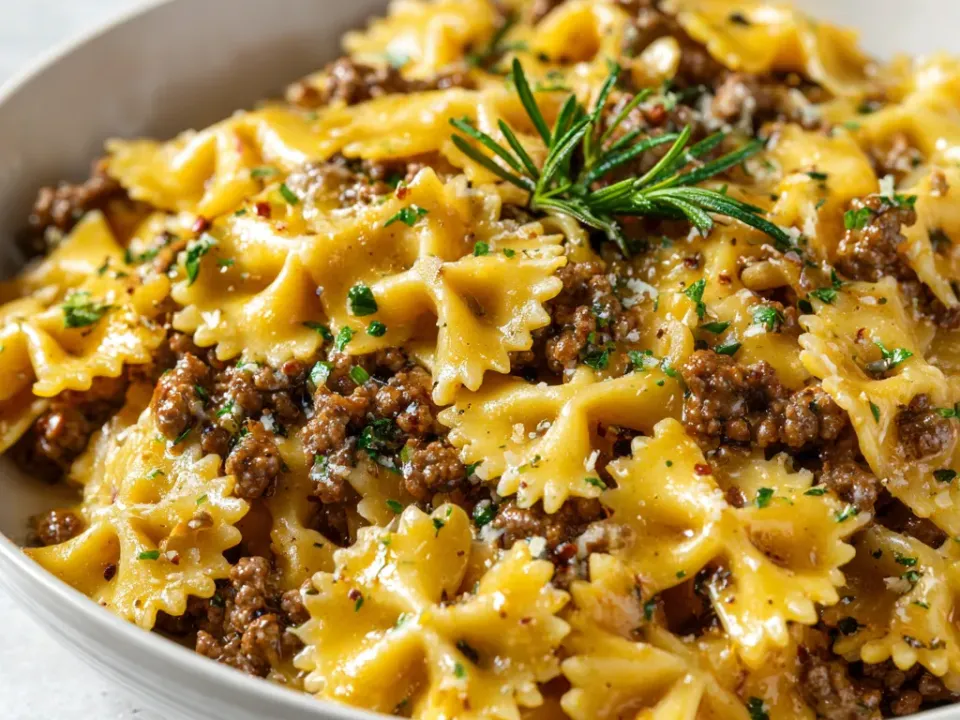
Farfalle boiled in well-salted water while ground beef browns in olive oil, then onion, six cloves of garlic and chilli flakes go into the same skillet.
Three tablespoons of butter melt in with the seasoning, beef broth reduces for a minute or two, and the drained pasta comes in with half a cup of its own water to be tossed into a sauce with the last butter and the Parmesan.
Why This Recipe Works
- The pasta water is an ingredient with its own line in the list, not an afterthought. Starch from the pasta is what holds butter and broth together as a sauce instead of a puddle of fat.
- The butter is divided three and one. Three tablespoons build the sauce over heat; the last tablespoon goes in with the Parmesan at the tossing stage, where it emulsifies rather than simply melts.
- Six cloves of garlic go in after the onion and get thirty to sixty seconds. It is a lot of garlic for a short exposure, which is precisely how you get sweetness rather than bitterness.
- Beef broth rather than water for the reduction. It reinforces what the beef has already put into the pan, and a low-sodium broth keeps the seasoning under the cook's control against the Parmesan's own salt.
- 85/15 beef, specified. There is enough fat in it to carry the flavour and the recipe still tells you to drain the excess if needed — the butter is doing the enriching, not the mince.
- Parmesan is finely grated, which matters when it is going into a hot emulsion. Coarse shreds clump; fine grating dissolves into the sauce.
The Recipe Offers Four Finishes, Not One
Four ingredients in this list are optional, and between them they make quite different dinners out of the same pan. The base recipe is complete without any of them — these are choices the recipe itself puts in front of you.
Which of the optional ingredients are going into the pan at steps 7 and 8?
None of them — the base version
Butter, Parmesan and pasta water alone. Fold in the parsley and serve.
This is a garlic butter sauce emulsified with starch, and it is complete on its own. Everything else is addition rather than correction.
The heavy cream
Half a cup added at step 7 with the last butter and the Parmesan, warmed through.
This is 'a creamy version'. It changes the sauce from a glossy emulsion into something closer to a cream sauce, and it will want less pasta water afterwards.
Lemon zest and juice
Half a lemon, folded in at step 8 with the parsley.
It is there 'for brightness'. Four tablespoons of butter, beef and Parmesan is a rich pan, and the acid cuts it.
Baby spinach
A cup, tossed in at step 8 just to wilt.
Just to wilt is the instruction — it goes in at the very end and the residual heat does the work. Cooked any longer it collapses and dulls.
How to Make It
Boil the pasta, save the water
Bring a large pot of salted water to a boil. Cook the farfalle until al dente according to package directions. Reserve at least 1 cup pasta water, then drain.
Brown the beef
While the pasta cooks, heat the olive oil in a large skillet over medium-high. Add the ground beef, season with a pinch of salt and pepper, and cook, breaking it up, until browned. Drain excess fat if needed.
Onion, then garlic
Add the diced onion to the skillet and sauté 2–3 minutes until softened. Stir in the minced garlic and red pepper flakes; cook 30–60 seconds until fragrant.
Butter and seasoning
Reduce the heat to medium. Add 3 tablespoons butter and stir until melted. Sprinkle in the Italian seasoning, 3/4 teaspoon kosher salt and 1/2 teaspoon black pepper.
Reduce the broth
Pour in the beef broth and simmer 1–2 minutes to slightly reduce and emulsify the garlic butter sauce.
Pasta in, with its water
Add the drained pasta to the skillet along with 1/2 cup reserved pasta water. Toss to coat and loosen the sauce as needed.
Last butter and Parmesan
Stir in the remaining 1 tablespoon butter and the Parmesan. For a creamy version, add the heavy cream and warm through. Adjust with more pasta water for a silky sauce.
Greens and brightness
Fold in the parsley and lemon zest and juice. Add the spinach if using and toss just to wilt.
Taste and serve
Taste and adjust the seasoning. Serve hot with extra Parmesan and black pepper.
Ingredient Notes
- Farfalle (bowtie) pasta
- Twelve ounces, cooked al dente. Bowties have a thick pinched centre that keeps bite while the wings hold sauce, which is why the shape suits an emulsified sauce like this one.
- Ground beef (85/15)
- A pound at that specific ratio. Leaner mince gives a drier result in a sauce that is already relying on butter for richness.
- Reserved pasta water (use as needed)
- Listed as an ingredient because it behaves like one. Half a cup goes in at step 6 and more is used at step 7 to reach a silky sauce.
- Unsalted butter, divided
- Four tablespoons split three and one. Unsalted throughout — three-quarters of a teaspoon of kosher salt plus Parmesan is already the recipe's salt budget.
- Finely grated Parmesan cheese
- Half a cup, finely grated so it melts into the sauce rather than sitting in strands.
- Heavy cream (optional for a creamy version)
- Half a cup. This is the alternative creamy version rather than a fix — the base sauce is complete without it.
Success Tips
- Salt the pasta water properly; it is the only seasoning the farfalle gets.
- Keep a full cup of pasta water back, not just the half cup the sauce needs.
- Drain the beef fat if it pools — the butter is what should be enriching this.
- Grate the Parmesan finely so it melts instead of clumping.
- Toss the spinach through with the heat low and serve straight away.
Serving Ideas
Extra Parmesan and black pepper at the table, as the last step says. Garlic bread would double up on the garlic butter; a sharp green salad is the better partner.
Storage and Reheating
Refrigerate
Refrigerate in an airtight container for up to 3 days. The sauce is an emulsion and will tighten considerably once cold.
Freeze
Not recommended in the creamy version. The base version freezes acceptably for up to 2 months, though the pasta softens.
Reheat
Reheat in a pan with a splash of water or broth, tossing until the sauce loosens back to a coating. A microwave tends to separate it.
Frequently Asked Questions
Can I use a different pasta shape?
The recipe is written for twelve ounces of farfalle. Any shape with enough surface to hold an emulsified sauce behaves similarly, but the cooking time comes from the packet rather than from this recipe.
The sauce went tight and greasy.
More reserved pasta water, tossed hard. That is exactly what step 7 means by adjusting for a silky sauce; the starch in that water is what brings butter and broth back together.
Do I need the lemon?
It is optional, there for brightness. In the creamy version it is worth having; in the base version it is a matter of taste.
Can I swap the beef?
The recipe specifies 85/15 ground beef and pairs it with beef broth. A leaner meat would need the fat and the broth reconsidered, which is beyond what this recipe states.