
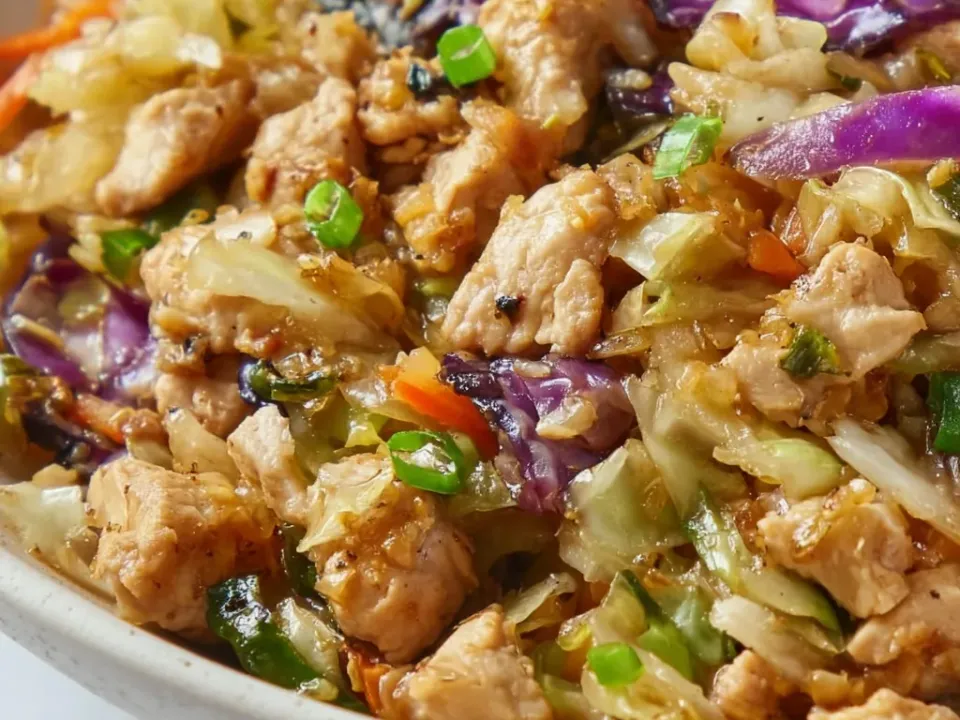
The filling of an egg roll — ground chicken, cabbage, carrot, ginger and garlic — cooked in one skillet and dressed with soy, rice vinegar and sesame.
Fifteen minutes of prep, fifteen minutes in the pan, and no wrapper to roll.
Why This Recipe Works
- Cooking the chicken and onion together at the start means the onion softens in the rendered fat rather than needing its own step, which is how this fits into fifteen minutes of pan time.
- A full tablespoon of grated fresh ginger is what makes the bowl taste like an egg roll rather than like a cabbage stir-fry. Ground ginger is not a substitute at that volume.
- Adding the cabbage after the aromatics rather than with them keeps the garlic from burning while five cups of vegetable slowly come up to temperature.
- The sauce goes in at the very end and cooks for one minute. Soy and rice vinegar added earlier would boil off their brightness across the cabbage's water.
- Toasted sesame oil is a finishing oil here, not a cooking one — a teaspoon in the last minute, where its aroma survives.
The Filling, Cooked in the Open
An egg roll bowl is the inside of an egg roll cooked in a pan instead of sealed in a wrapper and fried. Everything about the method follows from that: the filling has to lose its water in the open, and the seasoning goes on at the end rather than being trapped inside.
Brown6 to 8 minutes, to 165°F
Ground chicken and onion together, broken into crumbles. The chicken is lean, so the browning here is most of the savoury depth the dish gets.
Bloom30 seconds
Garlic and ginger into the hot pan, where they turn fragrant almost immediately. A tablespoon of grated ginger is a lot and it is meant to be.
Wilt, do not stew4 to 5 minutes
Cabbage and carrot go in and are tossed rather than left to sit. The target is crisp-tender: the cabbage has given up its raw crunch but still has structure, which is what keeps this from turning into a wet pan of greens.
Dress1 minute
Soy, rice vinegar, sesame oil and the optional sriracha go in last and cook for barely a minute. Long enough to coat, short enough that the vinegar and the toasted sesame keep their aroma.
Finish
Green onions and optional sesame seeds off the heat, for freshness and crunch against a soft pan.
Ingredient Notes
- Ground chicken
- One pound, and the recipe's own step 2 names 165°F for it. Ground poultry needs that threshold regardless of colour.
- Fresh ginger
- One tablespoon, grated. This is the flavour that carries the dish and the quantity is deliberately generous.
- Green cabbage, thinly shredded
- Five cups. Thin shreds wilt evenly in four minutes; thick ribbons need longer and release their water unevenly.
- Low-sodium soy sauce
- Three tablespoons, low-sodium because it goes in undiluted at the end onto an already-seasoned pan.
- Toasted sesame oil
- One teaspoon, toasted rather than plain, added with the sauce rather than used to cook in.
- Sriracha
- One teaspoon, explicitly optional. A single teaspoon across four servings is warmth rather than heat.
How to Make It
Heat the pan
Heat the neutral oil in a large skillet over medium-high heat.
Brown the chicken and onion
Add the ground chicken and onion and cook, breaking the chicken into crumbles, until the chicken reaches 165°F and the onion softens, 6 to 8 minutes.
Add garlic and ginger
Add the garlic and ginger and cook 30 seconds.
Toss in the cabbage and carrot
Add the cabbage and carrot and cook 4 to 5 minutes, tossing, until crisp-tender.
Dress the pan
Stir in the soy sauce, rice vinegar, sesame oil and the optional sriracha, and cook 1 minute.
Finish and serve
Finish with the green onions and the optional sesame seeds and serve.
Success Tips
- Have the cabbage and carrot ready before the pan goes on.
- Check 165°F on the chicken rather than judging by colour.
- Toss the cabbage rather than letting it sit, and stop at crisp-tender.
- Add the sauce at the end and give it only a minute.
- Keep the sesame oil for the finish, not the frying.
Serving Ideas
Straight from the pan in bowls, or over rice if you want it to stretch further. The green onions and sesame seeds are worth adding at the table so they stay crisp.
Storage and Reheating
Refrigerate
Refrigerate up to 3 days in a sealed container. The cabbage softens further as it sits.
Freeze
Not recommended. Cabbage that has already been cooked to crisp-tender goes limp and watery on thawing.
Reheat
Quickly, in a hot pan rather than a microwave, so the remaining moisture cooks off instead of steaming the bowl.
Frequently Asked Questions
Can I use ground pork or turkey instead?
The recipe is written for one pound of ground chicken. Ground turkey behaves almost identically and takes the same 165°F. Ground pork is fattier and would want draining after browning.
Can I use a bagged coleslaw mix?
The recipe calls for five cups of thinly shredded green cabbage plus a julienned carrot, which is roughly what a bag of coleslaw mix contains. The texture will be slightly finer and it may wilt a little faster.
Why did mine come out watery?
Usually a crowded pan. Five cups of cabbage need contact with hot metal to drive their water off; piled into a small skillet they steam. Use a large skillet, keep the heat up and toss rather than stir.
Can I make it ahead?
It reheats acceptably for a few days but it is at its best straight from the pan, when the cabbage still has bite and the sesame is still aromatic.