
Eleven ingredients and forty-five minutes for four stuffed breasts. The pocket is cut without going through, filled, seared, and finished in the oven in the same pan.
The surface is paprika and nothing else. There is no crumb coating on these.
Why This Recipe Works
- Cutting a deep pocket rather than butterflying keeps the filling enclosed on three sides.
- Cream cheese binds the spinach and mozzarella into a filling that does not run out when heated.
- Paprika on the outside gives the seared surface its colour.
- Three to four minutes a side browns the outside while leaving the oven to do the cooking.
- Reducing butter and broth in the same skillet turns the fond into the pale pan juices around the chicken.
Ingredient Notes
- Cream cheese
- Four ounces, softened, and the binder for the filling. Spinach and mozzarella alone would leak out of the pocket.
- Paprika
- A teaspoon on the outsides. It is the whole surface treatment — there is no flour, egg or breadcrumb on these breasts.
- Butter and broth
- A tablespoon and a third of a cup, reduced after the chicken comes out. That is the pale pan juice the finished plate sits in.
- Baby spinach
- A cup, chopped and raw into the filling. It wilts inside the breast as it cooks.
How to Make It
Cut a deep pocket
Heat oven to 400 degrees Fahrenheit. Cut a deep pocket into each chicken breast without slicing through.
Mix and fill
Mix cream cheese, spinach, mozzarella, and garlic. Divide the filling among the breast pockets and secure with toothpicks if needed.
Paprika outside, sear
Season outsides with paprika, salt, and pepper. Sear in olive oil 3 to 4 minutes per side so the surface turns browned and paprika-coloured with no crumb coating.
Oven to 165F, twice over
Transfer the skillet to the oven and cook until the thickest part and the center of the stuffing reach 165 degrees Fahrenheit.
Rest, then pan juices
Rest chicken 5 minutes. Add butter and broth to the skillet and reduce briefly into pale pan juices; spoon around the chicken.
Four Checks on a Stuffed Breast
A stuffed chicken breast has two failure modes: the filling escapes, or one of the two things inside it is not cooked. Each checkpoint below guards against one of them, and the last is about the finish.
Step 1 - the pocket
Deep, but NOT sliced through the far side.
A pocket keeps the filling enclosed on three sides; a butterflied breast has to be folded and tied. This is the difference between a filling that stays inside and one that runs into the pan during the sear.
Step 2 - the binder
4 oz of softened cream cheese through the 1 cup of chopped spinach and 1/2 cup of mozzarella.
Spinach and mozzarella on their own turn liquid as they heat. The cream cheese is what holds them together long enough for the breast to cook, and toothpicks close the gap if the pocket still gapes.
Step 4 - TWO temperatures
165F in the thickest part of the meat AND 165F in the centre of the stuffing.
The recipe names both, and they do not arrive together: a cold cream-cheese filling in the middle of a breast is the slowest thing in the pan, and it is the one most likely to be missed. Probe the stuffing separately.
Step 3 - no crumb
1 tsp of paprika, salt and pepper on the outside. Nothing else.
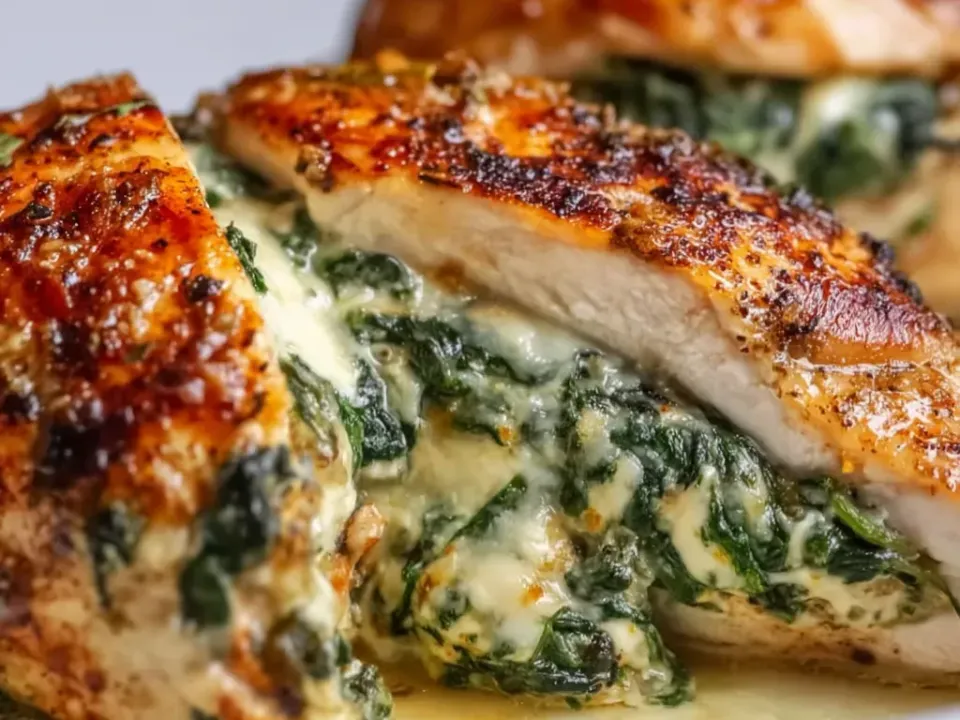
This one has no crumb crust: it is bare seared surface, and the paprika is what colours it.
Success Tips
- Cut the pocket deep but do not go through the far side.
- Use toothpicks if the pocket gapes; a sealed breast keeps its filling.
- Probe the stuffing as well as the meat — they do not reach temperature at the same time.
Serving Ideas
Four servings on white plates, each breast sliced open to show the creamy spinach filling under its browned paprika-coloured surface, with the pale buttery pan juices spooned around it.
Frequently Asked Questions
Should these have a crumb crust?
Not this one. The surface here is seared and paprika-coloured with no coating at all.
Why check two places?
The thickest part of the meat and the centre of the stuffing both have to reach 165 degrees Fahrenheit, and the filling is usually the slower of the two.
My filling leaked out. What happened?
Usually the pocket was cut through the far side, or it gaped during searing. Toothpicks are there for exactly that.