
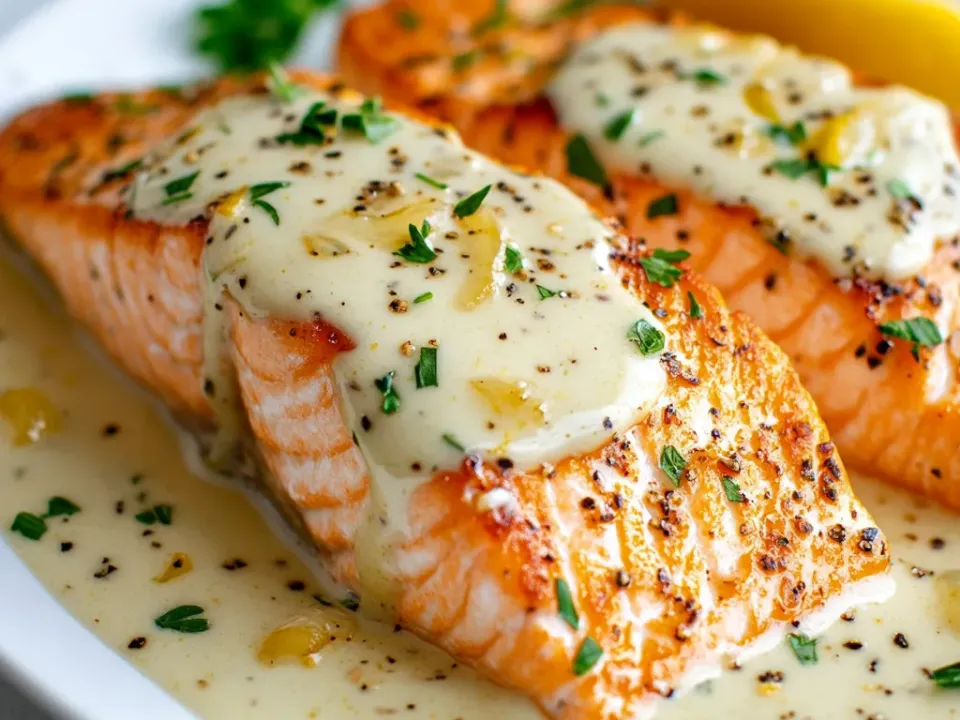
Four salmon fillets seasoned and set on a bed of thin lemon slices, with a third of a cup of broth poured around rather than over them.
One to one and a half hours on LOW, then the fish comes out and half a cup of the cooking liquid becomes a garlic, cream and herb sauce in a small pan.
Why This Recipe Works
- The cook is short and it is meant to be. A slow cooker on LOW is a gentle, even, humid heat — ideal for salmon at ninety minutes and catastrophic at six hours.
- Lemon slices as a rack. They keep the fillets off the hot base so nothing overcooks from below, and they season the fish through the steam.
- The broth goes around, not over. That is the difference between steaming the salmon and poaching it, and it is why the seasoning stays where it was put.
- The sauce is built from the cooking liquid, in a separate pan. Everything the fish gave off is in that half cup; reducing it with garlic, butter and cream takes four minutes and does not overcook the salmon meanwhile.
- Dill and parsley go in off the heat. Both are delicate, and both would be dull if they simmered even the two or three minutes the cream does.
Four Points Where Slow-Cooker Salmon Goes Wrong
A slow cooker is an unusual place to cook a fillet of salmon, and it works because of four specific decisions. Each of them is easy to skip and each of them costs the dish.
Step 1, before anything else
The salmon sits on lemon slices, not on the ceramic.
The slices are a rack. They hold the fillets off the base, which is the hottest surface in the cooker, and they perfume the fish from underneath at the same time.
Step 2
The broth is poured AROUND the salmon, never over it.
Liquid poured over the fillets washes the seasoning off and starts poaching the tops. A third of a cup around them makes steam, which is what actually cooks them.
Step 3, from the one-hour mark
The thickest fillet reads 145°F.
The range is one to one and a half hours because cookers and fillets both vary. This is the only reliable test, and it is why the recipe says to check early.
Step 5
The sauce is made in a separate pan, not in the cooker.
Cream added to the cooker would never reduce and the salmon would sit in it going past done. Half a cup of the cooking liquid carries all the flavour into a pan where a sauce can actually be made.
Ingredient Notes
- Salmon fillets, 5 to 6 ounces
- Four, in a single layer. Even thickness matters more than exact weight, because thickness is what the one-to-ninety-minute range is about.
- Lemon, thinly sliced
- A whole lemon, sliced thin and used as a rack. This is structural as well as aromatic.
- Heavy cream
- Half a cup, in the saucepan and never in the cooker. It needs a real simmer to thicken, which a slow cooker cannot give it.
- Fresh dill and parsley
- A tablespoon each, stirred in off the heat. Dried dill is not a substitute — the freshness is the point.
- Low-sodium broth
- A third of a cup, chicken or vegetable. Half of it becomes the sauce, so it carries flavour twice.
How to Make It
Lemon rack and salmon
Place lemon slices in the bottom of a slow cooker and set the salmon on top. Season with salt and pepper.
Broth around, not over
Pour the broth around the salmon, not directly over it.
Cook on LOW, checking early
Cover and cook on LOW for 1 to 1 1/2 hours, checking early, until the thickest fillet reaches 145°F.
Lift the salmon out
Transfer the salmon carefully to a platter and keep warm.
Start the sauce
Pour 1/2 cup of the cooking liquid into a small saucepan. Add garlic and butter and simmer for 1 minute.
Cream, then herbs off the heat
Stir in the cream and simmer gently for 2 to 3 minutes, until slightly thickened. Remove from heat and stir in lemon juice, dill and parsley.
Serve
Spoon the sauce over the salmon and serve.
Success Tips
- Set a timer for one hour and start checking then, not at ninety minutes.
- Lay the lemon slices so they overlap slightly and cover the base.
- Pour the broth down the side of the cooker, around the fillets.
- Use a wide spatula to lift the salmon; it is fragile when it is done.
- Take the sauce off the heat before the herbs and lemon juice go in.
Serving Ideas
New potatoes or rice and a green vegetable. The sauce is generous, so something plain to catch it is better than another rich side.
Storage and Reheating
Refrigerate
Refrigerate salmon and sauce separately for up to 2 days. The sauce thickens when cold and loosens with gentle warming.
Freeze
Freezing is not recommended. Cooked salmon goes dry and fibrous, and a cream sauce separates.
Reheat
Reheat gently, covered, at a low temperature just until warm. Salmon reheated hard is salmon cooked twice.
Frequently Asked Questions
Can I leave it cooking all day like other slow-cooker recipes?
No, and this is the one thing the recipe is emphatic about. Salmon needs one to one and a half hours on LOW; a standard all-day setting would leave you with something dry and falling apart.
Can I make the sauce in the slow cooker?
Cream will not thicken at slow-cooker temperatures, and the salmon would overcook while you waited. Half a cup of the cooking liquid carries the flavour into a pan where a sauce can be made in four minutes.
My salmon fell apart.
It went past 145°F. Start checking at the one-hour mark — the range in step 3 exists because fillet thickness and cookers both vary.
Can I use frozen fillets?
Thaw them fully first. A partly frozen fillet cooks unevenly and adds water to a cooker that is meant to be making steam rather than a poaching liquid.