
Eight ingredients, forty-seven minutes of work and at least four hours in the fridge afterwards.
Two short bakes rather than one: five minutes for the bases, then sixteen to eighteen for the filling on top of them.
Why This Recipe Works
- Pressing the base firmly is what makes it thick and distinct once unmoulded.
- A five-minute bake sets the base so it does not soften under wet filling.
- 325 degrees is gentle enough to set a small cheesecake without cracking it.
- Sour cream keeps a baked filling creamy and pale rather than dense.
- Four hours of chilling is what makes them firm enough to leave the pan whole.
Ingredient Notes
- Graham-cracker crumbs
- A cup and a half with four tablespoons of melted butter, pressed firmly into twelve thick bases and pre-baked so they hold when the cheesecakes leave the pan.
- Cream cheese
- Sixteen ounces, softened, beaten smooth with the sugar before anything wet joins it.
- Sour cream
- Half a cup. It is what keeps a baked filling creamy and pale rather than firming into something heavy.
- Pastel speckled candy eggs
- Thirty-six of them, generic — three whole eggs clustered on each cheesecake, never crushed into the filling.
How to Make It
Oven to 325°F, twelve cups lined for removal
Heat oven to 325°F and line a 12-cup muffin pan with removable parchment strips or silicone liners.
Bases pressed firmly, baked five minutes
Mix graham crumbs with butter and press firmly into 12 thick bases. Bake 5 minutes and cool briefly.
Filling beaten smooth, eggs one at a time
Beat cream cheese and sugar smooth, then beat in eggs one at a time, vanilla, and sour cream just until combined.
Sixteen to eighteen minutes, then four hours cold
Divide over the bases and bake 16 to 18 minutes until the edges are set and the centers no longer look wet. Cool, then chill at least 4 hours until firm enough to unmould.
Unmoulded, three whole eggs on each
Unmould and top each smooth cheesecake with 3 whole generic pastel candy eggs.
No piping and no sauce
Do not pipe cream or add sauce.
Why This One Goes in the Oven
These mini cheesecakes have a golden crumb and a pale top, and the key is in step 1: they are BAKED. Everything that follows - the firm round, the distinct base, the smooth unpiped top - follows from that.
Stage 1 of 5
The base - pressed HARD, then baked alone
Steps 1–2 of 6
1 1/2 cups of graham crumbs with 4 tbsp melted butter, pressed FIRMLY into 12 THICK bases in a pan lined with removable parchment strips or silicone liners, then baked 5 MINUTES on its own. Two things are being set up here. Firm pressing and a pre-bake are what let the base survive being lifted out of the pan later - you want a THICK DISTINCT biscuit base visible on an unmoulded round, and a loose crumb simply falls apart at that moment. The removable lining is chosen for the same reason: nothing here is served in the vessel it was made in.
- Oven to 325°F, twelve cups lined for removalHeat oven to 325°F and line a 12-cup muffin pan with removable parchment strips or silicone liners.
- Bases pressed firmly, baked five minutesMix graham crumbs with butter and press firmly into 12 thick bases. Bake 5 minutes and cool briefly.
Stage 2 of 5
The filling - eggs ONE AT A TIME
Steps 3–3 of 6
16 oz cream cheese beaten smooth with 2/3 cup granulated sugar FIRST, then 2 large eggs one at a time, 1 tsp vanilla and 1/2 cup sour cream, JUST UNTIL COMBINED. The order is the technique: sugar into cheese while it is stiff enough to work lumps out, then liquids once it is smooth, because nothing after this point will smooth a lump. One egg at a time keeps the batter emulsified, and stopping early keeps air out - beaten air is what makes a baked cheesecake rise and then crack, and this one needs a SMOOTH top.
- Filling beaten smooth, eggs one at a timeBeat cream cheese and sugar smooth, then beat in eggs one at a time, vanilla, and sour cream just until combined.
Stage 3 of 5
The bake - 325F, and a visual endpoint
Steps 4–4 of 6
16 TO 18 MINUTES at 325F, until THE EDGES ARE SET AND THE CENTRES NO LONGER LOOK WET. A low oven for a small cheesecake: hot enough to set the eggs, gentle enough not to puff and split the surface. The endpoint is deliberately visual rather than timed, because 12 small cheesecakes vary - and the centres are meant to leave the oven only just done, since they go on firming as they cool.
- Sixteen to eighteen minutes, then four hours coldDivide over the bases and bake 16 to 18 minutes until the edges are set and the centers no longer look wet. Cool, then chill at least 4 hours until firm enough to unmould.
Stage 4 of 5
FOUR hours cold, then out of the pan
Steps 4–4 of 6
Cooled, then AT LEAST 4 HOURS chilled UNTIL FIRM ENOUGH TO UNMOULD. This is the longest passive step in the recipe and the one that cannot be shortened. A baked cheesecake is soft when warm; the fridge is what turns it into a round that holds its shape and its base off the pan.
- Sixteen to eighteen minutes, then four hours coldDivide over the bases and bake 16 to 18 minutes until the edges are set and the centers no longer look wet. Cool, then chill at least 4 hours until firm enough to unmould.
Stage 5 of 5
Three WHOLE eggs each, and nothing else
Steps 5–6 of 6
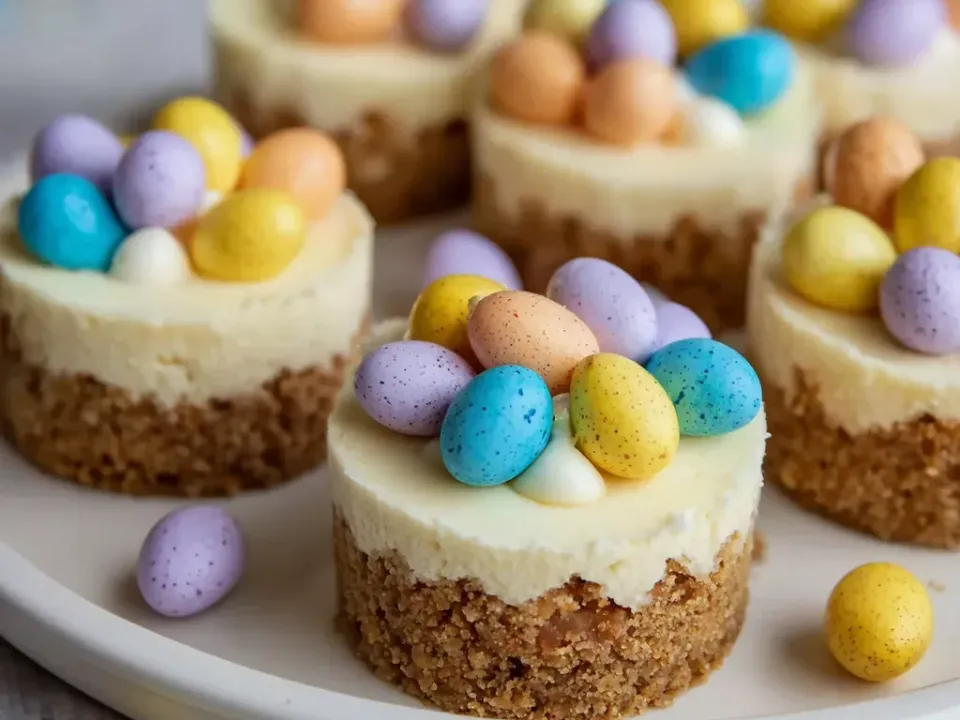
36 generic pastel candy eggs, 3 WHOLE ones CLUSTERED on each smooth top. Whole rather than crushed through. Any brand of candy eggs works. And step 6 is a refusal: DO NOT PIPE CREAM OR ADD SAUCE. The top stays smooth pale set cream.
- Unmoulded, three whole eggs on eachUnmould and top each smooth cheesecake with 3 whole generic pastel candy eggs.
- No piping and no sauceDo not pipe cream or add sauce.
Success Tips
- Press the bases hard; a loose base crumbles the moment you lift the cheesecake out.
- Beat the eggs in one at a time and stop as soon as the filling comes together.
- Pull them when the centres have stopped looking wet — they finish setting in the fridge.
Serving Ideas
Twelve small round cheesecakes on a white plate, each on its thick golden biscuit base with a smooth pale set top and a cluster of three whole pastel speckled eggs. No drizzle and no sauce.
Frequently Asked Questions
How is this different from the other Easter cheesecakes here?
This one is baked. These are baked at 325 degrees on a graham base and unmoulded as firm rounds.
Why chill four hours before unmoulding?
Because they have to come out of the pan whole, with the base intact. Less time and they are still too soft to hold their round shape.
Should the candy eggs go into the filling?
No. Three whole eggs sit clustered on top of each one — that is what the finished plate shows, and crushing them through would change the dessert.