
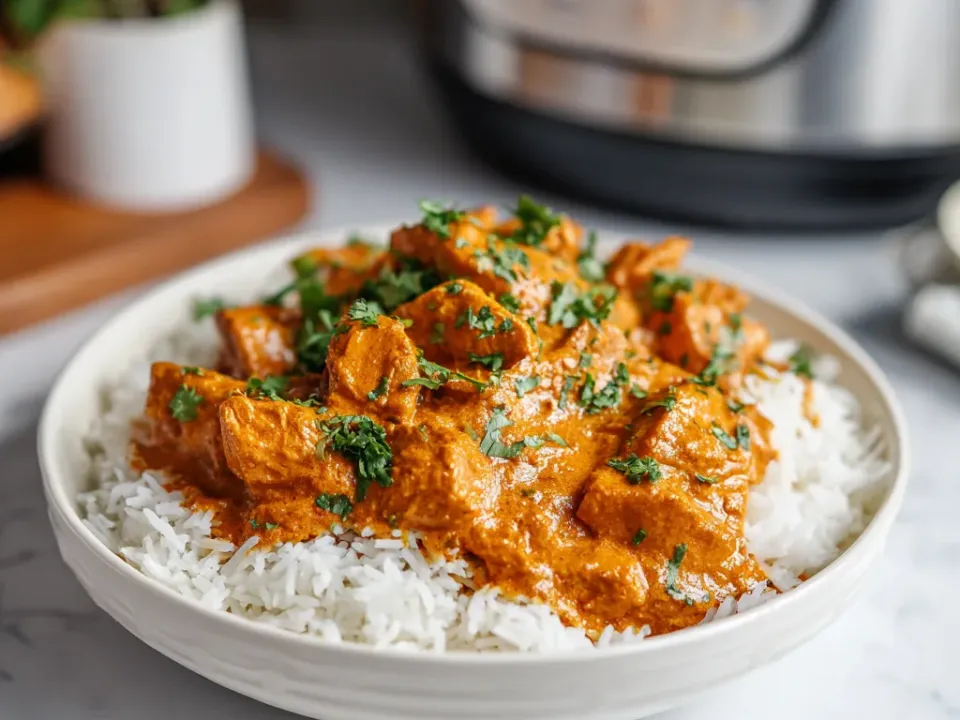
Butter chicken adapted for a slow cooker — a spiced yogurt marinade, a tomato and butter base, and cream stirred through at the end.
Fifteen minutes of work, four to five hours on Low, and six tablespoons of butter that are not optional.
Why This Recipe Works
- The yogurt marinade does two things at once: it seasons the chicken from the outside in, and its acidity works on the meat while the rest of the prep happens. It is worth the extra bowl.
- Building the tomato base in the cooker before the chicken goes in means the dry spices meet liquid straight away. Spices dropped on top of meat tend to stay on top of meat.
- Splitting the garam masala is the single most important detail. Long cooking dulls warm spices, so the half-tablespoon added at the end is what makes the finished sauce smell like the dish rather than like tomato.
- Butter is in at the start and cream at the end, and they are doing different jobs — the butter enriches the sauce as it cooks down, the cream lifts and lightens it in the last fifteen minutes.
- Thighs rather than breasts, cut into large chunks. They hold up across a five-hour cook where leaner cuts dry out.
When Each Thing Goes In
Five steps, but three separate moments where dairy or spice enters — and the order is the recipe. Everything below is that sequence, laid out on a timeline.
Before the cooker is switched on
Yogurt, lemon juice, ginger, garlic, 1 tsp salt, 1 tbsp garam masala — with the chicken
The marinade. It can be as short as the time it takes to prep the rest, or up to 12 hours refrigerated.
Into the empty cooker
Onion, tomato sauce, tomato paste, optional sugar, cumin, coriander, turmeric, paprika, optional chili powder, remaining 1 tsp salt
The base is built and stirred together BEFORE the chicken arrives, so the dry spices are distributed rather than sitting in pockets.
On top of the base
The marinated chicken, and 6 tbsp butter dotted over
The butter goes in at the start, not the end — it melts down through the sauce across the whole cook. Low 4–5 hours or High 2–3.
After the doneness check
Heavy cream, the remaining 1/2 tbsp garam masala, crushed fenugreek
The second masala hit is what keeps the finished dish from tasting like it has been cooking for five hours. 10–15 minutes covered on Low.
At the table
Black pepper, salt to taste, chopped cilantro
The last seasoning happens after the cream, because a cup of cream mutes salt that tasted correct before it went in.
Ingredient Notes
- Garam masala, divided
- One and a half tablespoons total: one into the marinade, half a tablespoon into the finish. The division is the recipe, not a rounding.
- Kosher salt, divided
- Two teaspoons total, split evenly between the marinade and the cooker base.
- Whole-milk yogurt
- One cup, whole-milk, with coconut yogurt as the listed dairy-free swap. Low-fat yogurt is thinner and more likely to split.
- Unsalted butter
- Six tablespoons, cut into pieces and dotted over rather than stirred in. Unsalted, because two teaspoons of kosher salt are already accounted for.
- Kasuri methi (dried fenugreek leaves)
- One teaspoon, crushed, optional. It is the flavour most people recognise but cannot name in a butter chicken.
- Kashmiri chili powder
- Half a teaspoon, optional. Kashmiri is mild and mostly there for colour; any mild chili powder can be used instead.
How to Make It
Marinate the chicken
In a bowl, combine the yogurt, lemon juice, ginger, garlic, 1 teaspoon of the salt and 1 tablespoon of the garam masala. Add the chicken and toss to coat. Marinate while you prep, or up to 12 hours refrigerated.
Build the base in the cooker
Add the onion, tomato sauce, tomato paste, sugar if using, cumin, coriander, turmeric, paprika, chili powder if using, and the remaining 1 teaspoon of salt. Stir to combine.
Add the chicken and butter, then cook
Nestle the marinated chicken into the sauce and dot with the butter. Cover and cook on Low for 4 to 5 hours, or on High for 2 to 3 hours, until the chicken is tender.
Finish creamy
Stir in the heavy cream, the remaining 1/2 tablespoon of garam masala and the crushed fenugreek. Cook covered on Low for 10 to 15 minutes to meld.
Season and serve
Season with pepper and additional salt to taste. Garnish with cilantro and serve over basmati rice with naan.
Success Tips
- Respect the two divided ingredients — half the salt and most of the masala go in early, the rest at the end.
- Stir the tomato base together before the chicken goes on top of it.
- Dot the butter over rather than stirring it in; it renders down through the cook.
- Check 165°F rather than relying on the tender cue alone.
- Season last, after the cream — a cup of cream flattens salt that tasted right before it.
Serving Ideas
Over steamed basmati with warm naan, which is what the recipe names and what the photograph shows. The sauce is generous, so rice earns its place.
Storage and Reheating
Refrigerate
Refrigerate up to 3 days in a sealed container. The flavour deepens overnight and the sauce thickens.
Freeze
Freezes reasonably for up to 2 months, though a heavy-cream sauce can look grainy on thawing. Thaw fully in the fridge and reheat gently, stirring, and it usually comes back together.
Reheat
Low and slow on the stove or in short microwave bursts, stirring between them. Loosen with a splash of cream or water if it has tightened.
Frequently Asked Questions
Can I use chicken breasts?
The ingredient list specifies boneless, skinless thighs in large chunks, and they suit a four-to-five-hour cook. Breasts will work but are leaner and dry out faster, so check for 165°F at the early end of the window.
Can this be made dairy-free?
Use coconut yogurt in place of the plain yogurt and full-fat coconut milk in place of the heavy cream. There is no listed substitute for the six tablespoons of butter, so that decision is yours to make.
How long does the chicken need to marinate?
Step 1 allows anything from the time it takes to prep the rest of the ingredients up to 12 hours refrigerated. Longer gives a more seasoned result; it is not required.
Is it hot?
Not by default. The only chili is half a teaspoon of Kashmiri or mild chili powder, and it is optional — Kashmiri is used mainly for colour. Add more if you want heat.