
Eleven ingredients and thirty-five minutes, in one pan of shallow oil.
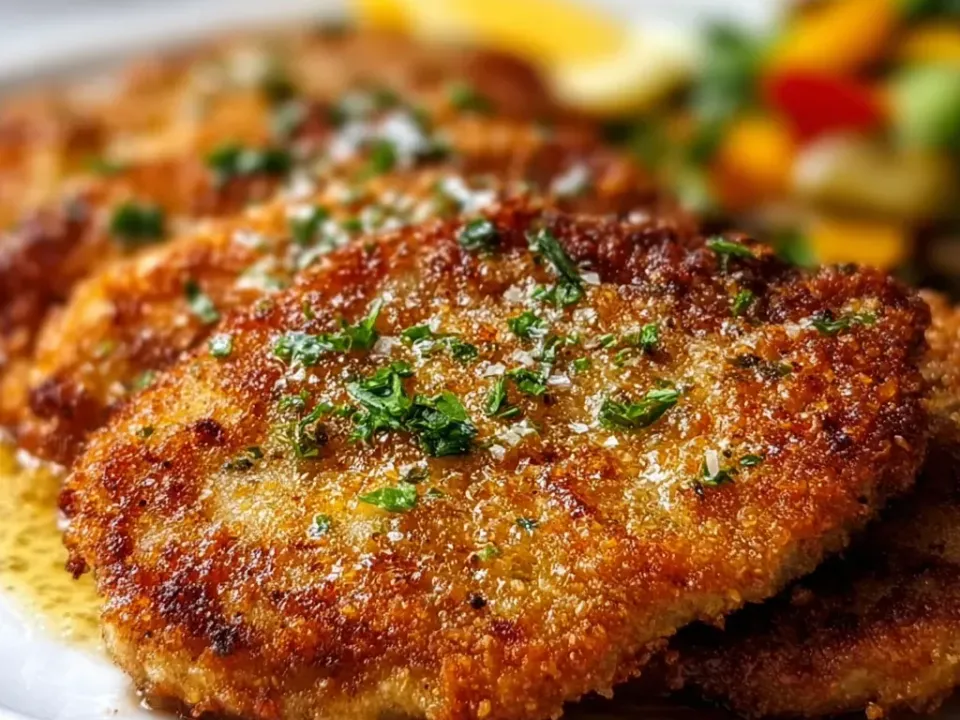
There is no sauce here at all. The finish is parsley, a pinch of flaky salt and a lemon wedge you squeeze yourself.
Why This Recipe Works
- Seasoning the cutlets before breading gets salt into the meat, not just the crust.
- Parmesan in the crumb browns alongside the panko instead of burning on top.
- Panko stays coarse, which is what gives the deeply golden textured crust.
- Shallow frying browns both faces evenly without submerging the cutlet.
- Flaky salt added after frying stays crisp on the surface.
Ingredient Notes
- Panko with Parmesan and dried Italian herbs
- A cup of panko with a third of a cup of Parmesan and a teaspoon of herbs. All three are mixed together, so the cheese browns inside the crust.
- Flaky salt
- Added after frying rather than before. It stays as visible crystals on the crust, which is what the finished plate shows.
- Lemon wedges
- One lemon, cut into wedges. A serving element rather than a garnish — the only acidity on the plate.
- Chicken breast cutlets
- Four. Thin enough that the crumb browns deeply in the time the chicken needs to reach temperature.
How to Make It
Cutlets seasoned first
Season the cutlets with kosher salt.
Three stations, with Parmesan in the crumb
Set up flour, beaten eggs, and a panko mixture with Parmesan and Italian herbs.
Flour, egg, seasoned crumb
Coat each cutlet in flour, egg, then the seasoned crumb.
Shallow-fried to golden and 165°F
Shallow-fry until deeply golden on both sides and the chicken reaches 165°F.
Drained, then parsley and flaky salt
Drain briefly and finish with parsley and a small pinch of flaky salt.
Lemon wedges, and no authenticity claim
Serve with lemon wedges; make no traditional or regional-authenticity claim.
Four Points Where a Plain Cutlet Is Decided
There is no sauce on this plate and no glaze on the chicken, which means the crust has nowhere to hide. The cutlet is left bare, so every decision below shows in the eating.
Before breading - step 1
The CUTLETS are salted, not just the crumb
3/4 tsp of kosher salt goes onto the chicken itself. It is the easiest step to skip and the one most responsible for a bland cutlet: a seasoned crust sits on unseasoned meat, and no amount of flaky salt at the end reaches inside. With no sauce coming later, this is the only chance to season the chicken at all.
The crumb - step 2
Parmesan and herbs go IN the panko, not on top
1 cup panko with 1/3 cup FINELY GRATED Parmesan and 1 tsp dried Italian herb blend, mixed together. Cheese inside the coating browns with it and becomes part of the crust; grated over a finished cutlet it just sits there pale. Dried herbs rather than fresh for the same reason as always - fresh leaves scorch in frying oil where dried ones toast.
The fry - step 4
DEEPLY golden on BOTH sides, and 165°F
Shallow frying rather than deep: the cutlet sits in the oil rather than swimming, so each face browns against the pan and you turn it once. Both conditions have to land together, which is why thin cutlets are specified - a thick breast would need long enough for the crumb to darken past golden. 165F is the safe temperature.
After the pan - steps 5 and 6
DRAIN BRIEFLY, then flaky salt - and NO sauce
Briefly is deliberate: long enough to shed loose oil, short enough that the crust is still hot when the FLAKY SALT goes on, which is when it sticks and stays visible as crystals. Then 2 tbsp parsley and LEMON WEDGES, a serving element the title never names. Nothing is poured over. This is ITALIAN-STYLE cooking, not a traditional regional recipe.
Success Tips
- Season the cutlets themselves before breading; the crust cannot salt the meat for you.
- Keep the oil at a steady shallow-fry heat — too cool and the panko drinks it.
- Add the flaky salt after draining, while the crust is still hot.
Serving Ideas
Four servings on white plates, the cutlets deeply golden and scattered with parsley and flaky salt, with a lemon wedge alongside and thin pan juices at the plate edge. No sauce.
Frequently Asked Questions
Is there a sauce?
No — nothing is poured over the cutlets. The lemon wedge is what you reach for at the table.
Why put the Parmesan in the crumb?
So it browns as part of the crust. Grated over the top after frying it would simply sit there and not colour.
Is this a traditional Italian recipe?
It is Italian-style. This recipe makes no claim of tradition, region or authenticity.