
Fourteen items and fifty-five minutes, and the blender does the step that defines the dish.
Two kinds of seafood go into this and they are treated in opposite ways. One disappears completely; the other is the only thing you can see.
Why This Recipe Works
- Softening the aromatics first gives the blender something sweet to work with.
- Cooking tomato paste and paprika a minute deepens both before liquid arrives.
- Fifteen minutes of simmering draws the crab's flavour into the stock.
- Blending completely smooth is what makes this a bisque rather than a chowder.
- Searing the shrimp apart keeps them whole and pink instead of lost in the purée.
Ingredient Notes
- Lump crab meat, picked over
- Eight ounces. It goes into the stock and is blended into the base — picking it over still matters, because shell fragments survive a blender.
- Large shrimp, tails left on
- Twelve ounces. Tails on for the garnish, and they are seared in their own pan rather than cooked in the soup.
- Tomato paste and paprika
- Two tablespoons and half a teaspoon. Together they are where the pale orange colour of the base comes from.
- Red pepper flakes
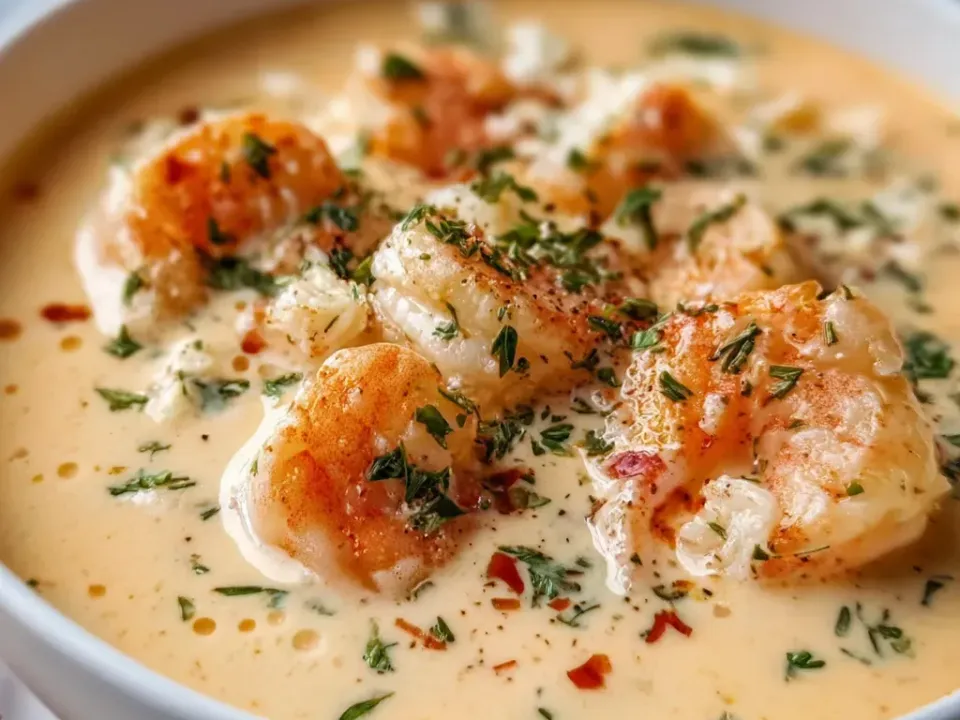
- A quarter teaspoon, scattered over at the end. The title names no heat, but the finished bowl carries visible flakes.
How to Make It
Aromatics softened, then tomato paste and paprika one minute
Melt butter and cook onion, carrot, and celery until soft; add tomato paste and paprika for 1 minute.
Stock and crab simmered fifteen minutes, then blended smooth
Add stock and crab; simmer 15 minutes, then blend completely smooth.
Cream stirred in, held at a gentle simmer
Stir in cream and keep at a gentle simmer.
Shrimp seared separately until pearly and opaque
Sear the shrimp separately until pearly/white and opaque; season lightly.
Ladled out and topped
Ladle the smooth bisque into bowls and top with shrimp, parsley, black pepper, paprika, and red pepper flakes.
Served with toasted bread
Serve with toasted bread.
Two Seafoods, Opposite Fates
The title names crab and shrimp, and only the shrimp can be seen. That is not an omission - it is the recipe. One of these two is meant to vanish completely into the base and the other is meant to sit on top of it, and almost every decision in this method follows from which is which.
The aromatics go in to be DESTROYEDVegetables collapsing softly, paste darkened a shade
2 tbsp of BUTTER with 1 chopped ONION, 1 chopped CARROT and 1 chopped CELERY rib, cooked UNTIL SOFT. Note that none of them is diced neatly - they are chopped, because nothing about their shape survives. They are here for sweetness and body in something that will be liquidised, which is why softness rather than colour is the endpoint. Then 2 tbsp TOMATO PASTE and 1/2 tsp PAPRIKA for ONE MINUTE in the dry pan: between them they are the entire source of the PALE ORANGE the finished bisque has.
The crab goes in, and is never seen againNo vegetable pieces and nothing suspended in the liquid
3 cups of SEAFOOD STOCK and all 8 oz of LUMP CRAB, SIMMERED 15 MINUTES, then BLENDED COMPLETELY SMOOTH. This is where the crab goes: it is named in the title but blended INTO the base. Fifteen minutes draws its flavour into the stock and the blender does the rest, which is why the finished soup tastes of crab throughout and shows none of it. PICK IT OVER first regardless - a blender will happily purée a fragment of shell into the bisque.
Cream in, and the heat comes DOWNA steady thick pale-orange surface, barely moving
1 cup of HEAVY CREAM stirred through and the pot held at a GENTLE SIMMER from here on. The base is finished at this point and everything after is assembly. Gentle matters: a cream soup taken back to a hard boil can break, and there is no recovering a split bisque.
The shrimp are cooked SOMEWHERE ELSEPearly white and opaque through, with a seared surface
12 oz of large shrimp, TAILS LEFT ON, SEARED SEPARATELY until PEARLY/WHITE AND OPAQUE - the only doneness cue this recipe has. A separate pan is the whole point: shrimp dropped into the pot before blending would be puréed with the crab, and shrimp simmered in the finished bisque would poach pale rather than searing. These are the one thing in the bowl you can see, so they are cooked to look like it.
The bowl is assembled, not stirredA clean smooth surface with the garnish sitting on it
Smooth bisque LADLED IN FIRST, then the shrimp set on top with 2 tbsp PARSLEY, black pepper, more PAPRIKA and 1/4 tsp RED PEPPER FLAKES. Four garnishes, and the title names none of them. Everything goes ON the surface rather than into it - stirred through, the whole visual logic of a smooth base with something sitting on it collapses. TOASTED BREAD alongside, as part of the serving rather than an optional extra.
Success Tips
- Pick the crab over carefully — a blender will not remove a piece of shell.
- Blend the base completely; anything less and it reads as a chowder, not a bisque.
- Sear the shrimp in a separate pan and only at the end, so they stay whole and pink.
Serving Ideas
Four bowls of smooth pale orange-cream bisque with nothing suspended in it, each topped with whole pink shrimp, chopped parsley, cracked black pepper, paprika and red pepper flakes, with toasted bread alongside.
Frequently Asked Questions
Where is the crab? I cannot see any.
In the base. Eight ounces of lump crab simmers in the stock and is then blended into it, so the crab is dissolved through the whole bowl rather than sitting in pieces.
How smooth should the base be?
Completely. There should be no vegetable pieces and nothing suspended in the liquid — that total smoothness is what separates a bisque from a chowder.
Why sear the shrimp separately?
So they stay whole and visible. Cooked in the soup before blending they would disappear into the base along with the crab.