
Nine ingredients and an hour, and the oven is doing two separate jobs in it.
The garlic bulb roasts for thirty minutes before it becomes sauce. That long soft roast is what turns raw garlic sweet enough to use a whole head of it.
Why This Recipe Works
- Roasting a whole bulb wrapped loosely steams it soft and sweet rather than harsh.
- Blending the cottage cheese removes every curd and leaves a smooth sauce.
- Squeezing the roasted cloves straight into the blender loses none of them.
- Pulling the orzo two minutes early leaves room for the bake.
- A bare surface blisters and browns where a crumb topping would hide it.
Ingredient Notes
- A whole garlic bulb
- One, roasted whole and squeezed into the blender. A whole head is only mild enough to do this because it has been roasted soft first.
- Cottage cheese
- A cup and a half, blended until completely smooth. No curds should remain anywhere in the finished sauce.
- Orzo
- Twelve ounces, boiled two minutes short. It finishes in the oven, and fully cooked orzo turns to paste there.
- Fresh thyme
- A teaspoon of leaves into the blender and sprigs laid on top at the end. The title names neither.
How to Make It
Oven to 400°F, the garlic bulb topped, oiled, wrapped and roasted thirty minutes
Heat oven to 400°F. Slice the garlic bulb top, drizzle with oil, wrap loosely in foil, and roast 30 minutes until soft.
Orzo cooked two minutes short and drained
Meanwhile cook orzo 2 minutes short of package directions; drain.
Roasted garlic blended with cottage cheese, milk, Parmesan and thyme until no curds remain
Squeeze roasted garlic into a blender with cottage cheese, milk, Parmesan, salt, and thyme; blend smooth so no curds remain.
Sauce folded through the orzo, baked fifteen to twenty minutes until blistered
Fold sauce through orzo, transfer to a square baking dish, and bake 15 to 20 minutes until blistered and golden on top.
Coarse black pepper and thyme sprigs to finish
Finish with coarse black pepper and thyme sprigs.
Two Named Ingredients, Neither of Them Visible
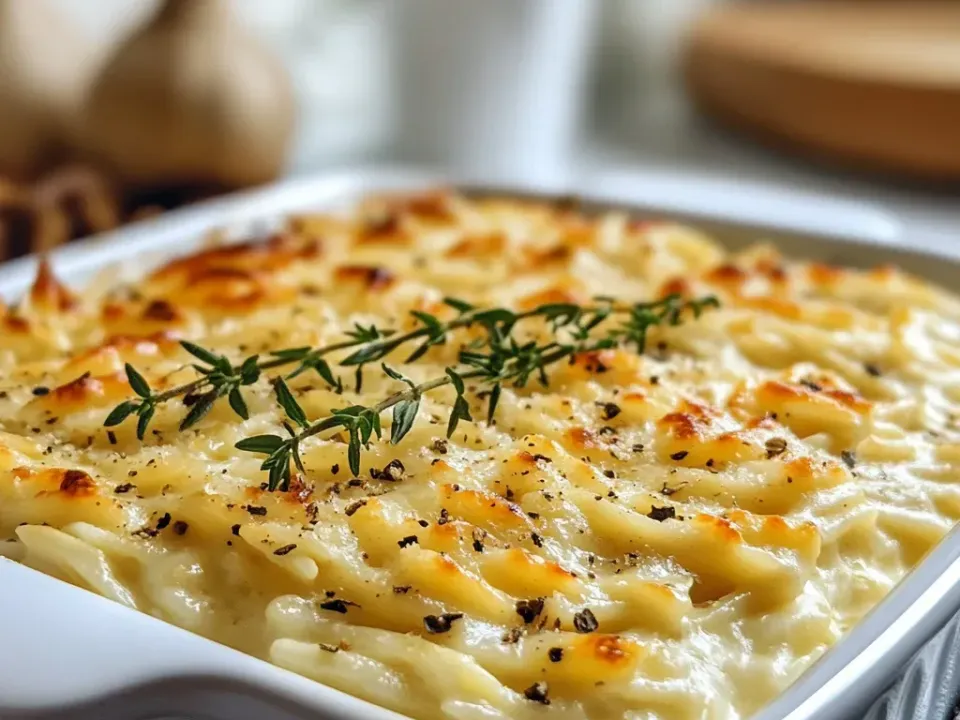
The name promises cottage cheese and roasted garlic, and the finished dish shows neither - no curds anywhere, no cloves anywhere, and the garlic bulbs in the picture are props sitting behind. That is not an omission. Both of them went through a blender, and the steps below are what that requires.
The bulb - roasted WHOLE, wrapped LOOSELY, 30 minutesCloves collapsing and squeezing out as a soft paste
1 WHOLE GARLIC BULB with its TOP SLICED OFF, drizzled with 1 tbsp of oil, WRAPPED LOOSELY IN FOIL and roasted 30 MINUTES UNTIL SOFT. Every part of that is deliberate. Sliced open so the oil reaches the cloves and so they can be squeezed out later. Wrapped LOOSELY so the bulb steams in its own moisture rather than roasting dry, which is the difference between sweet and acrid. And a full thirty minutes, because it is only that long soft roast that makes a whole head of garlic mild enough to put in one dish.
Meanwhile - orzo, TWO MINUTES SHORTGrains still firm with a distinct bite
12 oz cooked 2 MINUTES SHORT OF PACKAGE DIRECTIONS and drained. Orzo is small and it overcooks faster than almost any other shape, and there are 15 to 20 minutes of oven still ahead of it. Boiled to the packet time it comes out of the bake as paste. This runs alongside the garlic rather than after it.
The blender - and BLEND SMOOTH SO NO CURDS REMAINA completely smooth pourable sauce with no visible grain
The roasted garlic SQUEEZED IN, with 1 1/2 cups COTTAGE CHEESE, 1 cup MILK, 1/2 cup PARMESAN, 1/2 tsp salt and 1 tsp THYME LEAVES. This single step explains both absences at once. The garlic vanishes into the sauce - which is why no cloves appear in the dish and why the flavour is everywhere in it. And the cottage cheese is taken past smooth: NO CURDS REMAIN is a stated endpoint, not a preference, because the sauce should be a THICK PALE CREAM with no texture in it at all. Blend it longer than feels necessary.
Folded, then 15 to 20 minutes at 400°FGolden-brown blistered patches across an otherwise pale surface
The sauce folded through the orzo, transferred to a SQUARE baking dish, and baked UNTIL BLISTERED AND GOLDEN ON TOP. The dish goes in bare - nothing scattered over it. That is what allows the surface to blister: exposed sauce dries and browns in patches at 400F, and a crumb topping would both hide that and change the dish into something else. The surface is browned blistered patches, not a crumb finish.
The finish - PEPPER and THYME SPRIGS, both heavyVisible cracked pepper and whole sprigs on the blistered top
COARSE CRACKED BLACK PEPPER and fresh THYME SPRIGS laid on top. Both are visible components the title names neither of, and both are more generous than a garnish - a real dusting of pepper and whole sprigs laid across the surface. The thyme appears twice in this recipe, as leaves in the blender and as sprigs at the end, and only the second one is seen.
Success Tips
- Wrap the bulb loosely so it steams rather than roasting dry and bitter.
- Blend the sauce longer than feels necessary; any curd left shows in the dish.
- Leave the top bare — the blistered patches are the finish, not a crumb.
Serving Ideas
Six servings from a square dish, small orzo in a thick pale cream sauce with the surface baked to golden-brown blistered patches, dusted with coarse cracked black pepper and laid with fresh thyme sprigs.
Frequently Asked Questions
Where is the roasted garlic? I cannot see it.
In the sauce. A whole bulb is roasted soft and squeezed into the blender, so the garlic is dissolved right through the dish rather than sitting in it as cloves.
Should the cottage cheese stay lumpy?
No. It is blended until completely smooth with no curds remaining — that is what makes the sauce thick and creamy rather than grainy.
Is there a crumb topping?
None. The surface is left bare so it blisters and browns in patches in the oven, which is the finish this dish is meant to have.