
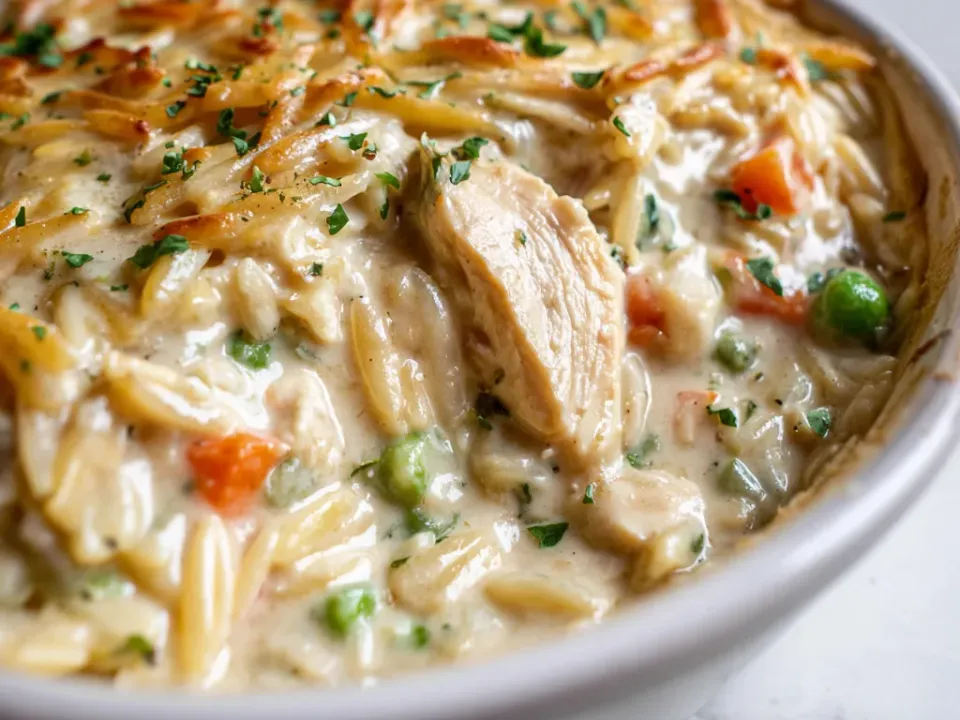
All of chicken pot pie's comfort with none of its pastry: a proper roux-based filling with orzo cooked into it and a buttery crumb topping over the top.
Forty minutes, one pan, and it uses cooked chicken — which makes it one of the best things to do with a supermarket rotisserie bird.
Why This Recipe Works
- The roux is what separates this from a creamy pasta. Cooking flour into the butter before the liquid goes in gives a gravy that stays stable and tastes like pot pie filling rather than like thin sauce.
- Cooking the orzo in the gravy rather than in water means it absorbs the broth and the thyme, and releases its starch back into the pan. That is a second thickening on top of the roux.
- A tablespoon of lemon juice at the end sounds minor in a pan this rich, and it is the reason the dish does not feel heavy. Butter, milk, cream and Parmesan with no acid anywhere would be cloying by the third mouthful.
- The butter is divided deliberately — some for the crumbs, the rest for the base. Toasted separately, the topping stays crisp long enough to matter.
A Pot Pie Without the Pie
Everything a chicken pot pie has, rebuilt in a skillet in forty minutes. Each layer here is standing in for a part of the original, and knowing which is which is what makes the substitutions obvious.
The mirepoix, in butter
Onion, carrot and celery softened in butter with thyme. This is the base of every pot pie filling ever made and it is the one stage worth not rushing — undercooked carrot stays crunchy right through to the plate.
The roux
Two tablespoons of flour cooked into the butter and vegetables before any liquid. This is the pot-pie gravy, and it is why the dish is creamy rather than merely wet. Flour added later would go lumpy.
The liquid, in three parts
Four cups of broth, a cup of milk, half a cup of cream. Broth for savour, milk for volume, cream for richness — a pot pie filling made with cream alone is heavy, and one made with broth alone is thin.
The orzo, cooked in the gravy
Twelve ounces, straight into the simmering liquid. This is what replaces the pastry: something starchy to carry the filling. It also thickens the pan further as it releases starch.
The fillings, at the end
Already-cooked chicken, frozen peas and Parmesan, added once the orzo is nearly done. The chicken only needs heating through and the peas need barely a minute — adding either early gives you dry chicken and grey peas.
The crumb topping is the crust. It goes on at the table rather than in the pan, because the moment it touches the sauce it starts to soften — which is also why the leftovers never taste quite the same as the first bowl.
Ingredient Notes
- Cooked shredded chicken
- Two cups, already cooked — rotisserie is the suggestion. Nothing raw goes into this pan, which is part of why it is a forty-minute recipe.
- Orzo
- Twelve ounces, about two cups. It needs stirring while it cooks in the gravy; a starchy pan with a roux in it catches on the base far more readily than boiling water does.
- Butter, divided
- Three tablespoons split between the crumb topping and the base. The division is the whole reason the topping is crisp.
- Panko or crushed butter crackers
- A cup, and the two give different results — panko is lighter and crisper, crackers are richer and saltier and taste closest to a pastry lid.
- Nutmeg and poultry seasoning
- Both optional, both easy to skip, and both doing something specific. A pinch of nutmeg is the classic partner to a milk-and-flour sauce; poultry seasoning is mostly sage and thyme and is what makes the dish taste like pot pie rather than like creamy orzo.
How to Make It
Toast the crumbs
In a large pan, melt part of the butter with the olive oil and toast the panko or crushed crackers until golden. Tip them out and set aside.
Soften the vegetables
In the same pan, melt the rest of the butter and cook the onion, carrots and celery until softened, then add the garlic and thyme.
Make the roux
Stir in the flour and cook it into the butter and vegetables for a minute, so it loses its raw taste before any liquid goes in.
Add the liquid
Whisk in the broth, then the milk and cream, and bring it to a simmer.
Cook the orzo in it
Stir in the orzo, salt, pepper and the optional nutmeg or poultry seasoning. Bring to a gentle simmer and cook, stirring often so it does not catch, 10 to 12 minutes until the orzo is al dente and the sauce is creamy.
Add chicken, peas and Parmesan
Fold in the cooked shredded chicken, the frozen peas and the Parmesan, and heat through for a minute or two.
Finish
Stir in the shredded chicken, peas, Parmesan, lemon juice and parsley, and cook 1 to 2 minutes to warm through. Adjust the seasoning.
Rest and top
Let it rest 2 to 3 minutes to thicken, then sprinkle over the buttery crumbs. For extra crunch, broil the skillet 1 to 2 minutes if it is oven-safe.
Success Tips
- Toast the crumbs first, in a clean pan.
- Cook the flour for a minute before adding liquid.
- Stir the orzo often; a roux-thickened pan catches easily.
- Add the topping per bowl rather than over the whole pan, so it stays crisp.
Serving Ideas
It is a complete dinner in a pan and wants only something green and sharp beside it. A salad with a mustardy dressing does more here than another warm side would.
Storage and Reheating
Refrigerate
Refrigerate up to 3 days, with the crumbs kept separately in an airtight container. The orzo keeps absorbing, so leftovers set firm.
Freeze
Not recommended. Cooked orzo in a roux-and-cream sauce turns grainy and soft on thawing, and the topping does not survive at all.
Reheat
In a pan with a good splash of broth or milk, stirring until it loosens back to a sauce. Add fresh toasted crumbs rather than reusing softened ones.
Frequently Asked Questions
It set solid in the fridge.
Expected. There is a roux, cream, Parmesan and twelve ounces of orzo in one pan, and orzo keeps drinking whatever is around it. A splash of broth or milk over gentle heat brings it back to a sauce.
Can I start with raw chicken instead?
You can, but it becomes a different recipe with a different timeline — the chicken has to be cooked through to 165°F before the orzo goes in, and it would need to come out of the pan while the base is built. The version as written is designed around chicken that is already cooked.
Can I make it gluten-free?
It needs three swaps rather than one: a gluten-free flour for the roux, gluten-free orzo, and gluten-free crumbs for the topping. The roux is the fiddly one — gluten-free blends thicken differently and want a little more time.