

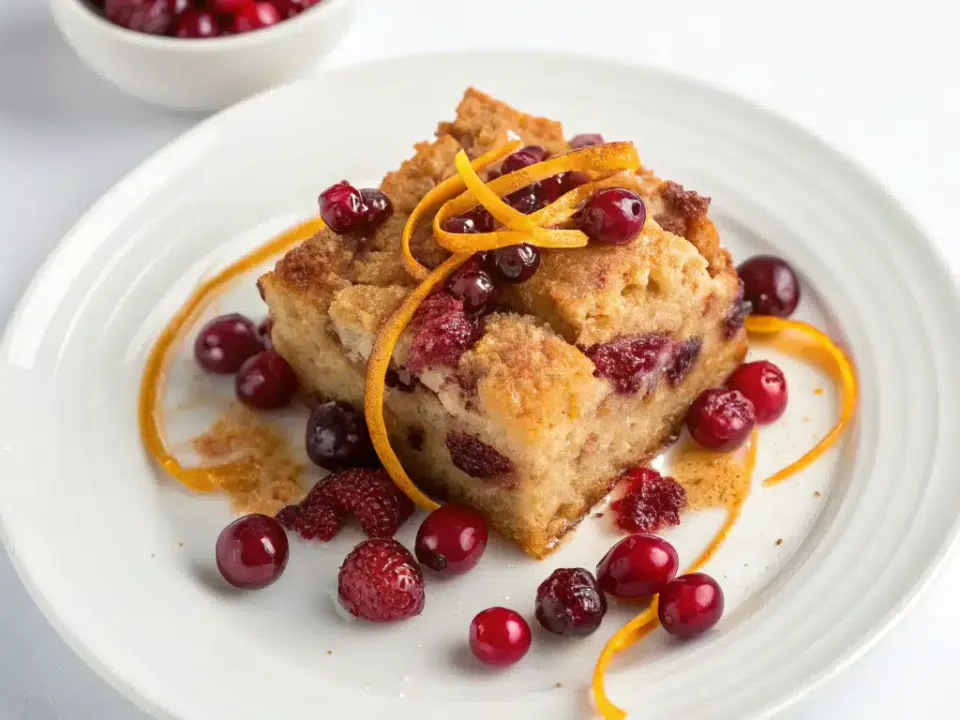
Bread pudding built on brioche and orange: zest and juice in the custard, fresh cranberries through it, and a sharp orange glaze poured over while it is still warm.
The cranberries keep it from being merely sweet, which is what most bread puddings suffer from.
Why This Recipe Works
- Day-old brioche is dry enough to drink the custard and rich enough not to go stodgy — fresh bread and lean bread both fail here for opposite reasons.
- Warming the dairy before it meets the eggs means the custard starts hot, so the centre reaches its set point before the top over-browns.
- Fresh cranberries burst as they bake and release acidity into the surrounding custard, cutting through cream, sugar and glaze at once.
- The glaze goes onto a warm pudding so it soaks slightly into the top instead of sitting on it as a sugar shell.
Tempering the Custard
This is a baked custard, and there is exactly one place it can curdle. Each rung below exists to keep the eggs from meeting heat faster than they can take it.
WarmSteamy, not boiling
Milk, cream, both sugars and the orange juice warmed together until steamy but not boiling. Steamy is the instruction, and it is deliberate: a boil here would cook the eggs on contact in the next step.
Season off the heatCool 2 to 3 minutes
Vanilla, cinnamon, nutmeg, salt and melted butter whisked in with the pan off the heat, then two to three minutes of cooling. That short rest drops the dairy to a temperature the eggs can survive.
TemperSlowly, whisking constantly
The warm dairy poured slowly into whisked eggs, whisking constantly — never the eggs into the pan. Adding gradually raises the eggs' temperature without setting them, which is the entire technique.
Soak10 to 15 minutes
Custard poured over the bread and gently pressed to submerge, then 10 to 15 minutes. Bread that has not absorbed the custard bakes as bread sitting in custard, which is a different and worse dish.
Bake to just setAbout 160°F
40 to 45 minutes until the centre reads about 160°F and the top is golden. Custard carries on setting off the heat, so this is the point to stop.
Ingredient Notes
- Day-old brioche or challah
- Eight cups, about a pound, in one-inch cubes. Enriched breads carry the custard best; a lean sourdough turns rubbery.
- Fresh or frozen cranberries
- One cup, and the reason this works as a holiday dessert. Frozen go in straight from the freezer. Dried cranberries are optional and do something different — chew rather than burst.
- Zest of two oranges
- Two oranges' worth for one dish, which sounds like a lot and is not. Zest carries the perfume; the juice in the custard and glaze carries the sharpness.
- Whole milk and heavy cream together
- Two cups to one. Cream alone would be heavy and milk alone thin — the ratio is what gives a custard that sets softly.
How to Make It
Heat the oven and prepare the dish
350°F (175°C), 9×13-inch dish greased with butter.
Layer the bread and fruit
Bread cubes into the dish, then the fresh cranberries, the dried cranberries if using, and the orange zest scattered over.
Warm the dairy
Milk, cream, both sugars and the orange juice in a saucepan over medium heat until steamy but not boiling.
Season and cool briefly
Off the heat, whisk in the vanilla, cinnamon, nutmeg, salt and melted butter, then let it cool 2 to 3 minutes.
Temper the eggs
Whisk the eggs in a large bowl, then slowly pour in the warm dairy mixture while whisking constantly.
Pour and soak
Pour the custard evenly over the bread, press gently to submerge, and leave to soak 10 to 15 minutes.
Bake
40 to 45 minutes, until the centre is just set at about 160°F and the top is golden.
Rest and glaze
Rest 15 minutes. Meanwhile whisk the powdered sugar with orange juice and a pinch of salt to a pourable glaze, then drizzle it over while the pudding is still warm.
Success Tips
- Pour the dairy into the eggs, never the eggs into the pan. This is the one irreversible step.
- Give it the full soak. Ten minutes is the minimum for the bread to actually absorb rather than float.
- Use a thermometer if you have one. About 160°F in the centre is far more reliable than judging a golden top.
- Glaze while warm, not hot. On a hot pudding the glaze runs straight off; on a cooled one it sits as a crust.
Serving Ideas
Warm with whipped cream or vanilla ice cream. Extra zest or sugared cranberries on top make it look like a centrepiece with almost no extra work.
Storage and Reheating
Refrigerate
Refrigerate covered up to 4 days. It firms considerably when cold and slices more neatly the next day.
Freeze
Freezes up to 2 months. Custard can weep a little on thawing, so thaw overnight in the fridge and reheat rather than serving from cold.
Reheat
Covered in a 325°F oven for 15 to 20 minutes, or in the microwave per portion. Add the glaze after reheating if you are making it ahead.
Frequently Asked Questions
What if I only have sandwich bread?
It works but the result is plainer and softer. Brioche and challah have enough egg and butter to hold their structure through a soak; a lean white bread turns pappy. Dry the cubes in a low oven first if your bread is fresh.
Can I assemble it the night before?
Yes — assemble through the soak, cover and refrigerate overnight, then bake straight from cold with about five extra minutes. A longer soak gives a denser, more uniform pudding.
My custard looked grainy. What went wrong?
The dairy was too hot when it met the eggs, or it went in too fast. Warm to steamy rather than boiling, cool for two to three minutes, and pour slowly while whisking.