
Twelve items and thirty-five minutes, with a pot of oil at the centre of it.
The batter is thick on purpose. A loose batter spreads into flat discs; a thick one holds the craggy irregular shape these are meant to have.
Why This Recipe Works
- Whipping the feta first means it is cold and ready when the fritters come out.
- A thick batter holds its shape and traps the kernels rather than spreading.
- Small batches keep the oil near 350°F instead of letting it crash.
- Draining on a rack lets steam escape so the crust stays craggy.
- Letting the oil recover between batches keeps every fritter equally crisp.
Ingredient Notes
- Corn kernels
- Two cups, thawed if frozen. Thawed matters — frozen kernels carry water straight into hot oil, which is both a spitting hazard and a soggy fritter.
- Feta with Greek yogurt and olive oil
- Six ounces with three tablespoons and a tablespoon. Whipped together they make the thick white spoonful on top.
- Sliced green onion, plus more for serving
- Two tablespoons in the batter and more scattered over at the end. Green onion rather than chives, and it appears twice.
- Vegetable oil
- Two inches in a heavy pot. Depth matters as much as temperature — shallow oil drops in temperature the moment batter goes in.
How to Make It
Feta, yogurt and olive oil whipped thick, then refrigerated
Whip feta, yogurt, and olive oil until thick and smooth; refrigerate while frying.
Dry ingredients whisked, then eggs, milk, corn and green onion
Whisk flour, baking powder, salt, and pepper; stir in eggs, milk, corn, and green onion to make a thick batter.
Two inches of oil heated to 350°F in a heavy pot
Heat 2 inches of oil to 350°F in a heavy pot.
Heaping tablespoons fried in small batches two to three minutes a side
Drop heaping tablespoons of batter into the oil in small batches and fry 2 to 3 minutes per side until deeply golden and craggy.
Drained, and the oil brought back to 350°F between batches
Drain on a rack or paper towels and let the oil return to 350°F between batches.
A spoonful of whipped feta on each, green onion scattered over
Serve each fritter with a spoonful of whipped feta on top and scatter with sliced green onion.
Two Inches of Oil at 350°F
Everything else in this recipe is a bowl and a whisk. One step is a pot of oil hot enough to cause a serious burn, so its handling is spelled out rather than left implied. Below is what happens before that pot, the gate itself, and what happens after.
- The whipped feta is made FIRST and goes COLD6 oz FETA whipped with 3 tbsp GREEK YOGURT and 1 tbsp OLIVE OIL UNTIL THICK AND SMOOTH, then REFRIGERATED WHILE FRYING. Made first for two reasons: there is no spare attention once oil is hot, and the contrast of a cold thick spoonful against a fritter straight from the pot is the point of the dish.
- A THICK batter, with the corn already dry3/4 cup FLOUR, 1 tsp BAKING POWDER, 1/2 tsp salt and 1/4 tsp pepper whisked, then 2 EGGS, 1/3 cup MILK, 2 cups CORN and 2 tbsp GREEN ONION stirred in. THAWED IF FROZEN is doing real safety work here, not just texture: ice crystals carry water, water hitting 350F oil flashes to steam instantly and throws oil out of the pot. Thaw and drain properly.
Check before you continue
350°F, held - and re-reached between every batch — A frying thermometer and a HEAVY pot with 2 inches of oil
Safe frying comes down to four instructions, and each one prevents a different accident. MAINTAIN THE OIL NEAR 350°F: below it the batter drinks oil, above it the outside burns before the inside cooks. ADD BATTER CAREFULLY TO PREVENT SPLASHING: lower each spoonful in close to the surface rather than dropping it from height. NEVER ADD WATER TO HOT OIL: it erupts. AVOID OVERCROWDING THE POT: each fritter cools the oil, and too many at once crashes the temperature past recovery and can boil oil over the rim. A heavy pot holds temperature better than a thin one, and two inches gives the fritters room without filling the pot.
- 2 to 3 minutes PER SIDE, in SMALL BATCHESHEAPING TABLESPOONS dropped in and fried UNTIL DEEPLY GOLDEN AND CRAGGY. Both words matter: deeply golden is the colour and craggy is the shape a thick batter gives that a thin one cannot. These are DEEP-FRIED rather than pan-fried flat.
- DRAINED, and the oil allowed to RECOVEROnto a rack or paper towels, and the oil brought BACK TO 350°F BEFORE THE NEXT BATCH. A rack is better than a plate: steam escaping from underneath is what keeps the crust craggy rather than softening it from below. The recovery wait is what makes the tenth fritter as good as the first.
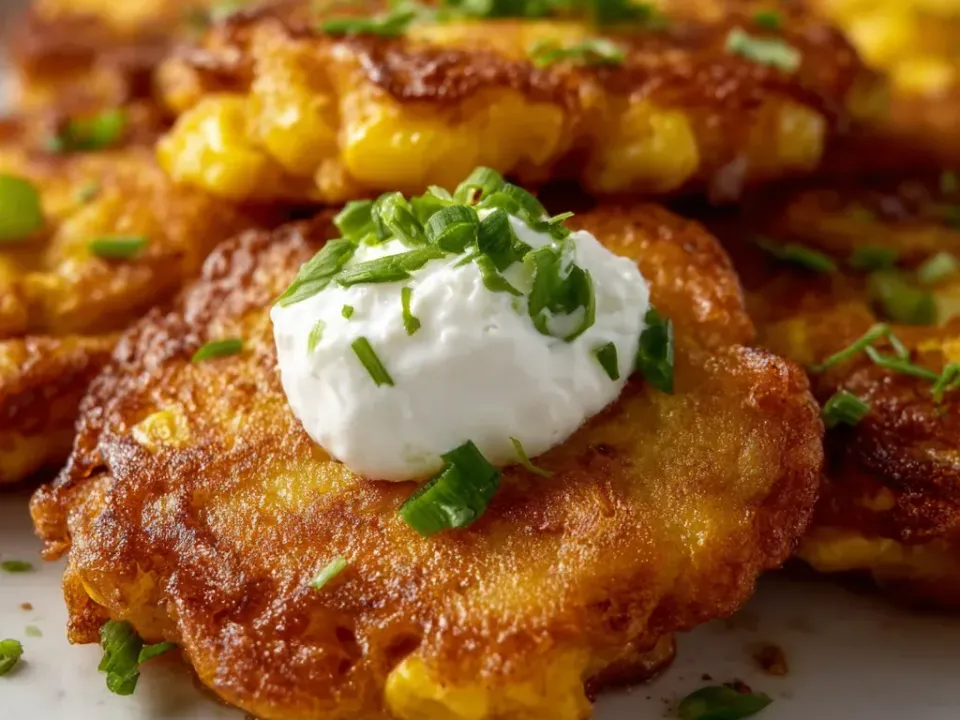
- A SPOONFUL on top, then green onionThe cold whipped feta goes ON TOP of each fritter as a single spoonful - not as a base underneath and not as a dip alongside. Then SLICED GREEN ONION scattered over, a component the title does not name.
Success Tips
- Thaw and drain frozen corn properly; water in the batter spits in hot oil.
- Fry a few at a time and wait for 350°F to come back before the next batch.
- Keep the whipped feta in the fridge until the last fritter is out of the pot.
Serving Ideas
Ten thick craggy golden fritters with whole corn kernels showing through the crust, each under a spoonful of thick whipped feta and scattered heavily with sliced green onion.
Frequently Asked Questions
Why does the oil temperature matter so much?
Below 350 degrees Fahrenheit the batter absorbs oil instead of sealing, and the fritters come out heavy and greasy. Small batches are what keep it there.
Is the whipped feta a dip?
No. It goes on top of each fritter as a single spoonful rather than being served alongside or spread underneath.
My batter spread out flat — what happened?
It was too loose. This batter should be thick enough that a heaping tablespoon holds its shape as it goes in, which is what gives the craggy irregular edges.