
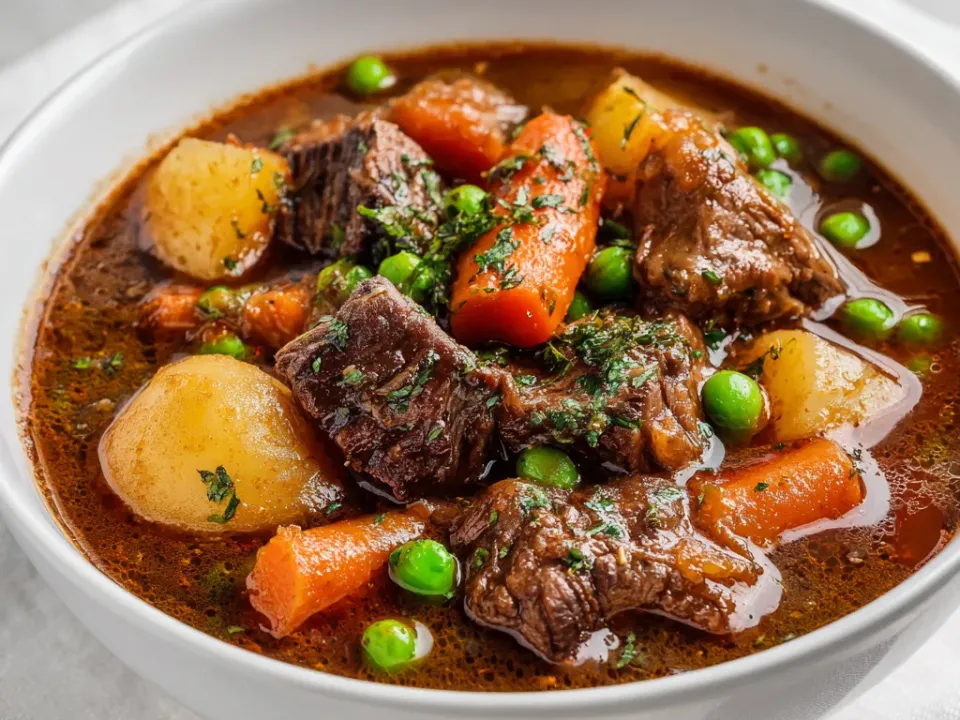
A proper beef stew in the slow cooker: chuck floured and browned first, then eight hours with potatoes, carrots and a bay leaf, finished with peas.
Twenty-five minutes of work at the start and almost nothing after that.
Why This Recipe Works
- Chuck is the only sensible cut here. Its connective tissue melts into gelatin over a long braise, which is what gives the gravy body and the meat its texture — a lean cut would simply go dry and stringy.
- Tomato paste and Worcestershire together bring the savoury depth. Both are concentrated and both survive eight hours where fresher flavourings would fade.
- Yukon Golds hold their shape across a full day where a floury baking potato would break apart into the gravy.
- The peas go in with the slurry at the end. Frozen peas need minutes, and eight hours would leave them grey and collapsed.
Thickened Twice, at Both Ends
This stew is thickened in two separate places by two different mechanisms, hours apart. Understanding which is doing what explains why the pot looks thin at hour seven and is right at hour eight.
Flour on the beef, before it is brownedBeef evenly dusted, not clumped
Three tablespoons tossed with the seasoned cubes. It does two jobs at once: it helps a proper crust form in the pan, and it dissolves into the braising liquid over eight hours as a slow, gentle thickener. This is why the gravy has body long before any slurry appears.
Browning, in batchesDeep brown on at least two sides
The crust is a chemical change the slow cooker cannot produce at any temperature it reaches. In a beef stew this contributes more than in almost any other slow-cooker dish, which is why this recipe keeps the step where the chicken stew drops it.
Eight hours on Low, to fork-tenderA cube falls apart under gentle pressure
Not to a temperature. Chuck passes every safety threshold within the first couple of hours; what takes eight is the connective tissue breaking down into gelatin. If it resists the fork it needs more time, not more heat.
Cornstarch slurry at the very endGravy coats the back of a spoon
Two tablespoons in cold water, with the peas, then 15 to 20 minutes on High. This is the correction rather than the main thickening — how much it needs depends on how much liquid the beef gave up, which varies.
Ingredient Notes
- Beef chuck in 1.5-inch cubes
- Two and a half pounds. Large cubes on purpose — smaller ones shred away entirely over eight hours.
- Flour on the beef
- Three tablespoons, tossed with the meat rather than stirred into the pot. It is doing crust and thickening at once.
- Worcestershire
- One tablespoon. Fermented, savoury and concentrated — one of the few flavourings that gains rather than fades over a long cook.
- Cornstarch and cold water
- Two tablespoons to three of water. Cold water, and it goes in only at the end.
How to Make It
Flour and brown the beef
Toss the beef cubes with the salt, pepper and flour, then brown them in the olive oil.
Load the cooker
Add the browned beef with the potatoes, carrots, onion, garlic, beef broth, tomato paste, Worcestershire, thyme, rosemary and bay leaf.
Cook
Cook on Low for 8 hours, until the beef is fork-tender.
Remove the bay leaf
Take out the bay leaf.
Thicken and add peas
Whisk the cornstarch with the cold water and stir it in with the peas.
Finish
Cook on High for 15 to 20 minutes to thicken.
Success Tips
- Brown in batches; a crowded pan steams.
- Cut the beef large.
- Judge doneness by fork-tenderness, not by a temperature or a clock.
- Use cold water for the slurry and give it the full time on High.
Serving Ideas
Crusty bread or mashed potatoes if you want to stretch it, though with a pound and a half of potatoes already in the pot it hardly needs another starch. A sharp green salad works better.
Storage and Reheating
Refrigerate
Refrigerate up to 4 days and it is better on the second day. It thickens considerably as it cools, which is the flour and the gelatin.
Freeze
Freezes very well up to 3 months. No dairy, so nothing separates; the potatoes soften a little on thawing.
Reheat
Gently on the stove with a splash of broth. Starch-thickened gravies scorch on the base over high heat.
Frequently Asked Questions
My beef was still tough after eight hours.
Undercooked, not overcooked — which is counterintuitive but almost always the answer with chuck. Connective tissue needs time to break down and it does not hurry. Put the lid back on and give it another hour on Low.
Can I skip the browning step?
You can, and the stew will be noticeably flatter. Browning contributes more in a beef stew than in most slow-cooker dishes, and the flour on the meat only forms a crust if it meets a hot pan. It is the twenty minutes worth keeping.
The gravy was thin even after the slurry.
Chuck releases a variable amount of liquid. Add a second slurry of a tablespoon of cornstarch in cold water and give it another spell on High, or leave the lid ajar for the last twenty minutes so some evaporates.