

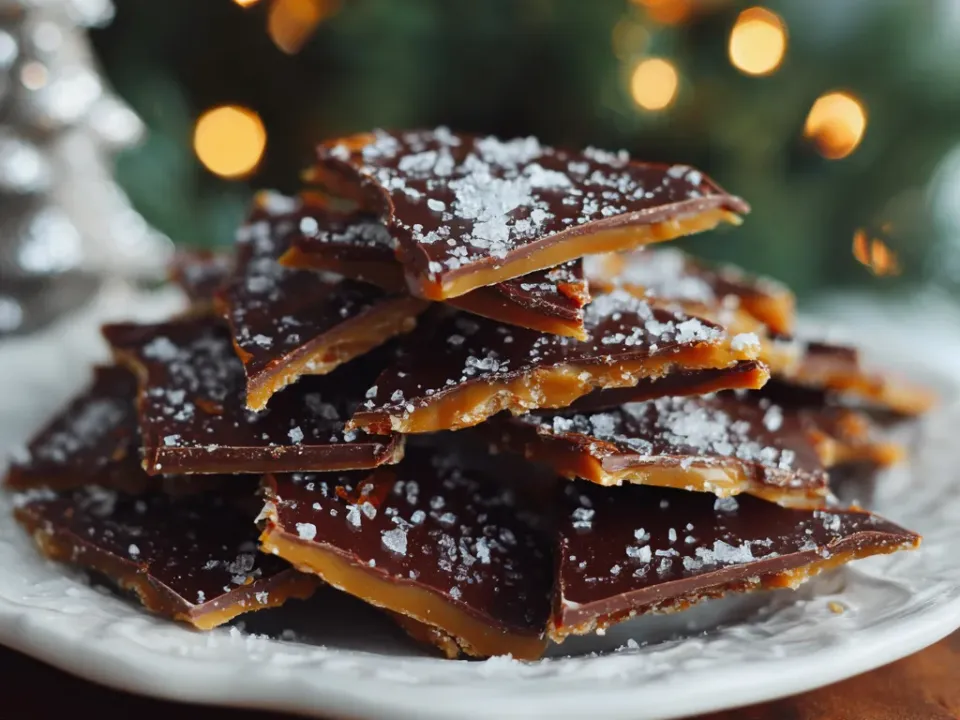
Butter toffee with a chocolate top and toasted nuts on both sides — the classic Christmas tin, made in one pan in about fifteen minutes of actual cooking.
Eight ingredients, and one of them is water. What it needs instead of a long list is a thermometer and your full attention for a quarter of an hour.
Why This Recipe Works
- Nuts scattered under the toffee as well as over it means every shard has crunch on both faces, and the base layer also stops the slab welding itself to the parchment.
- The chocolate is melted by the toffee's own residual heat rather than separately, which keeps it in temper better than remelted chocolate usually manages.
- A quarter cup of water at the start dissolves the sugar completely before boiling begins, which is the standard defence against a grainy, crystallised finish.
- Flaky salt on top of a butter-and-sugar candy is not decoration — it is what stops twenty-four pieces of toffee tasting like nothing but sweet.
Three Hundred Degrees
Most recipes can be judged by eye. This one cannot. Sugar at 285°F and sugar at 305°F look almost identical in the pan and set into two completely different sweets, so the thermometer is the recipe.
- Line the pan and warm itParchment, half the nuts scattered as a base layer, and the pan lightly warmed in a low oven. A warm pan matters: toffee poured onto a cold surface begins setting before it has finished spreading.
- Melt without rushingButter, sugar, water and fine sea salt over medium heat, stirred gently until the butter melts and the sugar is fully moistened. The quarter cup of water is there to dissolve the sugar evenly — it boils off entirely and is not part of the finished toffee.
- Boil steadily, 10 to 15 minutesStirred occasionally and gently. The time depends on the stove, which is precisely why there is a temperature as well.
Check before you continue
300°F, the hard-crack stage — Clip-on candy thermometer
Deep golden and smelling nutty. Below this the toffee stays chewy and will not snap; much above it and the butter separates and the sugar tastes scorched. The colour and the smell are corroboration, not the test — sugar changes state faster than it changes appearance.
- Vanilla, then pour immediatelyOff the heat, the vanilla goes in and bubbles violently — that is water hitting 300°F sugar and it is expected. Then straight into the pan and spread, because the toffee is already setting.
- Chocolate on residual heatOne to two minutes, then chips scattered over the hot slab and left to melt before spreading. No separate melting step: the toffee is more than hot enough to do it.
- Remaining nuts, salt, and an hourTopped and then left alone at room temperature for about an hour. Refrigerating to speed it up is what makes chocolate bloom grey.
- Break, do not cutLifted out by the parchment and snapped into shards. Toffee at the right hardness breaks along its own lines.
Ingredient Notes
- Unsalted butter
- A cup, cubed. Cubed melts evenly, which matters when the sugar is dissolving at the same time — uneven melting is one route to a separated toffee.
- Water
- A quarter cup, and it does not survive to the finished sweet. It exists purely to dissolve the sugar before the boil starts.
- Nuts, divided
- A cup of toasted sliced almonds or chopped pecans, half under and half over. Worth following that division exactly.
- Flaky sea salt
- For finishing, optional. Different from the fine sea salt in the toffee itself — this one is for texture and contrast on the surface.
How to Make It
Prepare the pan
Line a 9x13-inch pan or rimmed baking sheet with parchment. Sprinkle half the nuts over the parchment as a base layer, and lightly warm the pan in a low oven while you cook the toffee.
Start the toffee
In a heavy-bottomed saucepan, combine the butter, sugar, water and fine sea salt. Cook over medium heat, stirring gently until the butter melts and the sugar is fully moistened, then clip on a candy thermometer.
Cook to hard crack
Bring to a steady boil and cook, stirring occasionally but gently, until it reaches 300°F. It should be deep golden and smell nutty — 10 to 15 minutes depending on your stove.
Add vanilla and pour
Off the heat, carefully stir in the vanilla — it will bubble. Immediately pour the toffee over the nuts and spread evenly with an offset spatula.
Melt the chocolate on top
Wait 1 to 2 minutes, then scatter the chocolate chips over the hot toffee. Let them sit until melted, then spread into a smooth layer.
Finish and set
Top with the remaining nuts and a pinch of flaky sea salt if using. Cool at room temperature until fully set, about 1 hour.
Break it up
Lift the slab out by the parchment and break it into shards. Store airtight with parchment between the layers.
Success Tips
- Use a thermometer. Toffee is the one recipe here where judgement cannot substitute for a number.
- Have everything ready before you start heating sugar.
- Stir gently and occasionally, not constantly — vigorous stirring encourages crystallisation.
- Let it set at room temperature. The fridge makes the chocolate bloom.
Serving Ideas
A tin with parchment between the layers. It is a gift as much as a dessert, and it holds its texture for well over a week.
Storage and Reheating
Refrigerate
Airtight at cool room temperature up to 2 weeks, with parchment between layers. Humidity is the enemy — toffee goes sticky in a damp kitchen faster than it goes stale.
Freeze
Possible for up to 3 months, well wrapped, but not ideal: condensation on thawing softens the surface and can dull the chocolate.
Reheat
Never. Toffee is finished when it is set, and heat only takes it back towards a state you cannot recover from.
Frequently Asked Questions
Can I make it without a candy thermometer?
The traditional fallback is the cold-water test: a drop of syrup into ice water should form threads that snap rather than bend. It works, but it is far less reliable than a thermometer at a stage where twenty degrees changes the result completely. A thermometer is worth buying for this one recipe.
My toffee separated into butter and sugar.
Usually heat that was too high, or stirring too vigorously once it was boiling. Keep it at a steady boil over medium rather than pushing it, and stir gently and only occasionally. Some batches can be brought back by taking the pan off the heat and whisking hard, but it is not reliable.
It came out chewy rather than snapping.
It did not reach 300°F. Chewy toffee is undercooked toffee, and it is the commonest outcome of trusting colour instead of temperature — the deep golden shade arrives before the hard-crack stage does.