
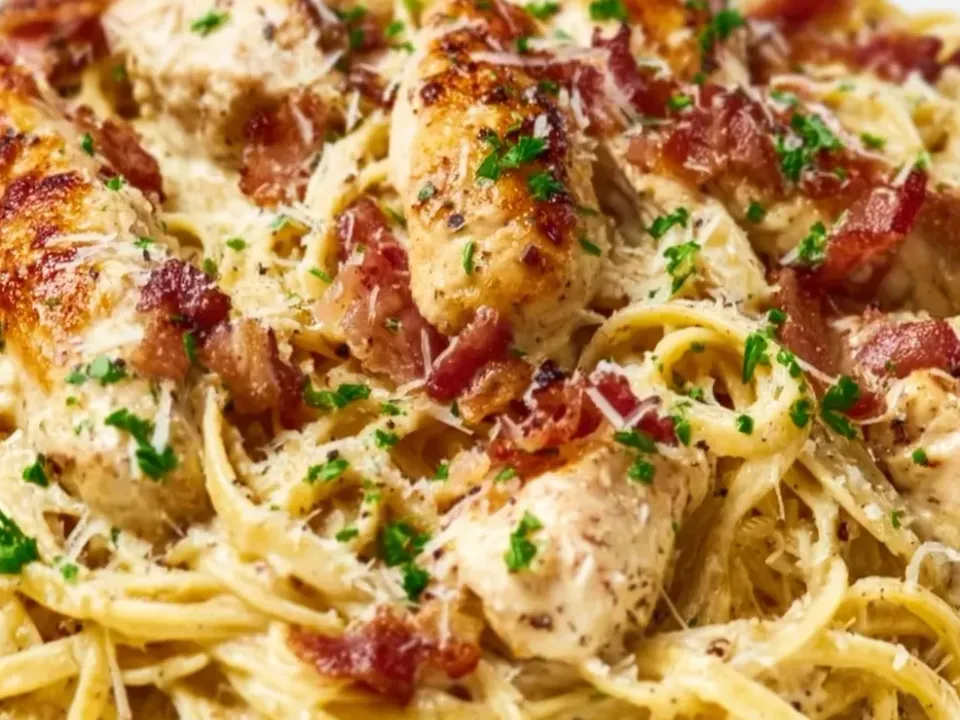
There is no cream in this. The pale creamy sauce is two whole eggs, two yolks and a cup of Parmesan, loosened with hot pasta water and emulsified by the heat already in the spaghetti — not by the pan.
Because that sauce is never brought to a firm set, the recipe specifies pasteurized eggs: when the egg stays soft on purpose, the egg is chosen for it.
Why This Recipe Works
- Cooking the bacon first and leaving a tablespoon of its fat gives the chicken something better than oil to brown in.
- Whisking the eggs with the Parmesan before they meet anything hot prevents them scrambling on contact.
- Tossing off the heat means the residual warmth of the pasta sets the sauce to creamy rather than curdled.
- Adding hot pasta water gradually is what turns the egg and cheese into a glossy emulsion.
Ingredient Notes
- Pasteurized eggs and yolks
- Two whole and two yolks, both pasteurized. The sauce is never brought to a firm set, which is why.
- Bacon
- Five ounces, chopped and crisped. A tablespoon of its fat is kept back to cook the chicken in.
- Hot pasta water
- Half a cup and more as needed, added gradually. It is what emulsifies the egg and cheese.
How to Make It
Crisp the bacon
Cook bacon until crisp; transfer with a slotted spoon, leaving 1 tbsp fat.
Brown the chicken to 165F
Season chicken and cook in the bacon fat until browned and 165 degrees Fahrenheit.
Pasta, and the egg mixture
Cook spaghetti until al dente. Whisk pasteurized eggs, yolks, Parmesan and black pepper in a bowl.
Toss off the heat
Off heat, toss hot drained spaghetti with chicken, bacon and the egg-Parmesan mixture, adding hot pasta water gradually until glossy and creamy.
Serve immediately
Serve immediately with extra Parmesan and parsley.
An Egg Sauce That Never Sets
Two different standards are in play here and they point in opposite directions. The chicken has a temperature to reach; the eggs have one they must never reach.
- The eggs are chosen for it2 pasteurized whole eggs and 2 pasteurized yolks, whisked with 1 cup of finely grated Parmesan and black pepper in a BOWL, well away from the pan. A carbonara sauce is an emulsion, not a cooked custard, so the eggs are made safe before they arrive.
- The chicken, which does have a temperature1 lb of diced breast browned in a tablespoon of the reserved bacon fat until it reads 165F. This happens on the heat and is finished before the eggs are anywhere near the pan.
- The bacon, out and crisp5 oz cooked first and lifted out with a slotted spoon. It rejoins at the toss so it is still crisp in the bowl.
Check before you continue
Glossy and creamy - never firm — The pan, OFF the heat
The hot drained spaghetti is the only heat the egg mixture is allowed to meet, loosened with hot pasta water added gradually. Left over a burner the eggs scramble and the sauce is gone; there is no way back from that, which is why the heat is removed rather than merely lowered.
- Straight to the tableExtra Parmesan and parsley, served immediately. The emulsion tightens as it cools and cannot be reheated without breaking.
Success Tips
- Take the pan off the heat before the egg mixture goes anywhere near it.
- Add the pasta water gradually rather than all at once; the sauce comes together in stages.
- Serve straight away — carbonara stiffens as it cools and cannot be reheated gently enough to recover.
Serving Ideas
Six servings in bowls, the spaghetti glossy and pale with the browned chicken and crisp bacon through it, extra Parmesan and parsley on top.
Frequently Asked Questions
Why pasteurized eggs?
The sauce is emulsified off the heat and is intentionally never cooked to a firm egg-dish texture, so the eggs are chosen to be safe as they are.
Is there cream in this?
No. The creaminess comes from eggs, Parmesan and hot pasta water.
My sauce scrambled.
The pan was still on the heat. The residual warmth of the drained pasta is all the sauce should ever meet.