
Seven ingredients and two hours forty-five minutes, of which most is cooling.
One step in this recipe is genuinely hazardous. Honey at caramel temperature is far hotter than boiling water and it reacts violently when liquid meets it.
Why This Recipe Works
- Blind-baking twelve minutes sets the crust before a wet filling goes in.
- Taking honey to deep amber develops the bitter edge that balances the sugar.
- Warmed cream added slowly tempers the caramel instead of seizing it solid.
- Cooling ten minutes stops the hot mixture scrambling the eggs on contact.
- A lower 325°F bake sets the custard gently without splitting it.
Ingredient Notes
- Honey
- Three quarters of a cup, cooked to about 300 degrees Fahrenheit. That is where the burnt in the name comes from — it is a caramel stage, not scorched honey.
- Heavy cream, warmed
- A cup and a quarter, warmed before it goes in. Cold cream into 300-degree sugar reacts far more violently and can seize the caramel solid.
- Eggs and brown sugar
- Three eggs and a third of a cup. They make this a custard rather than a caramel tart, and they set the filling.
- Unbaked 9-inch pie crust
- One, blind-baked twelve minutes first. The finished crust stays pale and flaky rather than deeply browned.
How to Make It
Oven to 375°F, crust blind-baked twelve minutes
Heat oven to 375°F; blind-bake the crust 12 minutes and cool slightly.
Honey cooked to about 300°F and deep amber, off the heat
Cook honey in a deep saucepan over medium heat until it reaches about 300°F and turns deep amber; remove from heat.
Warm cream whisked in slowly — it will foam and spit
Wearing long sleeves and keeping your face back, slowly whisk in the warm cream in small additions because the mixture will foam and spit.
Cooled ten minutes, then whisked gradually into the eggs
Cool 10 minutes; whisk eggs, brown sugar, vanilla, and salt, then gradually whisk in the honey cream.
Baked at 325°F until just set at 160°F
Pour into the crust and bake at 325°F for 32 to 38 minutes until the center is just set and reaches 160°F.
Cooled completely before slicing
Cool completely before slicing.
The Moment the Cream Meets the Honey
Almost everything in this recipe is gentle. One step is not. Honey taken to caramel temperature is roughly three times as hot as boiling water, and when liquid touches it that liquid flashes to steam instantly - which is why the protective measures are written into the instruction itself rather than left to a footnote.
- The crust goes in first, and comes out PALE1 unbaked 9-inch crust BLIND-BAKED 12 MINUTES at 375°F and COOLED SLIGHTLY. Twelve minutes sets the pastry so a wet custard cannot soak into it, but stops well short of colour - the crust should stay PALE rather than deeply browned, and it still has 32 to 38 minutes of the custard bake ahead of it.
- 3/4 cup of HONEY to ABOUT 300°F, in a DEEP saucepanCooked over MEDIUM heat UNTIL IT REACHES ABOUT 300°F AND TURNS DEEP AMBER, then REMOVED FROM HEAT. Deep is not a stylistic choice of pan: what happens next needs several inches of clear wall above the liquid. Deep amber is where the bitterness that makes this pie interesting develops - stopped pale it is just sweet, taken past it, acrid.
- 1 1/4 cups of cream, WARMEDWarmed before it is needed, not taken from the fridge. The violence of the reaction scales with the temperature difference, and cold cream hitting 300°F sugar both spits harder and can seize the caramel into a solid lump that will not redissolve.
Check before you continue
About 300°F and deep amber — then OFF the heat before any cream — A thermometer, a deep pan, long sleeves and distance
This is the step to slow down for. WEARING LONG SLEEVES AND KEEPING YOUR FACE BACK, SLOWLY WHISK IN THE WARM CREAM IN SMALL ADDITIONS BECAUSE THE MIXTURE WILL FOAM AND SPIT. Every clause is doing something. Off the heat first, so nothing is still climbing in temperature. Small additions, because the whole quantity at once produces one large eruption instead of several manageable ones. Long sleeves and face back, because caramel that lands on skin sticks at 300°F rather than running off. Foam and spit is a statement of what happens, not a caution about what might.
- 10 minutes' cooling, then the eggs - GRADUALLYThe honey cream is cooled 10 MINUTES before it meets 3 EGGS whisked with 1/3 cup BROWN SUGAR, 1 tsp VANILLA and 1/2 tsp SALT, and then it is added GRADUALLY. Both guards are against the same failure: hot liquid poured into eggs cooks them on contact, and a custard with scrambled threads through it cannot be strained back to smooth. Cooled, and gradually, and whisking throughout.
- 325°F, and JUST SET at 160°FPoured into the crust and baked 32 to 38 MINUTES. Note the drop from 375F - a custard baked hot curdles and splits, and 325F sets it gently. JUST SET is the texture and 160°F is the safe temperature for an egg custard; the centre should still have a slight wobble when it comes out.
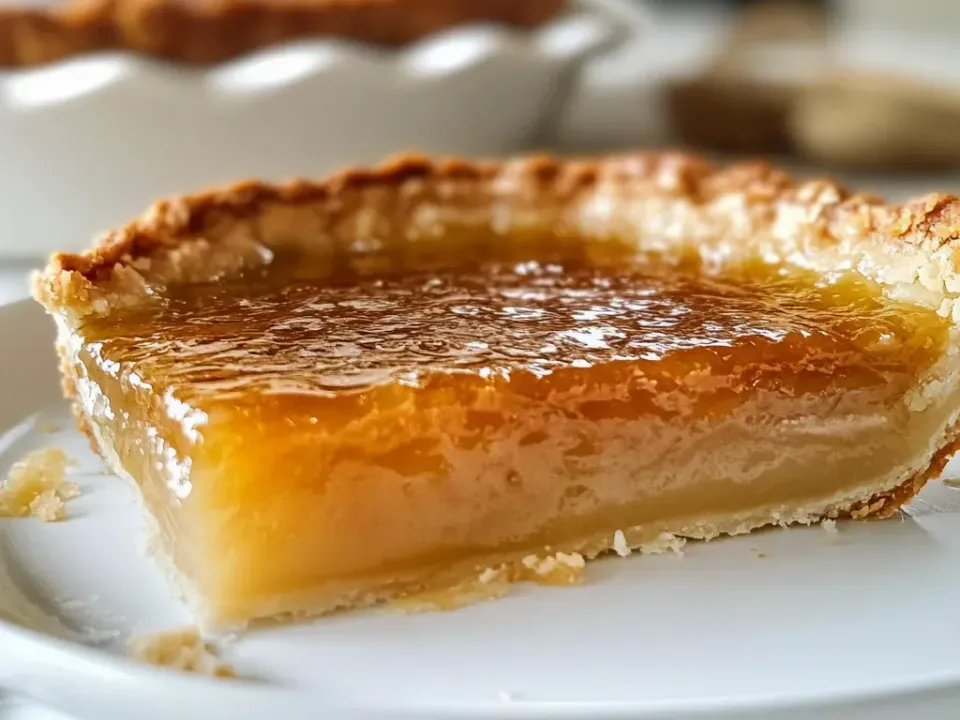
- COOLED COMPLETELY, and served plainThe last step is the longest. A custard pie cut warm runs at the edge of every slice; cooled completely it holds a clean face and the surface takes on the glossy, slightly crackled look the photograph shows. Nothing goes on it - no cream, no fruit, no garnish of any kind.
Success Tips
- Use a deep saucepan — the mixture climbs the sides when the cream goes in.
- Warm the cream first and add it a splash at a time, not in a stream.
- Cool the pie completely before slicing or the custard runs at the cut.
Serving Ideas
Eight slices of pie with a pale flaky short crust and a smooth translucent amber custard filling with a glossy, slightly crackled surface, served plain.
Frequently Asked Questions
Is the honey actually burnt?
It is caramelised. Cooked to about 300 degrees Fahrenheit it turns deep amber and picks up a bitter edge that balances the sweetness — scorched honey would just taste acrid.
Why the warning about adding the cream?
Sugar at 300 degrees Fahrenheit is far above boiling point. Liquid hitting it turns to steam instantly, and the mixture foams up and spits — hence long sleeves, face back, and small additions off the heat.
Should it be served with cream or fruit?
No. The filling is a single smooth amber layer and the pie is served unadorned — no cream, no fruit and no garnish.