
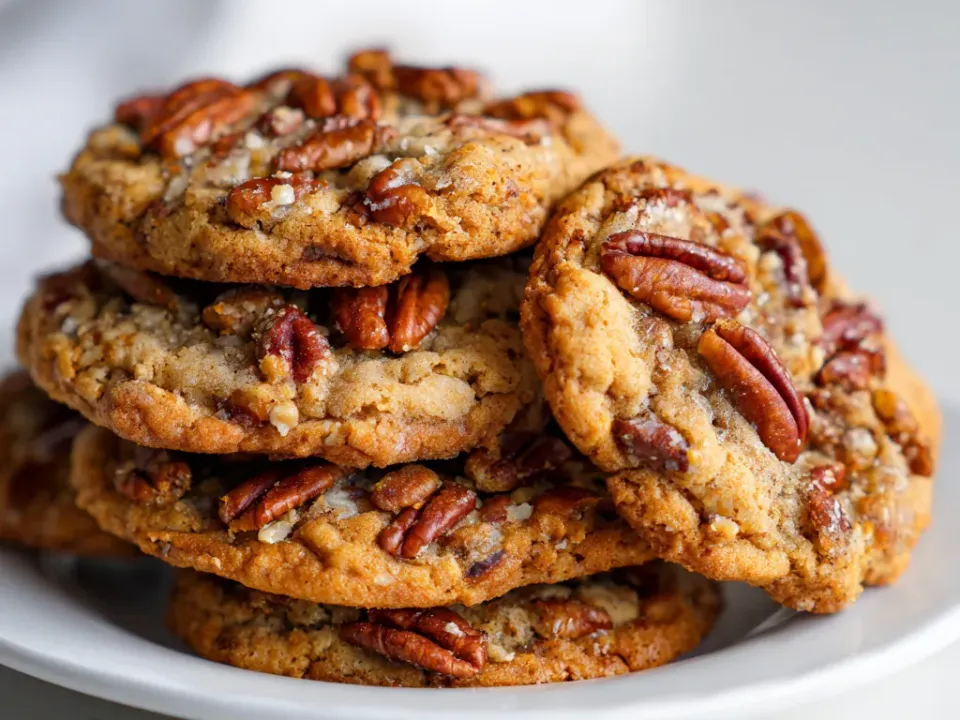
Pecan pie in cookie form: a soft brown-sugar thumbprint holding a spoonful of proper pecan pie filling, baked together.
Forty minutes for twenty-four cookies, and both components are stirred together rather than cooked separately.
Why This Recipe Works
- Toasting the pecans before they go into the filling is the six minutes that separates this from a sweet nut paste. Untoasted pecans taste flat under that much sugar.
- Corn syrup, or maple syrup, keeps the filling glossy and soft rather than setting hard. It is the same reason a pecan pie uses it.
- A teaspoon of cornstarch in the dough is marked optional and does something real — it softens the flour's protein slightly, which keeps the shell tender against a gooey centre.
- Baking to barely golden edges rather than to colour keeps the cookie soft. These are meant to yield, not to snap.
Ingredient Notes
- Vanilla extract, divided
- One and a half teaspoons total: a full teaspoon into the filling and half a teaspoon into the dough. The ingredient line spells the division out itself.
- Butter, in two places
- Half a cup softened for the dough and 2 tablespoons melted for the filling. Different quantities and different states.
- Brown sugar, in two places
- Half a cup in the dough and a third of a cup in the filling, both light brown. Easy to combine by accident when measuring.
- Light corn syrup or maple syrup
- A third of a cup, and they work as equals. Maple adds its own flavour, which suits the optional maple glaze at the end.
How to Make It
Heat the oven and toast the pecans
350°F (175°C), two baking sheets lined with parchment. Toast the pecans 6 to 8 minutes until fragrant, then chop.
Make the filling
Combine the chopped toasted pecans, 1/3 cup brown sugar, corn or maple syrup, melted butter, 1 teaspoon vanilla, cinnamon and a pinch of salt. Stir until glossy and set aside.
Cream the dough base
Cream the softened butter with 1/2 cup brown sugar and the granulated sugar until light and fluffy, 2 to 3 minutes, then beat in the egg and 1/2 teaspoon vanilla.
Add the dry ingredients
Whisk the flour, baking powder, baking soda, salt and cornstarch, then add to the wet ingredients and mix on low just until combined. Do not overmix.
Scoop and make wells
Scoop into 1.5-tablespoon balls, about 24, placed 2 inches apart. Press a deep thumbprint well into each.
Fill
Fill each well with about 1 rounded teaspoon of the pecan filling, avoiding overfilling.
Bake
10 to 12 minutes, until the edges are set and barely golden. If the filling spreads, nudge it back with a spoon while hot. Cool 5 minutes on the sheet, then move to a rack.
Glaze, optionally
Whisk the powdered sugar with maple syrup until pourable, drizzle over the cooled cookies and let it set.
Success Tips
- Make the filling first so it is ready when the dough is scooped.
- Press the wells deep. Shallow wells overflow.
- Do not overfill — it is the commonest failure.
- Nudge escaping filling back within seconds of the sheet coming out, while it is still fluid.
Serving Ideas
The optional maple glaze finishes them for a cookie plate and takes two minutes. Without it they are plainer and travel better, which makes them the better choice for a tin.
Storage and Reheating
Refrigerate
Airtight at room temperature up to 4 days. The filling stays soft; the shell firms slightly after the first day.
Freeze
Freeze baked and unglazed up to 2 months. Glaze after thawing — a frozen glaze goes cloudy and sticky.
Reheat
Not needed. Ten seconds in a microwave loosens the filling again if you want them warm.
Frequently Asked Questions
My filling ran out over the cookies.
Either the wells were too shallow or they were overfilled. A rounded teaspoon into a deep well is the target. The recovery is to nudge it back with a spoon in the first seconds out of the oven, while the sugar is still fluid.
Corn syrup or maple syrup?
Either works. Corn syrup is neutral and keeps the filling glossiest; maple adds a distinct flavour and pairs with the optional glaze. Both hold the filling soft, which is the structural job either one is doing.
Can I make these ahead?
The dough can be made and chilled a day ahead, and the filling keeps at room temperature for a few hours. Assembling and baking is best done together, since dough sitting with a wet filling in its well begins to soften underneath it.