
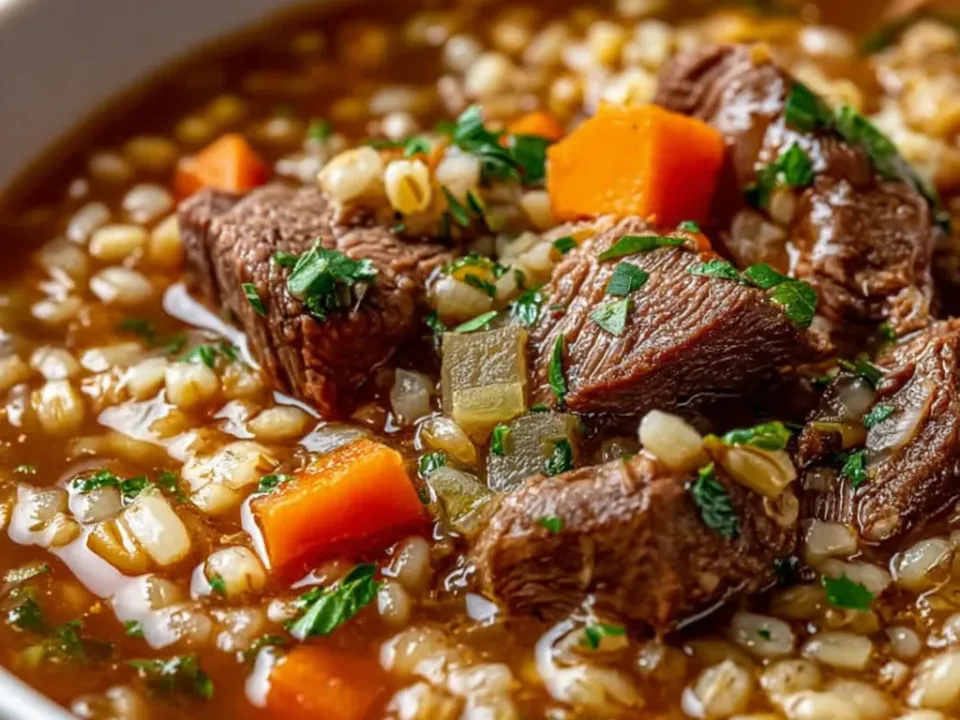
Cubed beef chuck browned in batches, then simmered for over an hour with pearl barley, root vegetables, tomatoes and eight cups of beef broth.
Twenty-five minutes of active work and an hour and a quarter of simmering, all in one pot. Eight servings.
Why This Recipe Works
- Chuck cut into three-quarter-inch cubes rather than left whole. Small pieces reach fork-tender in the same sixty to seventy-five minutes the barley needs, which is what lets one pot handle both.
- Browning in batches is the difference between a dark, savoury broth and a grey one. Crowded meat releases moisture and steams in it, and the fond left in the pan is where the depth comes from.
- Pearl barley cooked in the soup rather than separately. It releases starch as it goes and gives the broth a silky body that no thickener would replicate — which is also why the barley is rinsed first, to control how much.
- Two tablespoons of tomato paste cooked for a minute, plus a whole tin of diced tomatoes. The paste brings concentrated savour and colour; the tin brings acidity that cuts eight cups of beef broth.
- Partially covered is deliberate. Fully covered, nothing reduces and the soup stays thin; uncovered, it reduces too far and the barley claims what is left.
Seven Steps, Three Phases
Twenty-five minutes of active work at the front, an hour and a quarter of near-silence after it. Everything that determines how this soup tastes happens in the first three steps.
Stage 1 of 3
Brown, in batches
Steps 1–2 of 7
The beef patted dry, seasoned, and browned in batches in two tablespoons of oil. In batches is the instruction that matters — two pounds of cubes in one layer would fill the pan and steam, and you would lose the fond that becomes the broth.
- Dry and season the beefPat the beef dry and season with the salt and pepper.
- Brown it in batchesHeat the oil in a Dutch oven over medium-high heat and brown the beef in batches; transfer to a plate.
Stage 2 of 3
Build the base
Steps 3–3 of 7
Onion, carrots and celery for five minutes in the beef fat, then garlic and two tablespoons of tomato paste for one more. The paste is cooked rather than stirred in — a minute in a hot pan darkens it and takes off the tinned edge.
- Cook the vegetables and pasteAdd the onion, carrots and celery and cook 5 minutes. Add the garlic and tomato paste and cook 1 minute.
Stage 3 of 3
Simmer to two endpoints
Steps 4–7 of 7
Beef back in with eight cups of broth, tomatoes, barley, thyme, bay and Worcestershire, brought to a boil then dropped to a gentle simmer, partially covered, for sixty to seventy-five minutes. Two things have to be true at the end: tender barley AND fork-tender beef. Whichever is slower is the one to wait for.
- Return the beef and add everythingReturn the beef to the pot and add the broth, tomatoes, barley, thyme, bay leaf and Worcestershire.
- Bring up, then drop downBring to a boil, then reduce to a gentle simmer.
- Simmer partially coveredCover partially and simmer 60 to 75 minutes, stirring occasionally, until the barley is tender and the beef is fork-tender.
- FinishRemove the bay leaf, adjust the seasoning and finish with the parsley.
Ingredient Notes
- Beef chuck, 3/4-inch cubes
- Two pounds. Chuck is the right cut because its connective tissue softens over the simmer — a lean cut would be dry long before the barley was ready.
- Pearl barley, rinsed
- Three quarters of a cup, rinsed before it goes in. Pearl rather than hulled barley, which takes considerably longer than this recipe's window.
- Low-sodium beef broth
- Eight cups. Low-sodium is important here because the barley absorbs liquid and concentrates whatever salt remains over seventy-five minutes.
- Tomato paste
- Two tablespoons, cooked for a minute in the pan before any liquid arrives. It reads as savoury depth rather than as tomato in the finished bowl.
- Bay leaf
- One, whole, and removed at the end. Whole rather than crumbled so it can actually be found again.
How to Make It
Dry and season the beef
Pat the beef dry and season with the salt and pepper.
Brown it in batches
Heat the oil in a Dutch oven over medium-high heat and brown the beef in batches; transfer to a plate.
Cook the vegetables and paste
Add the onion, carrots and celery and cook 5 minutes. Add the garlic and tomato paste and cook 1 minute.
Return the beef and add everything
Return the beef to the pot and add the broth, tomatoes, barley, thyme, bay leaf and Worcestershire.
Bring up, then drop down
Bring to a boil, then reduce to a gentle simmer.
Simmer partially covered
Cover partially and simmer 60 to 75 minutes, stirring occasionally, until the barley is tender and the beef is fork-tender.
Finish
Remove the bay leaf, adjust the seasoning and finish with the parsley.
Success Tips
- Pat the beef genuinely dry — wet meat will not brown however hot the pan is.
- Brown in two or three batches rather than crowding the pot.
- Rinse the barley so the broth stays clear rather than cloudy.
- Keep the simmer gentle; a rolling boil breaks the beef up and cooks the barley unevenly.
- Leave the lid ajar rather than on or off entirely.
Serving Ideas
Deep bowls with crusty bread. It is substantial enough to be dinner without anything else on the table.
Storage and Reheating
Refrigerate
Refrigerate up to 4 days. The barley keeps drinking broth, so expect it noticeably thicker by the next day.
Freeze
Freezes for up to 3 months, though the barley softens further. Freeze in portions and expect to loosen it on reheating.
Reheat
Gently on the hob with extra broth or water to replace what the barley has taken up.
Frequently Asked Questions
Why is it so much thicker the next day?
Barley keeps absorbing liquid even off the heat. It is normal and easily fixed — add broth or water when reheating until it is soupy again.
Can I use quick-cooking or hulled barley?
Quick-cooking barley will be done long before the beef and turn to mush over seventy-five minutes. Hulled barley takes considerably longer than the window here. Pearl barley is what the timing is written for.
Do I have to brown the beef in batches?
It is the single biggest contributor to how this soup tastes. Two pounds of cubes at once will not fit in one layer, and what you get instead of browning is grey steamed meat and a pale broth.
Can I make this in a slow cooker?
The recipe is written for a Dutch oven with a partially covered simmer, which controls how much liquid the barley gets. A slow cooker holds liquid rather than reducing it, and no slow-cooker timing is published here.