
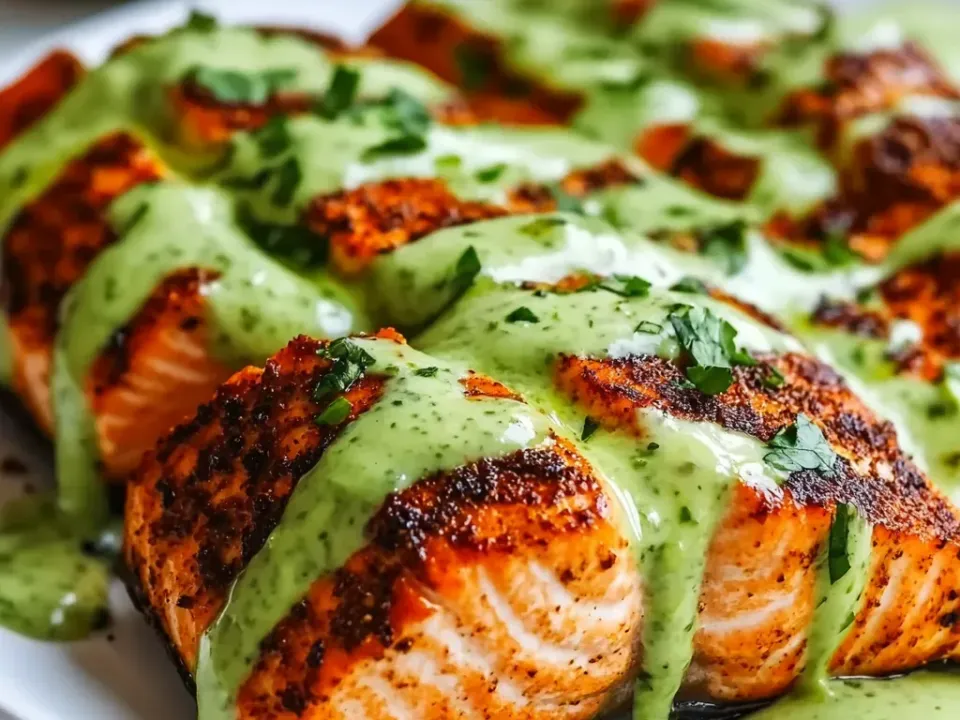
Thirty minutes, twelve ingredients, and two components that never share any heat: fillets from a hot oven and a sauce from a blender.
Blackened is a look, and it comes from spice on a surface exposed to direct high heat. A 425 degree Fahrenheit oven gets most of the way there and one or two minutes under the broiler finishes it — if it is needed at all.
Why This Recipe Works
- Oil rubbed on before the Cajun seasoning is what makes the spice adhere to the fillet.
- 425 degrees Fahrenheit cooks a six-ounce fillet through in ten to fourteen minutes without drying it.
- The broiler is a finishing tool here, used briefly and only if the surface is not dark enough.
- Greek yogurt gives the avocado sauce body and acidity that avocado alone would not have.
- Two to three tablespoons of cold water lets the sauce blend smooth while staying thick enough to sit on top of the fish.
Ingredient Notes
- Cajun seasoning
- Two teaspoons across four fillets. It is what darkens under the broiler, so it goes on evenly rather than in patches.
- Olive oil, in both parts
- A tablespoon rubbed onto the fish and another tablespoon blended into the sauce. Measured separately.
- Plain Greek yogurt
- A third of a cup. It carries the tang and the body; avocado and lime alone would be softer and flatter.
- Cold water
- Two to three tablespoons, added to the blender to loosen the sauce. Cold, and adjusted by eye — thick is the target.
How to Make It
Hot oven, lined pan
Heat oven to 425 degrees Fahrenheit and line a sheet pan.
Oil, then spice
Rub salmon with olive oil, Cajun seasoning, and salt.
Bake, then blacken
Bake 10 to 14 minutes, then broil 1 to 2 minutes if needed to create the dark blackened-looking surface without overcooking.
Check for 145F
Cook until the thickest part reaches 145 degrees Fahrenheit.
Blend the green sauce
Blend avocado, yogurt, lime juice, olive oil, cilantro, garlic, water, and salt until thick, pale green, and smooth.
Spoon it over, cold
Spoon the uncooked avocado-lime sauce over the salmon just before serving.
Up to Blackened, Then Straight Back Down
Three rungs of increasing heat and then one that uses none at all. The last one is not a cooking step, and treating it as one would ruin it.
CoatOil, then spice, evenly
4 fillets of about 6 oz rubbed with 1 tbsp olive oil, then 2 tsp Cajun seasoning and 1/2 tsp salt. Oil first: it is what holds the spice on the fish, and the spice is what will darken later.
Bake - 425F10 to 14 minutes, to 145F
Ten to fourteen minutes on a lined sheet pan. This is the rung that actually cooks the fish, and the target is 145F in the thickest part.
Broil - only if needed1 to 2 minutes, watched
One to two minutes of direct heat, and the recipe is explicit about the purpose: to create the dark blackened-looking surface WITHOUT overcooking. The salmon is at or near temperature before this rung starts, so it is a colour step, not a cooking one - and if the surface is already dark, it can be skipped.
No heat at allChilled until the last moment
1 ripe avocado, 1/3 cup Greek yogurt, 2 tbsp lime juice, 1 tbsp olive oil, 2 tbsp cilantro, 1 small garlic clove, 2 to 3 tbsp cold water and 1/4 tsp salt blended until thick, pale green and smooth, kept chilled, and spooned over just before serving. A separate uncooked component - it is never warmed, and cold against hot blackened fish is the contrast the plate is built on.
Success Tips
- Watch the broiler closely. One to two minutes is the whole window, and it is optional if the surface is already dark.
- Check the thickest part with a thermometer rather than judging by colour; the spice crust hides how done the fish is.
- Blend the sauce while the salmon bakes and keep it chilled until it is spooned over.
Serving Ideas
Four fillets on a white platter, the dark blackened Cajun surface visible under a thick pale green avocado-lime sauce with cilantro over it.
Frequently Asked Questions
Do I have to use the broiler?
Only if needed. The recipe says one to two minutes to create the dark surface without overcooking — the oven may already have done enough.
Should the sauce be warmed?
No. It is a separate uncooked component, blended raw and kept chilled until it goes over the fish just before serving.
How done should salmon be?
145 degrees Fahrenheit in the thickest part, which is the USDA figure for fish.