
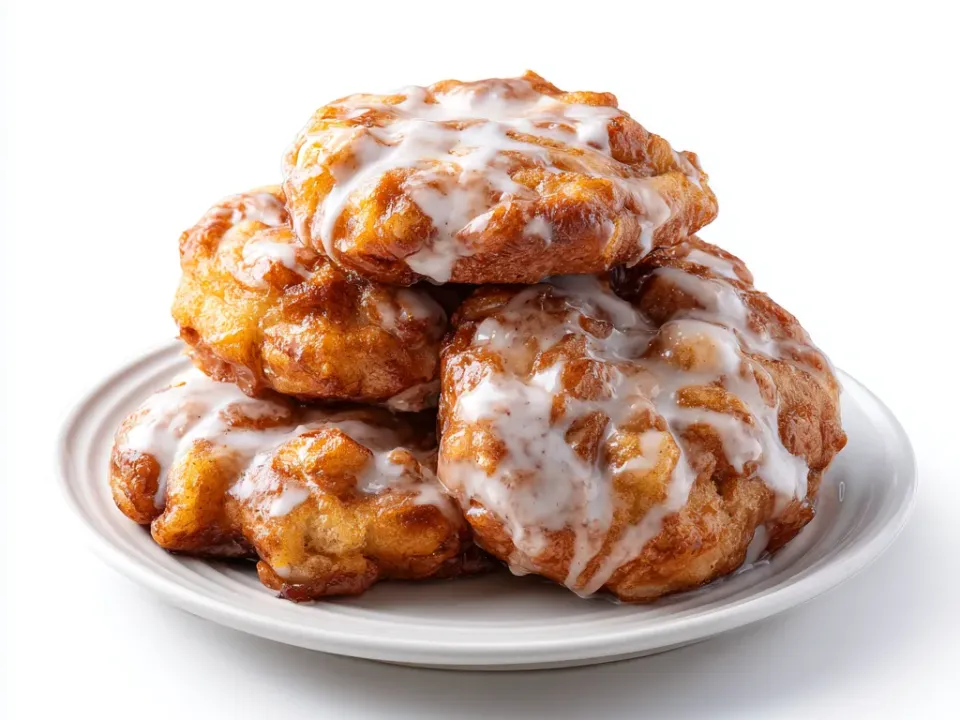
Apple fritters made on a sheet pan instead of in a pot of oil — the same craggy shape and the same cider glaze, without the frying.
Twelve fritters, twenty minutes of work, and about a quarter of an hour in a hot oven.
Why This Recipe Works
- Two and a half cups of diced apple into one cup of flour is a very high fruit ratio, and it is what keeps a baked fritter from reading as a muffin. The batter is barely enough to hold the apples together.
- Half-inch dice matters more than the apple variety. Larger pieces stay firm and wet in a sixteen-minute bake; much smaller and they disappear into the crumb.
- Both baking powder and baking soda are in the list. The powder does the lifting; the soda works against the acidity of the apples and lemon juice and helps the edges brown in the time available.
- Flattening each mound slightly with a damp spoon is what makes the shape read as a fritter rather than a scone. It also gets the centre cooked in the same window as the edge.
- Glazing while warm lets the glaze sink into the craggy top instead of sitting on it as a lid.
Four Phases, Ten Steps
A fritter recipe with no oil in it has to earn the name somewhere else — in the craggy scooped shape and the glaze. The ten steps fall into four phases, and only one of them is fussy.
Stage 1 of 4
Set up
Steps 1–2 of 10
Oven to 400°F and the sheet lined and greased before anything is mixed, because the batter should not sit. The apples are diced and tossed with lemon juice in the same breath.
- Heat the oven and line the panPreheat the oven to 400°F (200°C). Line a rimmed baking sheet with parchment and lightly grease the paper, or use a lightly greased muffin-top pan.
- Dice the applesDice the apples and toss with the lemon juice. Set aside to keep them bright and flavorful.
Stage 2 of 4
Two bowls
Steps 3–4 of 10
Dry whisked together in one bowl — flour, both sugars, both raising agents, cinnamon, nutmeg, salt. Wet whisked smooth in another — eggs, milk, melted butter, vanilla. They stay separate until the next step.
- Whisk the dry ingredientsIn a large bowl, whisk the flour, granulated sugar, brown sugar, baking powder, baking soda, cinnamon, nutmeg and salt.
- Whisk the wet ingredientsIn a second bowl, whisk the eggs, milk, melted butter and vanilla until smooth.
Stage 3 of 4
Combine and portion
Steps 5–6 of 10
Wet into dry, stirred gently until just combined, then the apples folded through. Twelve mounds of about two heaping tablespoons, two inches apart, flattened slightly with a damp spoon. This is the only fussy phase, and overmixing here is the one mistake that cannot be corrected later.
- Combine and fold in the applesPour the wet ingredients into the dry and stir gently until just combined. Fold in the apples, and the nuts if using. Do not overmix.
- Scoop twelve moundsScoop 12 mounds of about 2 heaping tablespoons each onto the sheet, spacing them 2 inches apart. Flatten slightly with a damp spoon for the classic fritter shape.
Stage 4 of 4
Bake and glaze
Steps 7–10 of 10
Fourteen to sixteen minutes with one rotation, the glaze whisked while they bake, five minutes of cooling on the pan and then the glaze goes on while they are still warm.
- BakeBake 14 to 16 minutes, rotating the pan once, until puffed and golden at the edges. For extra colour, brush the tops with melted butter and bake 1 to 2 minutes more.
- Make the glazeWhile they bake, whisk the powdered sugar, apple cider (or milk), vanilla and a pinch of salt until smooth and drizzleable.
- Cool briefly, then glazeCool the fritters on the pan for 5 minutes, then transfer to a rack. Drizzle or dip in the glaze while warm.
- ServeServe warm. Store any leftovers as directed for best texture.
Ingredient Notes
- Honeycrisp or Granny Smith
- The recipe names both. Honeycrisp keeps its sweetness and holds shape; Granny Smith is sharper and stands up against a cup of powdered sugar in the glaze.
- Lemon juice
- One tablespoon over the diced apples. It keeps them from browning while the batter is mixed, which is the whole reason it is a separate early step.
- Apple cider in the glaze
- Two to three tablespoons, with milk as the listed alternative. Cider is what makes the glaze taste of apple rather than of sugar.
- Pecans or walnuts
- Half a cup, explicitly optional, folded in with the apples rather than scattered on top.
- Melted butter for brushing
- One tablespoon, optional, and only for colour in the last minute or two of the bake. Not part of the batter.
How to Make It
Heat the oven and line the pan
Preheat the oven to 400°F (200°C). Line a rimmed baking sheet with parchment and lightly grease the paper, or use a lightly greased muffin-top pan.
Dice the apples
Dice the apples and toss with the lemon juice. Set aside to keep them bright and flavorful.
Whisk the dry ingredients
In a large bowl, whisk the flour, granulated sugar, brown sugar, baking powder, baking soda, cinnamon, nutmeg and salt.
Whisk the wet ingredients
In a second bowl, whisk the eggs, milk, melted butter and vanilla until smooth.
Combine and fold in the apples
Pour the wet ingredients into the dry and stir gently until just combined. Fold in the apples, and the nuts if using. Do not overmix.
Scoop twelve mounds
Scoop 12 mounds of about 2 heaping tablespoons each onto the sheet, spacing them 2 inches apart. Flatten slightly with a damp spoon for the classic fritter shape.
Bake
Bake 14 to 16 minutes, rotating the pan once, until puffed and golden at the edges. For extra colour, brush the tops with melted butter and bake 1 to 2 minutes more.
Make the glaze
While they bake, whisk the powdered sugar, apple cider (or milk), vanilla and a pinch of salt until smooth and drizzleable.
Cool briefly, then glaze
Cool the fritters on the pan for 5 minutes, then transfer to a rack. Drizzle or dip in the glaze while warm.
Serve
Serve warm. Store any leftovers as directed for best texture.
Success Tips
- Stir only until the batter just comes together — overmixing gives a tough, bready fritter.
- Keep the dice at half an inch so the apples cook in the same time as the batter.
- Space the mounds two inches apart; crowded mounds steam instead of browning.
- Rotate the pan once, as the method says — most ovens are uneven across sixteen minutes.
- Glaze while the fritters are still warm so it soaks in.
Serving Ideas
Warm, within an hour of baking, which is when the contrast between the craggy edge and the soft apple centre is at its best. Coffee is the obvious pairing.
Storage and Reheating
Refrigerate
Keep in a loosely covered container at room temperature for up to 2 days. An airtight box traps steam and softens the edges the bake worked for.
Freeze
Freeze unglazed for up to a month, then reheat and glaze fresh. A frozen glaze weeps as it thaws.
Reheat
A few minutes in a moderate oven brings the edges back. A microwave will warm them through but softens them completely.
Frequently Asked Questions
Are these really fritters if they are baked?
They are baked, and the recipe is explicit about it — a 400°F oven, a lined sheet and a 14-to-16-minute bake. What makes them read as fritters is the very high proportion of diced apple, the scooped craggy shape and the glaze, rather than the oil.
Which apples should I use?
The recipe names Honeycrisp or Granny Smith. Either holds its shape through the bake; the choice is really sweet versus sharp against a sweet glaze.
Do I need a muffin-top pan?
No. Step 1 offers it as an alternative to a lined rimmed baking sheet. The pan gives a more uniform round; the sheet gives the craggier edge.
Can I make the batter ahead?
It is not built for it. Both raising agents start working as soon as the wet and dry meet, and the apples release liquid into a batter that is barely holding them as it is. Mix and bake in one go.