
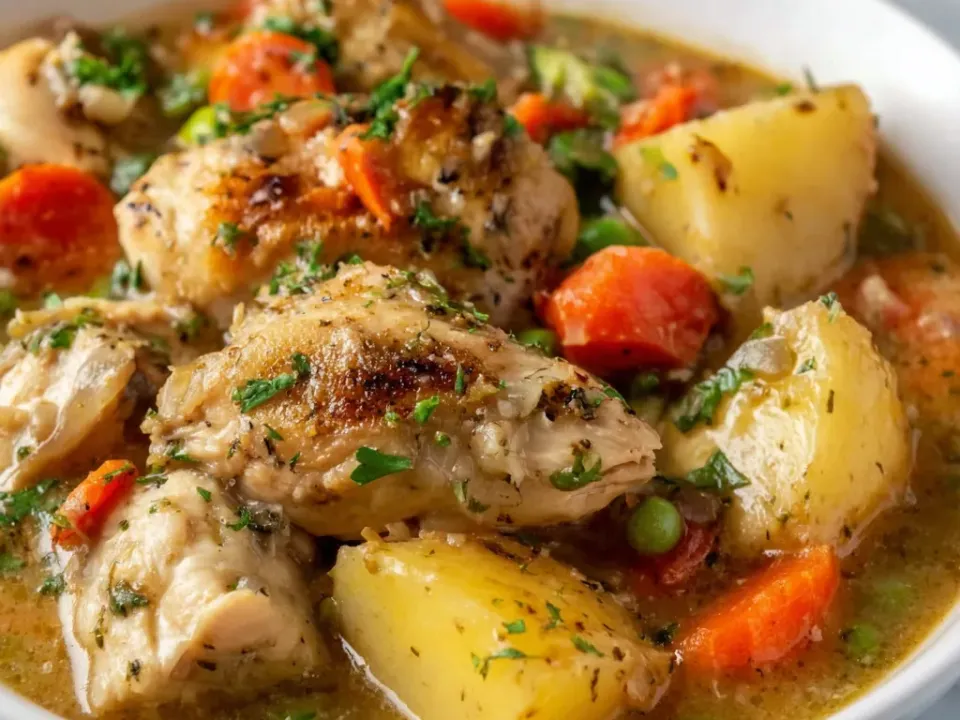
Chicken thighs, potatoes and root vegetables cooked slowly into a stew, thickened at the end and finished with peas and parsley.
Twenty minutes of chopping, six to seven hours on Low, and no pan to wash before it starts.
Why This Recipe Works
- Thighs rather than breasts is the choice that makes an all-day cook work. They hold together in large chunks and their fat keeps them tender long past the point breast would be dry.
- Yukon Golds are waxy enough to keep their shape across seven hours where a floury baking potato would break down entirely into the broth.
- Thyme and rosemary together are the classic pairing for a poultry stew, and crushed rosemary rather than whole needles distributes far better in a pot that is never stirred.
- Frozen peas go in at the very end and only need the fifteen to twenty minutes of thickening time. Added at the start they would be grey and collapsed.
Five Steps, and Why the Slurry Is Last
This is a genuine dump-and-go: everything except the thickener and the peas goes in at once. The interesting decisions are all about what is deliberately held back.
Step 1
No browning stage at all
Unusual for a stew, and a real time saving. Two tablespoons of tomato paste plus thyme, rosemary and a full mirepoix carry enough savoury depth that browning contributes less here than it would in a plainer pot — and chicken thighs brown far less rewardingly than beef anyway.
Step 1, still
Tomato paste goes in raw with everything else
In a stovetop stew you would fry the paste to caramelise it. In a slow cooker there is no opportunity, so it works instead as a concentrated savoury and slightly acidic thickener across the whole cook.
Step 2
165°F in the chicken AND tender vegetables
Two cues, not one. The chicken will reach temperature well before the potatoes are soft, so the potatoes are usually what decides when this is done.
Step 3
Cornstarch whisked with COLD water
Cold, always. Cornstarch stirred into warm liquid clumps instantly and those lumps never disperse — you get a stew with gelatinous specks in it and no extra thickness.
Step 4
High for 15 to 20 minutes after the slurry
Cornstarch needs real heat to gelatinise. Stirred into a pot that is only warm at the end of a Low cook, it does almost nothing, and this is the commonest reason a slurry appears not to work.
Ingredient Notes
- Thawed chicken thighs in large chunks
- Two pounds. Thawed is a slow-cooker safety rule; large chunks are what stop the meat disappearing into the broth.
- Yukon Gold potatoes
- A pound and a half in one-inch pieces. Waxy golds hold; floury potatoes disintegrate.
- Tomato paste
- Two tablespoons, in raw at the start. It is the concentrated savoury note in a pot with no browning stage.
- Cornstarch and cold water
- Two tablespoons to three of water. Cold water specifically, and it goes in near the end.
How to Make It
Load the cooker
Combine the potatoes, carrots, celery, onion, garlic, chicken, broth, thyme, rosemary, salt, pepper and tomato paste.
Cook
Cook on Low for 6 to 7 hours, until the chicken reaches 165°F (74°C) and the vegetables are tender.
Thicken and add peas
Whisk the cornstarch with the cold water and stir it in along with the frozen peas.
Finish thickening
Switch to High for 15 to 20 minutes to thicken.
Serve
Stir through the parsley and serve.
Success Tips
- Cut the chicken and potatoes large.
- Whisk the cornstarch into cold water, never warm.
- Give it the full 15 to 20 minutes on High after the slurry.
- Judge doneness by the potatoes; the chicken gets there first.
Serving Ideas
Crusty bread, and little else — it is already meat, potatoes and vegetables in one bowl. A green salad if you want something sharp against it.
Storage and Reheating
Refrigerate
Refrigerate up to 4 days and it improves overnight as the herbs settle. It thickens further as it cools.
Freeze
Freezes up to 3 months, though the potatoes soften noticeably on thawing. There is no dairy, so nothing separates.
Reheat
Gently on the stove with a splash of broth to loosen. Cornstarch-thickened stews can thin slightly if boiled hard, so keep it below a rolling boil.
Frequently Asked Questions
The slurry did not thicken anything.
Two likely causes: the water was not cold, so the cornstarch clumped instead of dispersing, or the pot never got hot enough afterwards. Cornstarch has to be heated to gelatinise — the 15 to 20 minutes on High is what makes it work.
It came out thin even after thickening.
Chicken thighs and vegetables release a lot of liquid, and how much varies. Give it another slurry of a tablespoon of cornstarch in cold water and another spell on High, or leave the lid ajar for the last twenty minutes to let some evaporate.
Can I use chicken breasts?
They will cook through, but six to seven hours is a long time for a lean cut and they tend to go stringy. If breasts are what you have, cut them very large and check at the earlier end of the range.